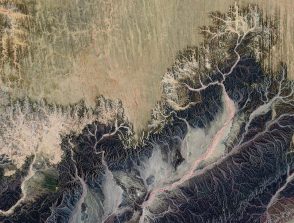


Snow dunes in Antarctica
23/09/2024
IPGP - Îlot Cuvier
14:30
Séminaires Dynamique des fluides géologiques
Salle 310
Marine Poizat
Institut des géosciences de l'environnement (IGE)
Dunes are bedforms that are frequently encountered in sand desert, river beds, polar regions and even on planets, like Mars. Formed through the intricate interplay between wind and surface sediment, dunes exhibit a variety of shapes and sizes. While sand dunes have garnered considerable scientific interest, their counterparts, snow dunes, have received comparatively less attention, despite their presence being reported since the 1900s in Antarctica. As a result, fundamental questions about the processes of deposition and accumulation of snow remain unanswered, impacting the understanding of snow redistribution and surface mass balance variability in Antarctica and, more generally, the eolian transport of a cohesive material.
To address these knowledge gaps, we provide the first comprehensive Antarctic-wide map documenting the presence and orientations of long dunes (100-1000 m in length) across Antarctica using satellite imagery. We retrieve dune orientations and presence using 2D spatial autocorrelation on all available optical satellite imagery (Sentinel-2 and Landsat-8). The results reveal that these dunes are ubiquitous and stable in Antarctica, and that their orientation is mainly parallel to the flux direction across most regions. To explain this fact, we applied a well-established theory originally developed for sand dunes. This theory relates dune orientation to the availability of sediments for wind transport and the wind regime. We show that this theory could successfully be extended to snow dunes to explain the observed orientation. Furthermore, the predominance of long dunes aligned parallel to the flux direction, rather than perpendicular, indicates a scarcity of mobile snow available for transport in Antarctica. This is a counter-intuitive result for the most windy and almost completely snow-cover continent of our planet.
To further understand this, we investigated the temporal evolution of dune orientations in Terre Adélie, Antarctica. We showed that dune orientations vary every few months, following events of significant precipitation and strong winds. In addition, the new orientations observed align well with theoretical predictions when applied during precipitation events. However, despite these variations, no migration is observed. Therefore, we argue this lack of migration is due to the rapid sintering of snow dunes.
These findings demonstrate that snow dunes are significant objects which should be accounted for in polar models or remote sensing interpretation over Antarctica. Our results have major implications for in-situ surface mass balance measurements but also ice core interpretation, as they highlight the spatial heterogeneity of the snow surface.