

Revealing the Hidden Structure of Planetary Bodies through Geodetic and Geophysical Constraints
22/06/2026
Campus Paris-Rive-Gauche
14:00
Planetary science seminars
522, bât. Lamarck
Antonio Genova
Sapienza University of Rome
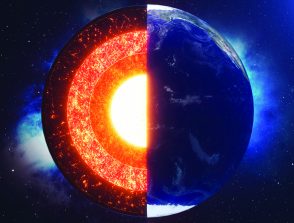
Planetary bodies preserve the record of their formation and evolution from the surface to the deep interior. Although their internal structure cannot be directly observed, its properties can be constrained by studying how planets and moons rotate, deform, and respond to the distribution and redistribution of mass on and beneath their surfaces.
This presentation describes how gravity, topography, planetary orientation, tidal deformation, and temporal variations of low-degree gravity fields can be jointly interpreted to investigate the structure and evolution of planetary bodies. These geodetic and geophysical constraints are combined with geological and geochemical observations to infer crustal density and thickness, elastic thickness, the composition and distribution of subsurface or surface deposits, the rheological properties of mantles and icy shells, and the size, state, and dynamical coupling of deep cores.
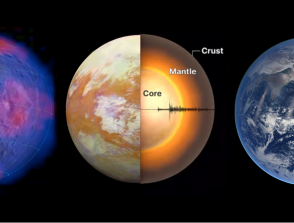
The talk covers applications to terrestrial planets and icy moons, including Mercury, Mars, Venus, Europa, and Enceladus. At crustal and surface scales, the joint analysis of gravity and topography constrains lateral variations in crustal properties and surface deposits. At intermediate depths, loading, tidal response, and long-wavelength gravity signatures provide sensitivity to lithospheric, mantle, and ice-shell rheology. Librations offer complementary constraints on the mechanical response of the outer layers and can provide evidence for internal decoupling associated with magma layers or subsurface oceans. At deeper levels, the joint inversion of pole orientation and low-degree gravity coefficients constrains the polar moment of inertia, and the properties of deep interiors, including the size and state of planetary cores. Temporal gravity variations further provide a means to monitor climate-driven mass redistribution and to investigate the mechanical response of planetary interiors to surface loading and tidal forcing.
Visio: https://visio.numerique.gouv.fr/owk-pims-txt