Afin d'être accessible au plus grand nombre, nous vous informons que vous avez la possibilité de modifier la taille d’affichage du contenu de notre site.
Pour cela, voici les commandes à reproduire à l'aide de votre clavier :
The NicoletTM iN10 MX microscope offers fast, non-destructiveimaging and characterization of materials using Fourier transform infrared (FTIR) spectromicroscopy. The infrared signal can be detected in transmission, reflection or attenuated total reflectance (ATR) mode. Imaging is hyperspectral, i.e., all pixels in the images collected correspond to FTIR spectra, which can then be analyzed individually to characterize and locate compositional heterogeneities within the sample. Spectromicroscope control and data processing are carried out using OmnicTM PictaTM and OmnicTM SpectaTM softwares (Thermo ScientificTM). Several mineral and organic compound databases are available (including in-house databases).
Practically:
● The sample must be solid; depending on the type of analysis, preparation may be required ● Minimum sample size of 50 μm ● Spatial resolution down to 10-20 μm in transmission and reflection mode and 4 μm in ATR mode ● DTGS and liquid nitrogen cooled MCT-A detectors ● Spectral detection range from 700 to 4000 cm-1 (mid-infrared, MIR) ● Spectral resolution down to 4 cm-1
co-funds SESAME (Région Ile de France)/Université Paris Cité-IPGP
Caption:
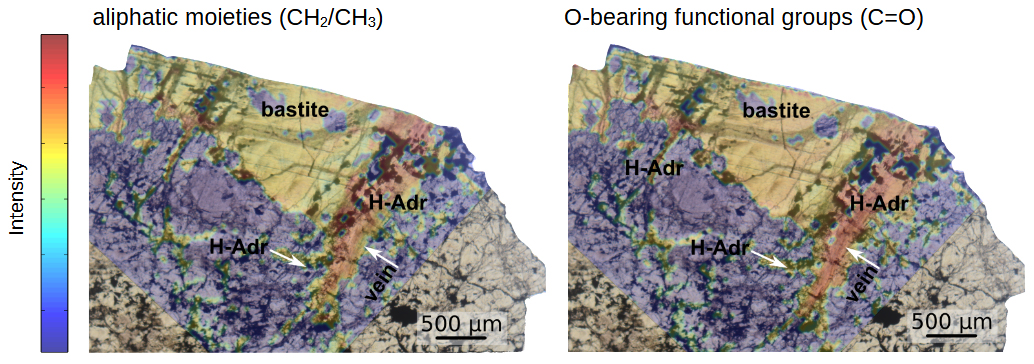
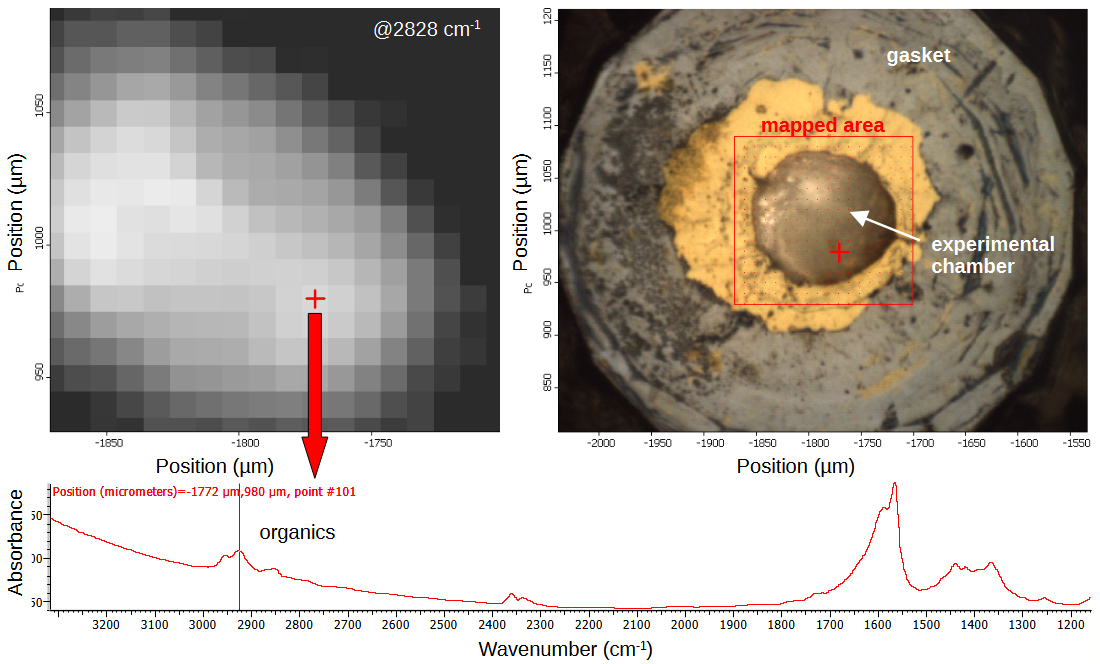
The FTIR imaging microscope Nicolet™ iN10 MX can be used to acquire 2D hyperspectral images over large areas and identify the various components and their distribution within various types of samples (above, maps in transmission of a thin section of hydrated oceanic rock crosscut by veins within which the presence of organic compounds is highlighted; modified from Pasini et al., 2013; similarly below, organic and mineral assemblages are jointly characterized post mortem in transmission in a diamond anvil cell gasket; modified from Tao et al., 2025).
Planetary Research: a new open-access journal for planetary sciences
Led by an international community of researchers, with strong involvement from IPGP scientists, the new journal Planetary Research offers an alternati...
What if the next stars of recycling were… bacteria?
A new comic book from IPGP takes us behind the scenes of metal bio-recovery. Featuring bacteria, precious metals and a generous dose of humour, it rev...
Mapping regolith migration on Phobos to support the MMX sample-return mission
Researchers from the Institut de Physique du Globe de Paris (IPGP), in collaboration with the Centro de Astrobiología (Spain) have published a new stu...
Lorraine Delaroque and Ines Ouar, two IPGP PhD students, receive awards at international conferences
Two doctoral students from the Planetology and Space Sciences team were recently recognized for their research at two international conferences.