Citoyen / Grand public
Chercheur
Étudiant / Futur étudiant
Entreprise
Partenaire public
Journaliste
Enseignant / Elève

Two IPGP PhD Students Join a NSF Oceanographic Expedition on a equatorial Transform Fault!

Date de publication : 07/11/2025

Recherche

Équipes liées :
Géosciences marines

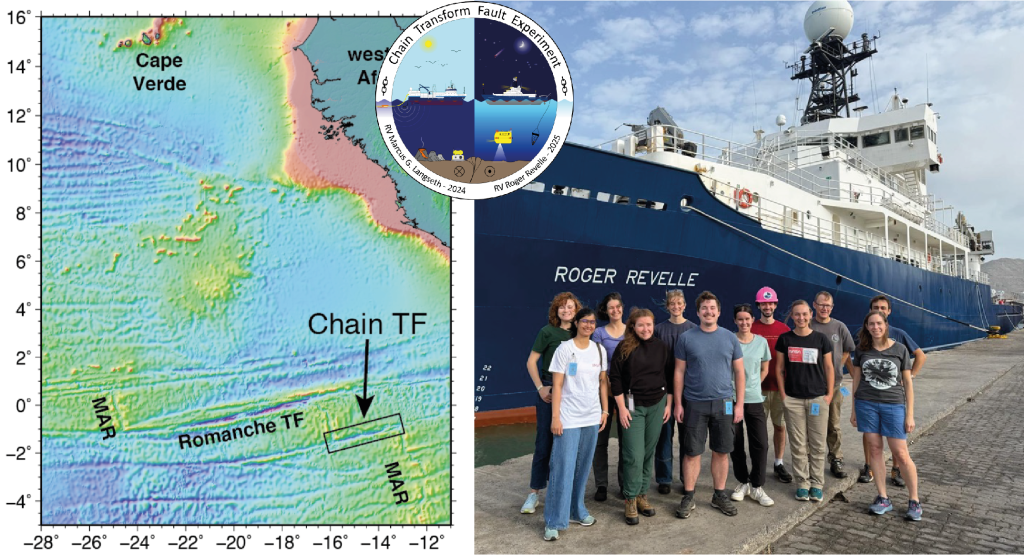
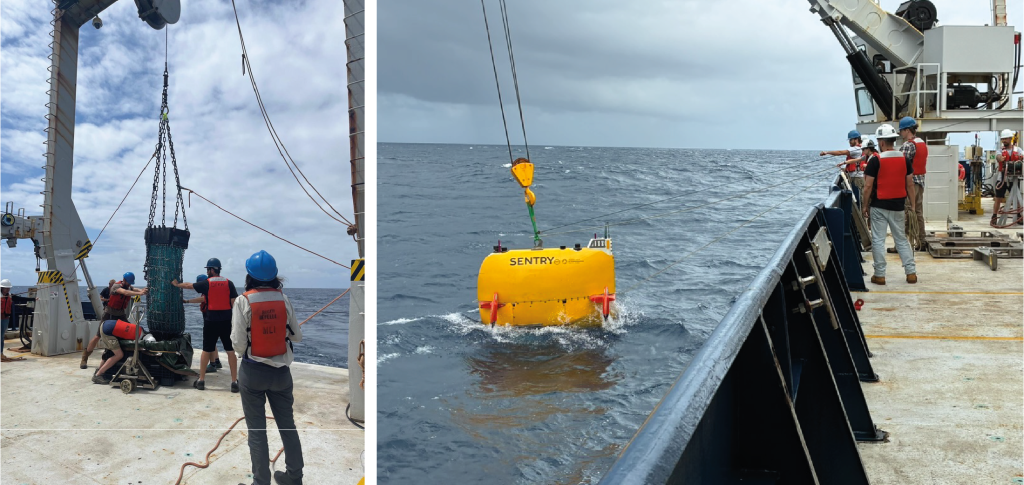
The oceanographic cruise is the third and final cruise of “Chain Transform Fault Experiment”, onboard R/V Roger Revelle, spanning from 10th October to 13th November, 2025. The main scientific goal of the expedition, led by Jessica Warren (University of Delaware), is to understand the dynamic behavior of a slow-slipping oceanic transform system from the study of the Chain Atlantic fault zone. Its composition, rheology, seismicity, structure, and magmatism will be characterized through acquisition of active and passive seismic data, high-resolution geophysical surveys using autonomous underwater vehicle (AUV) Sentry and dredging of rocks targeting active fault zone.

Location of Chain Transform Fault; Right: The science party in front of R/V Roger Revelle in Sao Vincente harbor of Cabo Verde

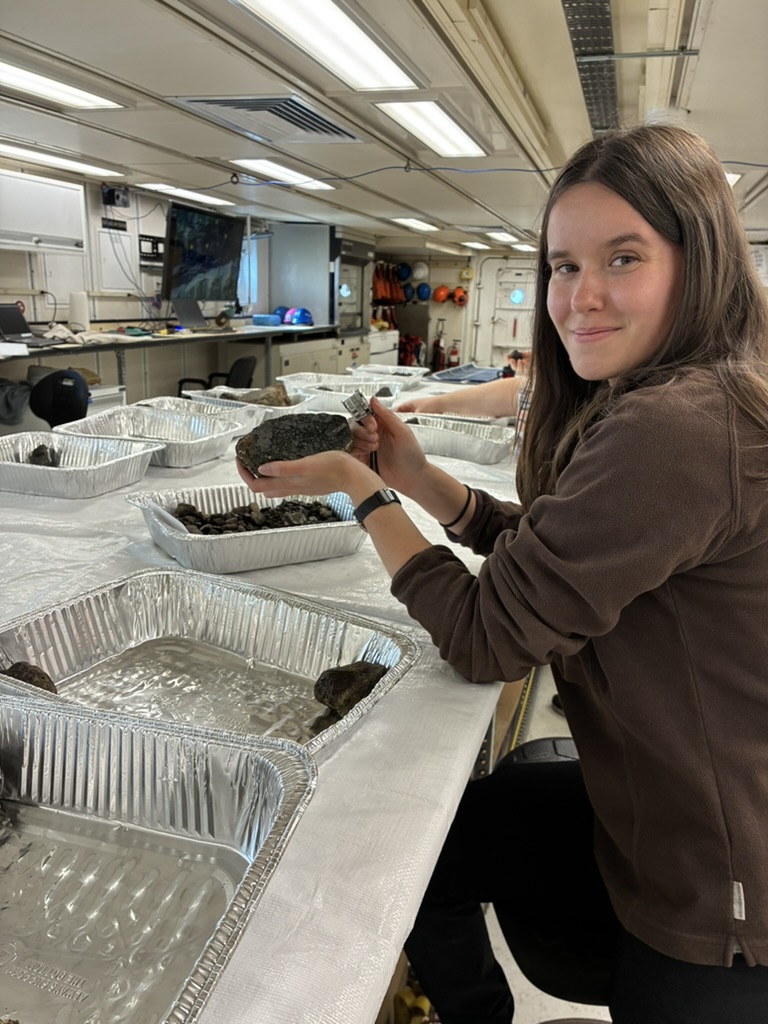
For Suzanne, this expedition represents a unique opportunity to complement her PhD research on fluid–rock interactions and the deep carbon cycle along transform faults. She will gain valuable field experience, develop new analytical skills, and collaborate with international experts. The collection and analysis of samples will provide new insights into fluid circulation in these environments and its impact on carbon dynamics, directly contributing to her research on the origin of organic matter in these still little-studied systems.


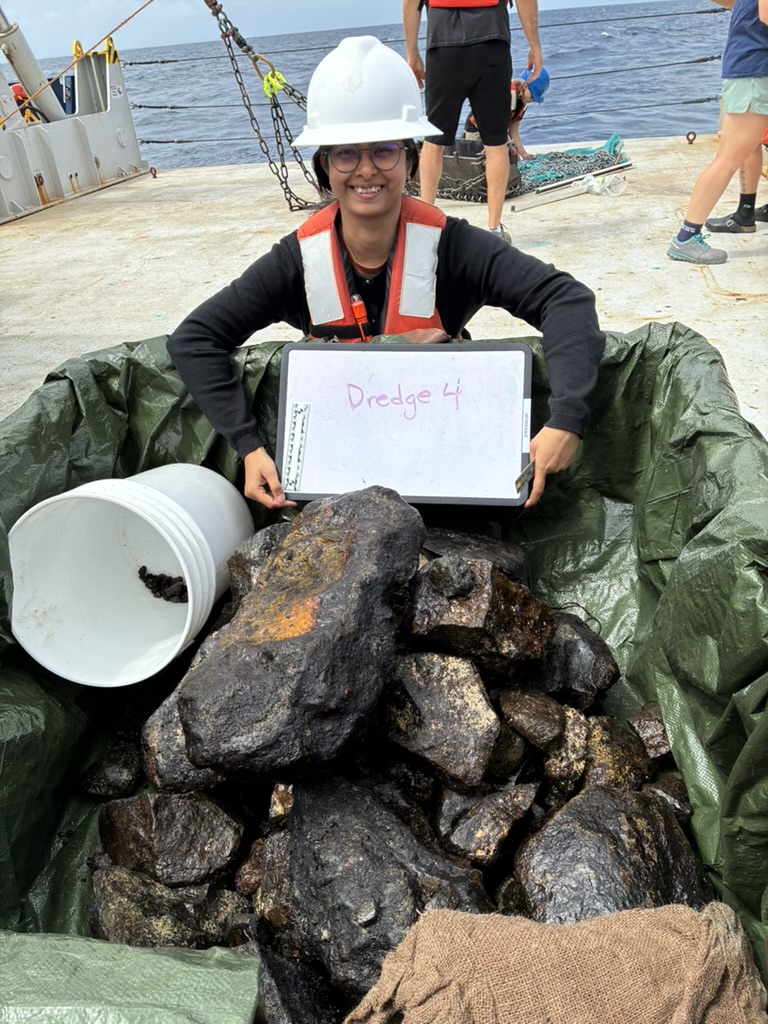
For Sampriti, this experiment will be an enriching experience, complementing her PhD thesis on the composition, hydration and deformation of magmatic rocks at oceanic transform faults. She will learn novel data collection methods in marine expeditions expand her technical expertise in marine research and foster international collaboration. Analysis of the active fault zone rocks recovered from the dredges will help to understand along-strike variations in lithologies and deformation and study the role of seawater and melt on oceanic transform fault

                                      Dredge coming from ocean’s bottom; Right: Sentry on its way to explore the ocean depth

                Their expedition expenses are covered by NSF and International mobility support of IPGP PhD students. 

                More info : https://ui.adsabs.harvard.edu/abs/2024nsf….2318855B/abstract

Dernières actualités
L’instrument SPSS, contribution française du CNES et de l'IPGP, à bord de la mission américaine Artemis IV
Le CNES (Centre National d’Études Spatiales) et l’Institut de physique du globe de Paris, Université Paris Cité, sont fiers d’annoncer la sélection pa...
Distinctions internationales pour Daniel Neuville dans le domaine des sciences du verre
Daniel Neuville, directeur de recherche CNRS à l'IPGP a été distingué en 2025 par le prix Morey et a été élu en janvier 2025 à la présidence des comit...
Un tsunami médiéval révélé par des blocs de corail géants dans les Caraïbes
De nouveaux travaux scientifiques viennent de lever le voile sur un épisode géologique aussi spectaculaire qu’oublié : un tsunami d’une ampleur except...
Un nouvel éclairage de l’histoire de l’atmosphère terrestre à travers les isotopes du néon et du xénon
Une étude révèle comment le dégazage mantellique et la fuite de gaz vers l’espace ont façonné la composition de l’atmosphère au fil des âge.