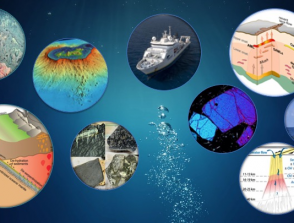





A seafloor spreading event captured by in-situ seismo-geodetic monitoring
28/10/2026
IPGP - Îlot Cuvier
11:00
Séminaires Géosciences Marines
Salle 310
Jean-Yves Royer
Ifremer
Over geological time, the growth of the ocean floor involves magmatic and tectonic extension at mid-ocean ridges (MORs). Because long-term in-situ monitoring of these submarine plate boundaries remains challenging, little is known about how these systems operate on yearly timescales. To address this question, we took on the challenge of deploying an autonomous seismo-geodetic observatory on the Southeast Indian Ridge near 37°S and were lucky enough to capture a significant seafloor spreading event involving magmatic emplacement and tectonic deformation. This event started on 26 April 2024, two months after the deployment of the instruments across the ridge axis and nearby Amsterdam transform fault (TF). It began as a rapidly migrating swarm of extensional seismicity along the axial valley, causing 4 m of subsidence of the valley floor and more than a metre of horizontal extension across the valley. We interpreted this as the deflation of a sill-like reservoir feeding propagating dykes along the ridge axis. The dykes eventually led to the outpouring of about 160 million m3 of lava at the seafloor in about 16 days, while inducing both seismic and aseismic slip on valley-bounding normal faults and finally triggering seismic activity on the abutting TFs. Large-scale aseismic slip induced by magmatic processes could be the primary mechanism by which MOR normal faults accrue their displacement, which would account for their well-documented seismic deficit.