

Artificial ice sheet at the laboratory scale : model experiments and field work
02/12/2026
IPGP - Îlot Cuvier
11:00
Séminaires communs Dynamique des Fluides Géologiques et Géomagnétisme
Salle 310
Baptiste Auvity
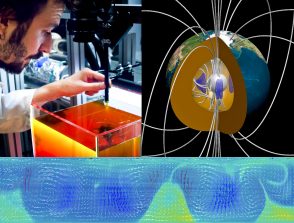
As Arctic seawater freezes, it forms sea ice, which is fragmented—notably by ocean swell. This thesis combines laboratory experiments and field campaigns to understand the threshold at which waves cause sea ice to fracture. In the laboratory, experiments involving the fracture of a thin varnish layer (acting as an ice analogue) by standing waves demonstrate that the failure threshold depends on ice curvature and forcing wavelength; an elastic energy-based criterion is proposed. In the field, a new method was developed to measure ice thickness and swell direction. Additionally, an experiment was conducted to study the fragmentation of a freshwater ice sheet by boat-generated waves. The mechanical properties of the ice were measured and the failure threshold quantified, providing a benchmark for wave-induced ice sheet fracture.