Citizen / General public
Researcher
Student / Future student
Company
Public partner
Journalist
Teacher / Pupil

Albert Tarantola receives the 2018 Maurice Ewing Medal posthumously from SEG

Albert Tarantola receives the 2018 Maurice Ewing Medal posthumously from SEG

Publication date: 14/10/2018

Awards and Distinctions, Institute Life, Press, Research
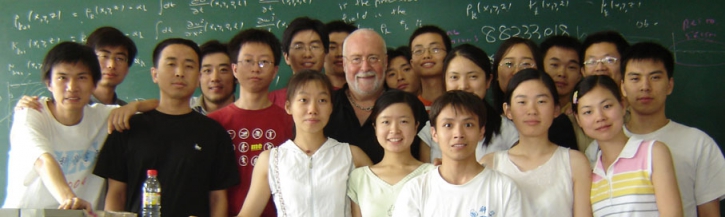
The Society of Exploration Geophysicists (SEG) awarded Albert Tarantola the 2018 Maurice Ewing Medal, its highest accolade, at its 88th International Congress (October 14-19 2018).

This renowned geophysicist, who died in 2009 at the age of 60, spent his entire career at the Institut de Physique du Globe in Paris. He became famous for solving inverse problems that enabled him to deduce information about the Earth’s internal structure from seismic waves.

The teams at the Institut de Physique du Globe de Paris are proud to see him receive this award posthumously today.

Albert Tarantola surrounded by his students at the IPGP in 2006.
Latest news
A study led by scientists from the Institut de physique du globe de Paris, in collaboration with the École Polytechnique Fédérale de Lausanne, reveals...
SOUFRIÈRE_50 – 50 years of scientific advances on volcanoes for a more resilient future
Few days before the opening of the international conference SOUFRIÈRE_50 – 50 years of scientific advances on volcanoes for a more resilient future, t...
Wildfires: nanoparticles reveal combustion conditions
A study conducted by researchers at the Institut de physique du globe de Paris (IPGP) and Université Paris Cité, in collaboration with Memorial Univer...
Radio ‘whistlers’ originating from lightning strikes reveal unprecedented behaviour above the magnetic equator
A team from the Institut de Physique du Globe de Paris (IPGP – Université Paris Cité / CNRS) has, for the first time, documented and explained the unu...