
Citizen / General public
Researcher
Student / Future student
Company
Public partner
Journalist
Teacher / Pupil

Charles Le Losq appointed member of the Institut Universitaire de France

The role of the Institut Universitaire de France (IUF) is to encourage the development of high-level research in universities and to strengthen interdisciplinarity. This year, Charles Le Losq, lecturer at the IPGP, has been awarded a junior chair for a period of 5 years, in recognition of the excellence of his scientific activity, which will enable him to consolidate his scientific position.
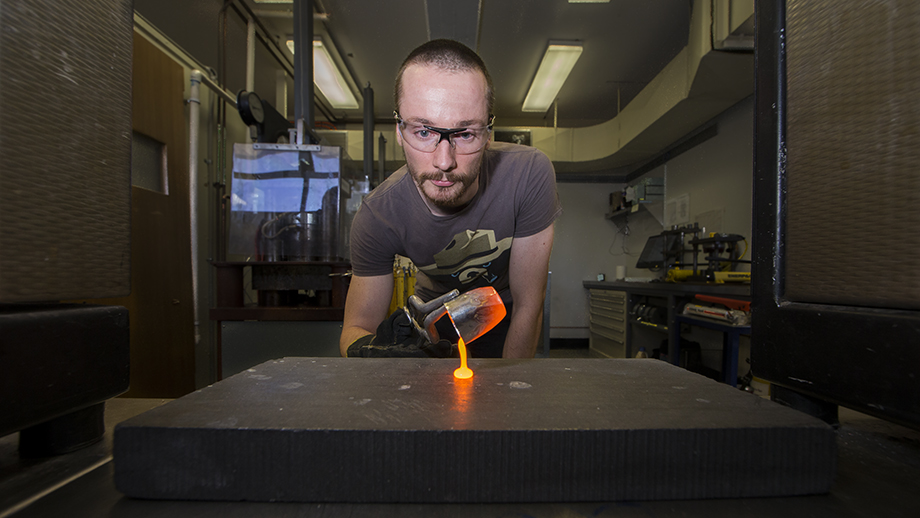
Charles Le Losq appointed member of the Institut Universitaire de France

Publication date: 14/06/2024

Awards and Distinctions, Research

After a PhD at the IPGP on the properties of glasses and silicate liquids (2009-2012), Charles Le Losq continued his postdoctoral research at the Carnegie Institution for Science (2013-2015) and the Australian National University (2015-2019), where he developed his expertise in experimental petrology and machine learning applied to geosciences. In 2019, he joined the IPGP as a Lecturer, with a Chair of Excellence from the Université Paris Cité focusing on his work on the use of artificial intelligence to predict the properties of materials, particularly volcanic lavas and glasses. Since 2023, he has been particularly interested in adapting and using these models to predict the properties of magma oceans, especially on lava exoplanets.

This is the background to its IUF project. High-pressure experiments and atomistic simulations will document the dynamics of magmas under extreme conditions. The new data, coupled with machine learning, will make it possible to better predict the behaviour of magmas in fluid dynamics simulations, and thus to study the life and decline of planetary and exoplanetary magma oceans. This project aims to push back the frontiers of our understanding of magma oceans, with important implications for the study of planet and exoplanet formation.

Latest news
What can the light from Vesta’s avalanches tell us?
A study conducted at the Institut de Physique du Globe de Paris uses images from NASA’s Dawn mission and a Bayesian inversion of the Hapke photometric...
Cosmochemistry in the service of Alzheimer's disease diagnosis: copper reveals its isotopic secrets
A multidisciplinary study led by researchers at the Institut de Physique du Globe de Paris (IPGP), in collaboration with teams from the Faculty of Hea...
Are the hidden currents of Ganymede’s ocean finally detectable?
A study conducted by researchers from the Institut de physique du globe de Paris (IPGP) and CNRS shows that the convection motions driving the hidden ...
Discovery of CO₂ hydrates off the coast of Mayotte: a unique site for studying carbon storage in the ocean
More than 120 CO₂ hydrate deposits were discovered at the Fer à Cheval site, 10 km east of Petite Terre (Mayotte), during the Geoflamme campaign co-le...