
Citizen / General public
Researcher
Student / Future student
Company
Public partner
Journalist
Teacher / Pupil

Meteorites and magnetism in comics!

To make it easier to communicate her research subject, a researcher from the IPGP and MIT has teamed up with an illustrator, herself a geophysicist, to create a comic strip that takes readers on a journey from the Sahara to Mars, via the inside of rocks! This initiative, funded as part of a European project under the Marie Skłodowska-Curie Actions programme and now available online, will be presented at the European Geosciences Union Congress in Vienna on 17 April.
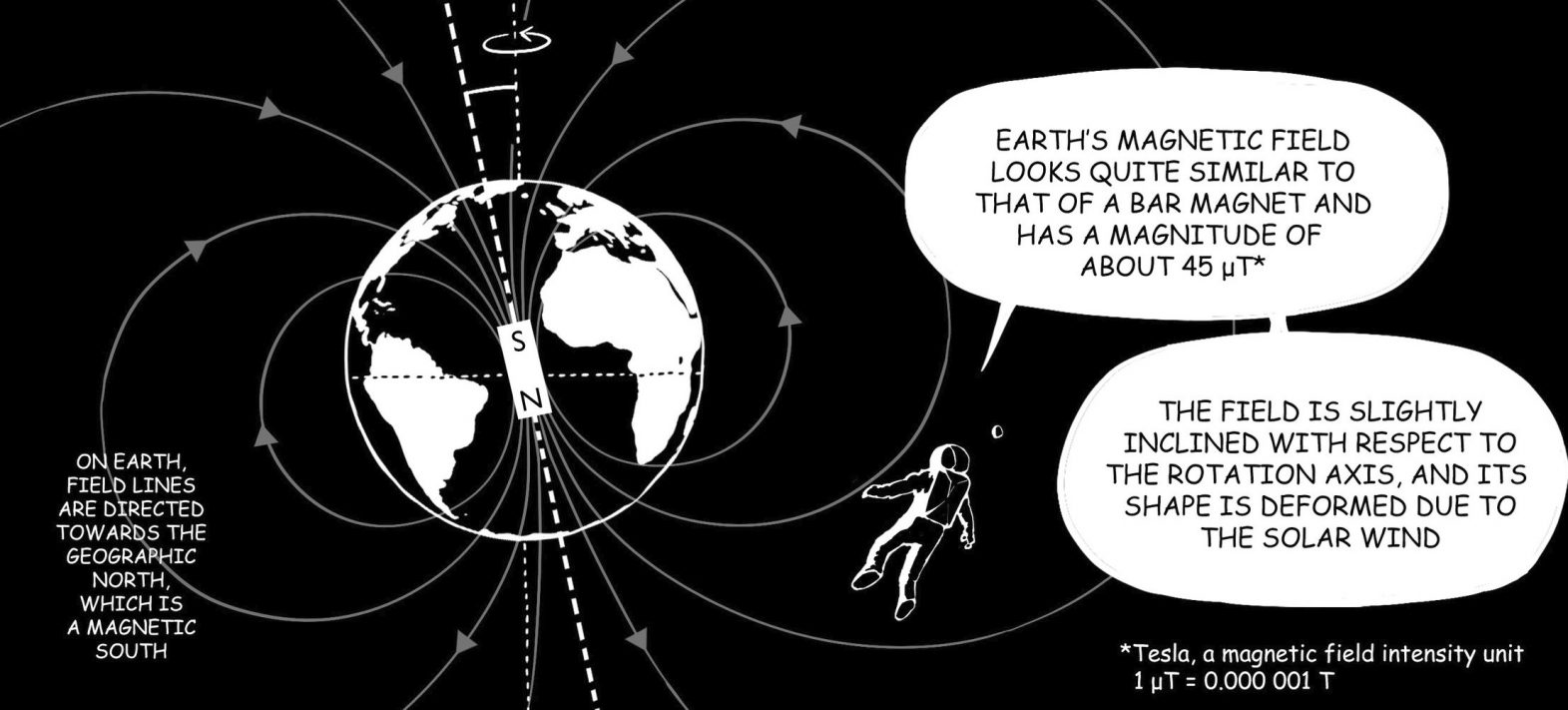
Meteorites and magnetism in comics!

Publication date: 10/04/2024

General public, Research

Somewhere in the vast landscape of the Sahara desert, a man stumbles upon an unusual kind of rock. After being passed around from dealers to collectors, the rock finds itself in a research laboratory. The rock is confused and does not remember where it comes from. A researcher invites the rock to a space journey, leading it back to its origins, planet Mars, before bringing it back to the lab to study it.

Meteors and meteorites have always fascinated people, but a particular aspect of these space rocks remains enigmatic to most people: their magnetic records. This comic illustrates how planetary magnetic fields are generated, how rocks record them and how the magnetic record of rocks helps scientists decipher how planets form and evolve over time. The comic also aims at spreading an important message: meteorites should not be exposed to magnets. Doing so comes at the risk of erasing billion years old records of geological history.


> More about the projectDeciphering the magnetic record of planetary rocks using spacecraft and laboratory measurements

Latest news
MAJIS on board JUICE: a key instrument for exploring Jupiter’s icy moons
As part of the team involved in the development and validation of the MAJIS instrument, the Paris Institute of Earth Physics is contributing to the sc...
Frédéric Moynier elected member of the Academia Europaea
Frédéric Moynier, professor at the Institut de physique du globe de Paris (IPGP) and Université Paris Cité, and Deputy Director for Research at IPGP, ...
Can we listen to Titan’s heartbeat?  Icequakes as a window into a hidden ocean.
Can we listen to Titan’s heartbeat? Icequakes as a window into a hidden ocean.
What lies beneath the surface of Titan, Saturn’s largest moon? This question is central to the upcoming Dragonfly mission, which will deploy a drone e...
Lithium isotopes unveil the hidden chemistry of Guadeloupe's volcanic waters
IPGP researchers present the first systematic lithium isotope survey of Guadeloupe's surface waters, revealing that a single small island can host a r...