InSight is the first mission dedicated to studying the internal structure of Mars. Among other scientific tools, it includes the SEIS seismometer, for detecting “Martian earthquakes”, and the APSS meteorological station, comprising sensors for measuring wind, temperature and atmospheric pressure, as well as a magnetometer. A new understanding of Mars has emerged in the light of the first two years of the InSight mission, revealing a living planet, the scene of earthquakes, dust devils and strange magnetic impulses.
For several months now, a global dust storm has covered Mars, severely limiting the energy available to InSight and the SEIS and APSS instruments. The CNES and NASA operational teams have managed to keep most of the seismic and meteorological sensors switched on, even intermittently, enabling them to provide very good scientific data, including the recent detection of new Martian earthquakes. CNES operates the SEIS and APSS instruments from the FOCSE-SISMOC operations centre at the Toulouse Space Centre, while the IPGP data centre (University of Paris/IPGP/CNRS) distributes SEIS data to the scientific community.
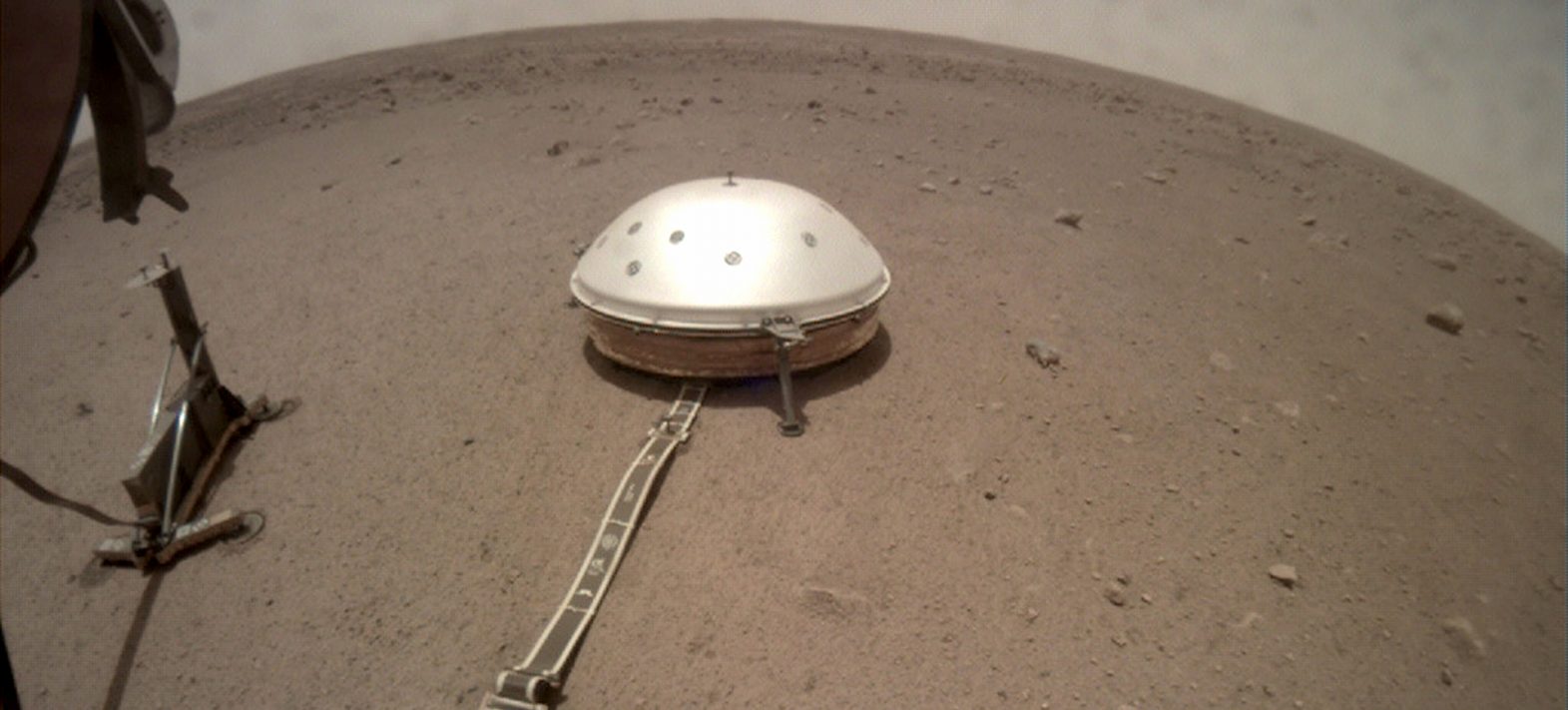
When night falls on Mars, the cable linking SEIS to the InSight lander, the ‘tether’, tends to generate thermoelastic cracks that disrupt the measurements when the temperature drops sharply at this time of day. At the initiative of the IPGP and CNES, one of the new activities of the extended mission will be to cover the tether with a layer of Martian regolith using the shovel at the end of InSight’s arm. This will considerably improve the quality of the seismic signal produced by SEIS, by attenuating the effects of temperature gradients on Mars.
In addition to seismological activities, InSight’s meteorological activities produced by the APSS instrument, which provides some of the most detailed data collected on Mars, will constitute, along with those of their counterparts on the Curiosity Rover and the Perseverance Rover due to land on Mars in February, the first available and operational meteorological network on another planet.
Scientific data from the first Martian year (two Earth years) and published scientific papers are freely accessible from the SEIS experiment website(https://www.seis-insight.eu/fr/science/seis-accueil).
About InSight and SEIS
JPL manages the InSight mission on behalf of NASA’s Science Mission Directorate. InSight is part of NASA’s Discovery program, managed by the Marshall Space Flight Center (MSFC), a NASA facility in Huntsville, Alabama. Lockheed Martin Space in Denver built the InSight probe, including its cruise stage and lander, and supports spacecraft operations for the mission. CNES is the prime contractor for SEIS, and the Institut de Physique du Globe de Paris (University of Paris/IPGP/CNRS) has scientific responsibility for it. CNES is financing the French contributions, coordinating the international consortium (*) and has been responsible for the integration, testing and supply of the complete instrument to NASA. IPGP designed the VBB (Very Broad Band) sensors, tested them before delivery to CNES and, as part of the InSight National Observation Service, is contributing to their operation and distributing the data to the scientific community. CNES developed and operates FOCSE-SISMOC, the mission centre for the SEIS and APSS instruments. Several CNRS laboratories, including LMD (CNRS/ENS Paris/Ecole polytechnique/Sorbonne University), LPG (CNRS/Université de Nantes/Université d’Angers), IRAP (CNRS/Université de Toulouse/CNES), LGL-TPE (CNRS/Ecole normale supérieure de Lyon/Université Claude Bernard Lyon 1), IMPMC (Sorbonne University/Museum national d’Histoire naturelle/CNRS) and LAGRANGE (CNRS/Université Côte d’Azur/Observatoire de la Côte d’Azur) are working with IPGP and ISAE-SUPAERO to analyse data from the InSight mission. These analyses are supported by CNES and ANR.
(*) In collaboration with SODERN for the production of the VBBs, JPL, the Swiss Federal Institute of Technology Zurich (ETHZ, Switzerland), the Max Planck Institute for Solar System Research (MPS, Göttingen, Germany), Imperial College London and Oxford University have supplied the SEIS subsystems and are participating in the scientific exploitation of SEIS.