Afin d'être accessible au plus grand nombre, nous vous informons que vous avez la possibilité de modifier la taille d’affichage du contenu de notre site.
Pour cela, voici les commandes à reproduire à l'aide de votre clavier :
Zoom in
CTRL +
+
Zoom out
CTRL +
-
Reset to zero
CTRL +
0
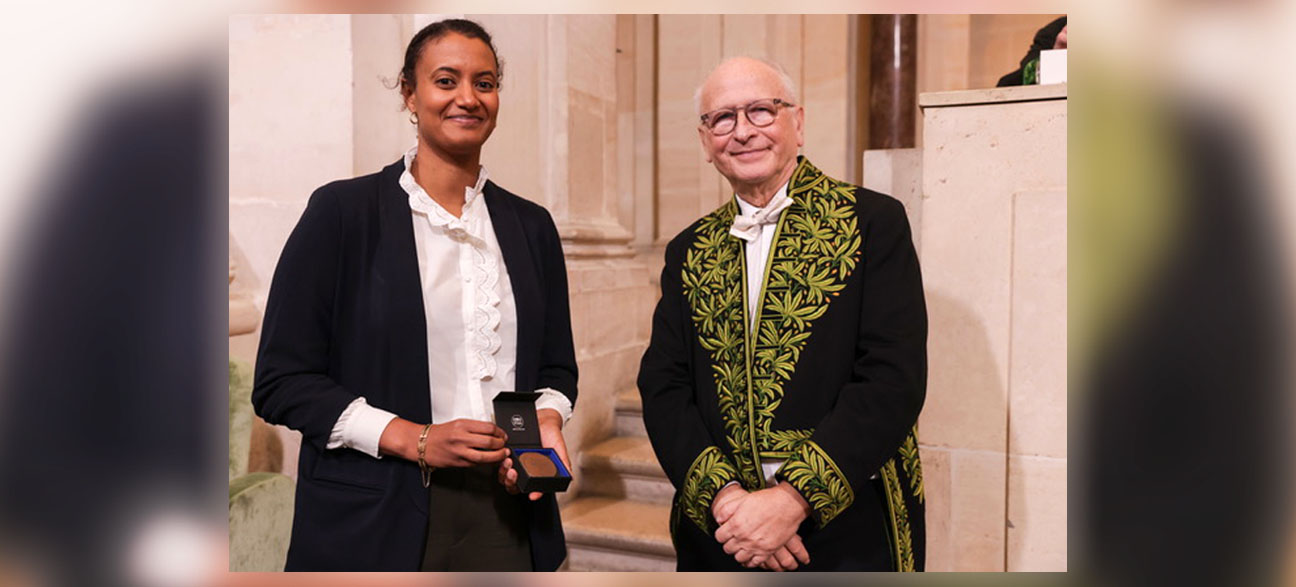
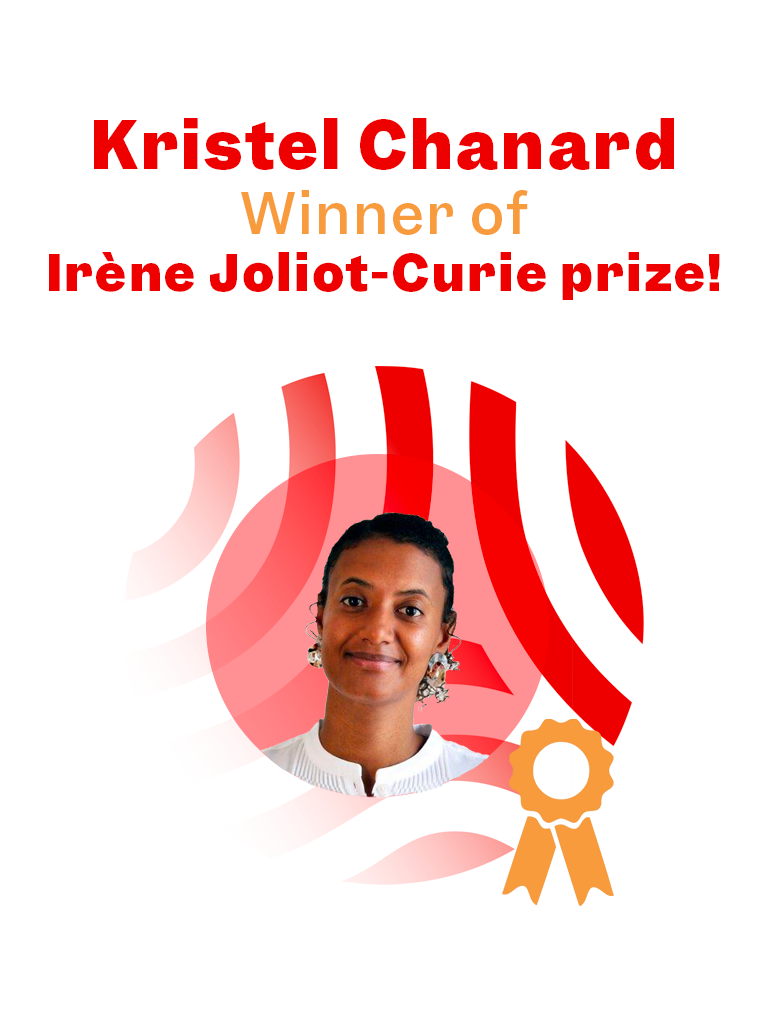
Kristel Chanard receives the 2025 Irène Joliot-Curie Prize in the “Young Female Scientist” category.
Publication date: 27/11/2025
Awards and Distinctions, Institute Life, Research
Awarded by the Ministry of Higher Education, Research, and Space, the Academy of Sciences, and the Academy of Technologies, this prize has been recognizing women scientists for the excellence of their work since 2001, thereby helping to increase the number of inspiring female role models in science, such as Irène Joliot-Curie. The ceremony took place on November 25, 2025, under the dome of the Institut de France.
A researcher at the National Institute of Geographic and Forest Information (IGN), Kristel Chanard conducts her work at the Paris Institute of Earth Physics (IPGP-CNRS/IPGP/Université Paris Cité), where she studies the interactions between climate, hydrology, and Earth deformations. A recognized specialist in hydrogeodesy, she has played a key role in the development of this field and has received several international awards, notably from the European Geosciences Union (EGU), the American Geophysical Union (AGU), and the CNRS bronze medal. Kristel Chanard is also committed to promoting equality and diversity in science through scientific outreach, mentoring, and training on inclusion, particularly among young girls and underrepresented groups.
What does winning this Young Female Scientist Award mean to you? “Winning this award is first and foremost a great honour which, even though it is awarded individually, recognises scientific work carried out with students and colleagues, as well as with the technical and administrative teams who make research work possible on a daily basis. It also reminds me how fortunate I have been to benefit from a high-quality public education and to have found, early on, a framework in public research that has allowed me to develop my work. However, this award does not change what matters most to me: continuing to have the time and freedom to explore scientific questions, train students in research, and have the collective conditions necessary to carry out research work.”
How can this award help to raise the profile of women in geosciences and, more broadly, in scientific careers?
In geosciences, as in many other disciplines, gender inequalities, and more broadly the obstacles faced by other under-represented groups, persist. I believe that increasing the visibility of women in science is not an end in itself: this visibility only makes sense if it helps to transform the conditions of access, work and recognition for women in our disciplines. In this context, I believe that the Irène Joliot-Curie Prize serves a real purpose. It helps to show that women have a rightful place in research, that their contributions matter, and that there is a wide range of scientific careers to choose from. This visibility is important, but the challenge goes far beyond highlighting a few careers: it is also about creating the conditions of access and work so that all those who wish to pursue scientific careers can not only succeed but also feel fully at home there.
Does this recognition open up new opportunities for your research (or your science communication activities)? “This award can certainly open up opportunities for research and science communication, but I don’t take that for granted. Above all, it offers welcome visibility for scientific issues and research work that are close to my heart. It also serves as a reminder of the importance of science communication and commitment to equal opportunities in science, two aspects of my work as a researcher that I feel very strongly about. But an award, however prestigious, remains above all an encouragement for me to pursue what matters most: continuing to produce high-quality research, training students, and contributing, at my level, to making the academic world as equitable as possible.”
Planetary Research: a new open-access journal for planetary sciences
Led by an international community of researchers, with strong involvement from IPGP scientists, the new journal Planetary Research offers an alternati...
What if the next stars of recycling were… bacteria?
A new comic book from IPGP takes us behind the scenes of metal bio-recovery. Featuring bacteria, precious metals and a generous dose of humour, it rev...
Mapping regolith migration on Phobos to support the MMX sample-return mission
Researchers from the Institut de Physique du Globe de Paris (IPGP), in collaboration with the Centro de Astrobiología (Spain) have published a new stu...
Lorraine Delaroque and Ines Ouar, two IPGP PhD students, receive awards at international conferences
Two doctoral students from the Planetology and Space Sciences team were recently recognized for their research at two international conferences.