
Citizen / General public
Researcher
Student / Future student
Company
Public partner
Journalist
Teacher / Pupil

Storage of carbon by the Himalaya: the importance of organic carbon unveiled

An international team, led by IPGP researchers, has looked into organic carbon stored as graphite in the Nepal Himalaya, whose importance as compared with well-known carbonates for the global carbon budget of the chain remains poorly understood. Studying this stored graphite is essential to better estimate the carbon sink/source duality of large orogens and its associated effects on Earth’s climate.
Storage of carbon by the Himalaya: the importance of organic carbon unveiled

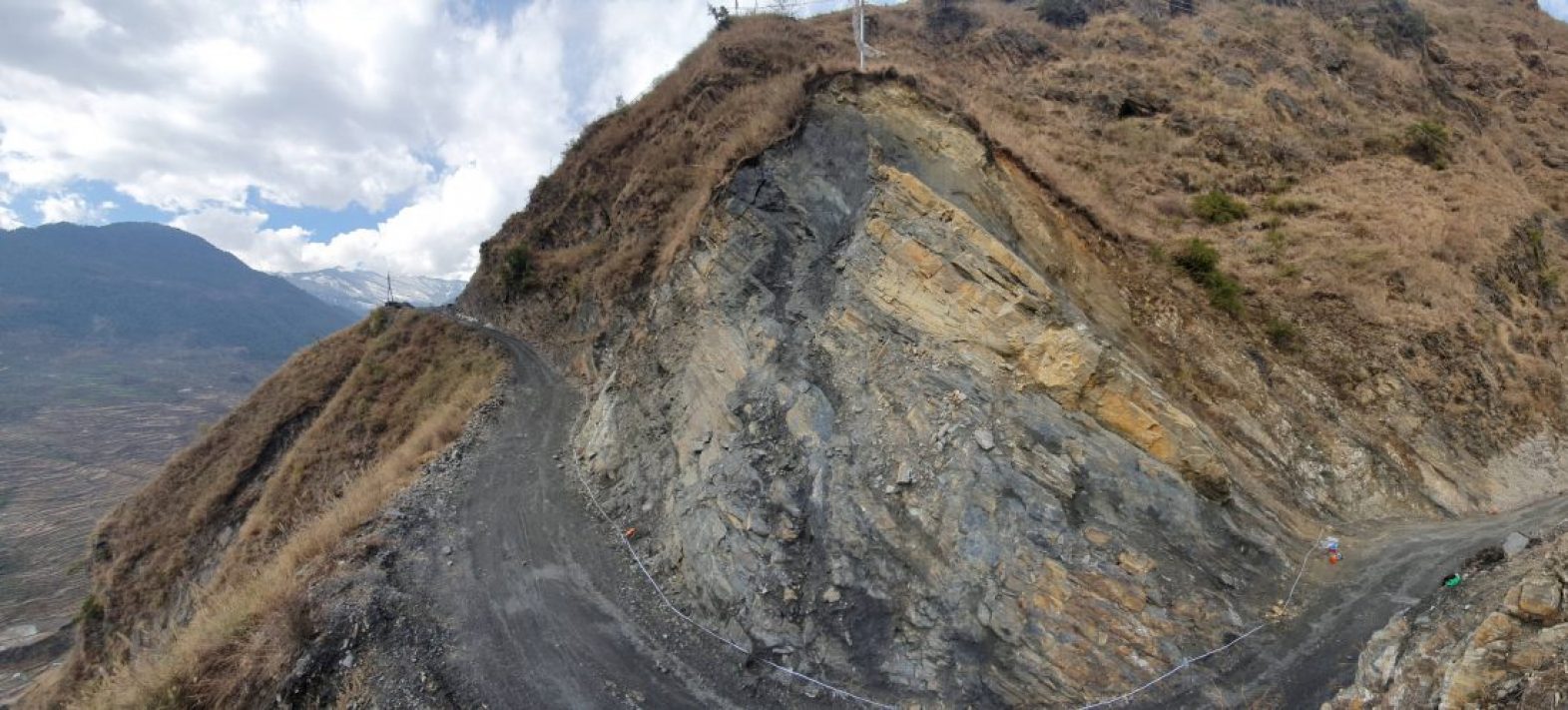
Graphitic black schist outcrop in the Nepal Himalaya.
Publication date: 24/03/2023

Research

Related teams :
Physics of natural sites

While carbonates represent the major storage of inorganic carbon in large mountain belts, organic carbon stored as graphite may have a substantial contribution. Although fundamental to define the global carbon budget of orogens such as the Himalaya which also exhibits metamorphic carbon release as carbon dioxide (CO2), the importance of the storage of graphite remains insufficiently constrained.

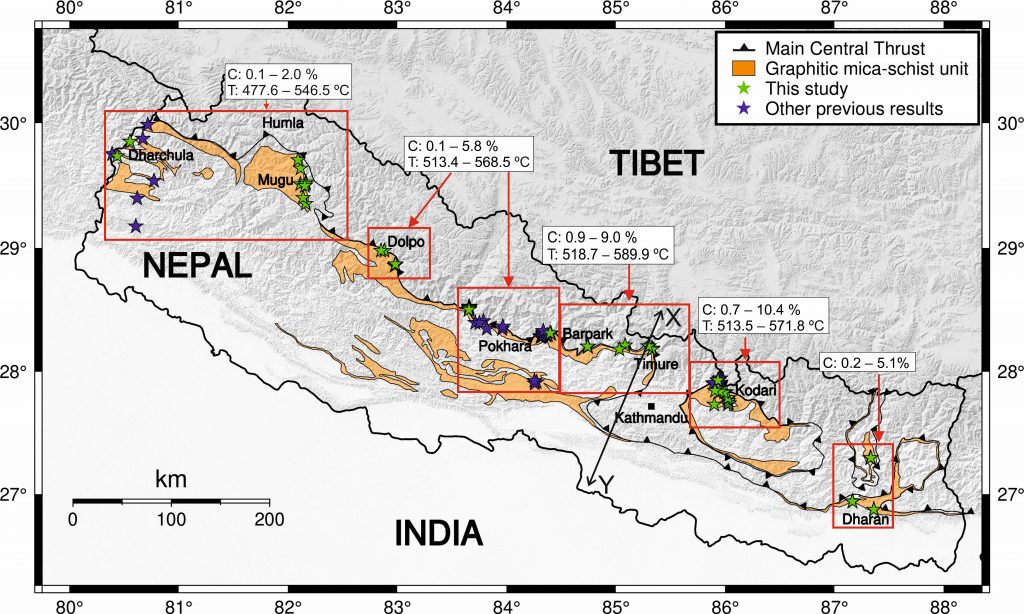
Map showing the graphitic black schist unit in the Nepal Himalayas and associated total organic carbon content and peak metamorphic temperature in several regions.
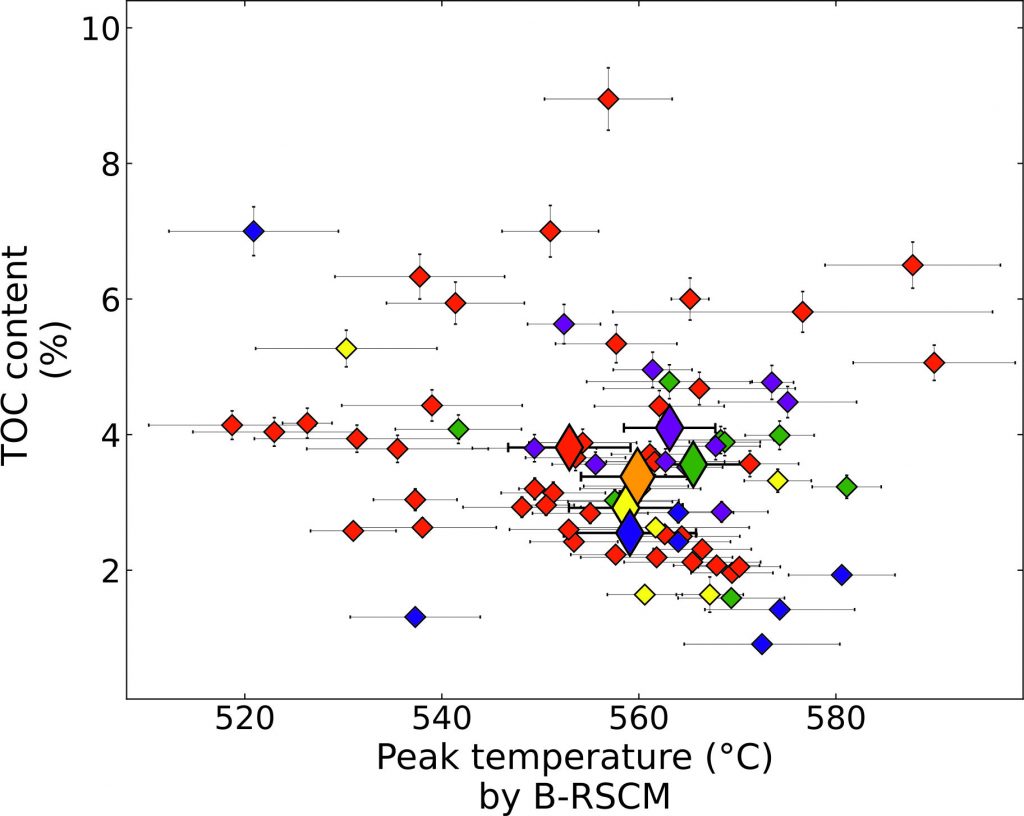
Relation between the total organic carbon content and the peak metamorphic temperature for graphitic black schists from the Upper Trisuli valley, Central Nepal.

An international team, led by IPGP researchers and composed of researchers from ENS (PSL Research University/CNRS), CRPG (Lorraine University/CNRS), the University of Turin (UniTO /CNR-IGG) in Italy, the Central Department of Geology of the Tribhuvan University and the Department of Mines and Geology (DMG) in Nepal, has analyzed extensively graphite occurrences within the so-called black schists in the Nepal Himalaya using numerous well-established and novel techniques, and estimated the contribution of organic carbon to the global carbon budget.

The results show the significant coherence of metamorphic conditions for the graphitic black schists in the vicinity of the Main Central Thrust zone from the metric scale to the scale of an 800-km-long lateral portion of the Himalaya. The total organic carbon (TOC) content and the temperature attained by metamorphism (peak-T) are consistent, suggesting a similar thermal history of these graphitic rocks.

First-order extrapolations reveal that organic carbon may represent up to 20 % of the total amount of carbon stored by the Nepal Himalaya. Graphite is more stable than carbonates during prograde metamorphism and remains passively stable, not involving CO2 producing and consuming reactions. Higher TOC content and peak-T are reported in Central Nepal, where the current metamorphic CO2 emission is also the highest. The graphitic black schists emerge as remarkable signs of the carbon sink/source duality of the Himalayan orogeny and its associated effects on Earth’s climate.

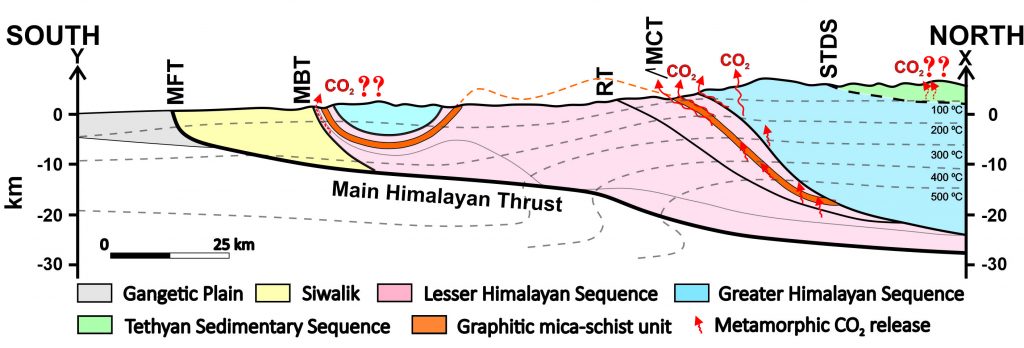
Simplified tectonic cross-section of the Nepal Himalaya showing the graphitic black schist unit and the current metamorphic CO2 emission zones.

Ref : Thapa, S., Girault, F., Deldicque, D., Losno, R., France-Lanord, C., Groppo, C., Rolfo, F., Tamang, S., Rigaudier, T., Debret, B., Paudyal, K.R., Adhikari, L.B., Perrier, F., 2023. Metric, kilometric and large-scale coherence of metamorphic conditions from graphitic phyllite in the Upper Lesser Himalaya of Nepal: Contribution to the estimation of carbon stored during Himalayan orogeny. Chem. Geol., 121378, https://doi.org/10.1016/j.chemgeo.2023.121378

Latest news
Beneath Antarctica: the deep-time story behind Earth's largest
Beneath Antarctica: the deep-time story behind Earth's largest "gravity low"
Why is gravity slightly weaker above Antarctica than anywhere else on Earth? And how did this remarkable anomaly emerge – and then steadily intensify ...
SOUFRIÈRE50 International Conference – First Circular
Fifty years after the eruption of 1976–1977, La Soufrière remains a benchmark volcano for research, monitoring and collective reflection on volcanic r...
“Jerk”, a promising new method for early warning of volcanic eruptions
Forecasting volcanic eruptions in time to alert authorities and populations remains a major global challenge. In a study published in Nature Communica...
CNES and IPGP to supply SPSS instrument as France’s contribution
 to U.S. Artemis IV mission
CNES and IPGP to supply SPSS instrument as France’s contribution
 to U.S. Artemis IV mission
The French space agency CNES (Centre National d’Études Spatiales) and the Institut de physique du globe de Paris – Université Paris Cité are proud to ...