Afin d'être accessible au plus grand nombre, nous vous informons que vous avez la possibilité de modifier la taille d’affichage du contenu de notre site.
Pour cela, voici les commandes à reproduire à l'aide de votre clavier :
Zoom in
CTRL +
+
Zoom out
CTRL +
-
Reset to zero
CTRL +
0
Xavier Mangenot receives the 2018 Van Straelen thesis prize from SGF
Publication date: 24/07/2018
Awards and Distinctions, Institute Life, Press, Research
The Geological Society of France’s annual Van Straelen Dissertation Prize is awarded to a young researcher whose doctoral work stands out for its originality and quality in the earth-surface field.
Xavier Mangenot receives the 2018 Van Straelen Prize for his thesis entitled: Contributions du thermomètre Δ47 et du chronomètre U-Pb à l’étude de l’histoire diagénétique, thermique et hydrogéologique des réservoirs carbonatés du Jurassique Moyen du bassin de Paris.
Summary of his thesis:
Since the 1970s, the reconstruction of the thermal history of sedimentary basins has been based on the chemical and physical properties of the organic matter present in the sediments. The constant improvement in rock analysis techniques has led to the recent emergence of two new, highly promising isotopic tools for studying carbonate minerals. These methods are Δ47 clumped isotope thermometry and U-Pb chronometry using LA-ICP-MS, which can be used to constrain the absolute temperature and age of carbonates with hitherto unequalled precision. The coupling of these two isotopic tools was tested for the first time during this thesis and gave rise to a new approach called Δ47/(U-Pb) thermo-chronometry of carbonates. This approach was tested on the Paris Basin and enabled a direct and accurate reconstruction of the time-temperature path of a reservoir rock over more than 150 million years. The ease of use and accuracy of these characterisation methods means that it is now possible to describe the thermal history of sedimentary basins in a new way.
What if the next stars of recycling were… bacteria?
A new comic book from IPGP takes us behind the scenes of metal bio-recovery. Featuring bacteria, precious metals and a generous dose of humour, it rev...
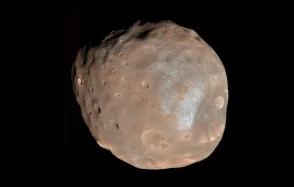
Mapping regolith migration on Phobos to support the MMX sample-return mission
Researchers from the Institut de Physique du Globe de Paris (IPGP), in collaboration with the Centro de Astrobiología (Spain) have published a new stu...
Lorraine Delaroque and Ines Ouar, two IPGP PhD students, receive awards at international conferences
Two doctoral students from the Planetology and Space Sciences team were recently recognized for their research at two international conferences.
Titanium and cerium nanoparticles: in the Seine river, manufactured pollution now matches natural background
A study led by researchers at the Institut de Physique du Globe de Paris (IPGP) and Université Paris Cité shows that concentrations of manufactured ti...