Why is gravity slightly weaker above Antarctica than anywhere else on Earth? And how did this remarkable anomaly emerge – and then steadily intensify – over geological time?
A new open-access study in Scientific Reports offers clear, compelling answers. Led by researchers at the Institut de Physique du Globe de Paris (IPGP), the work was supported by the Make Our Planet Great Again (MOPGA) initiative, funded by the French National Research Agency (ANR).
Rewinding Earth’s interior over 70 million years
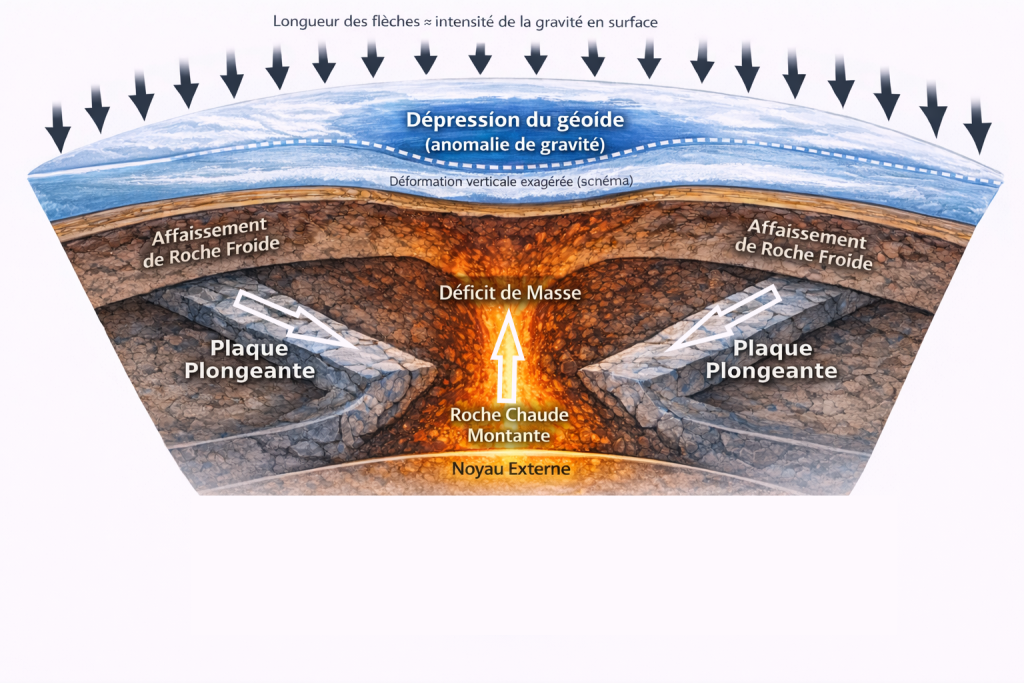
To trace the origin of this unique “gravity low,” the team reconstructed the evolution of Earth’s internal dynamics over nearly 70 million years. This “low” is not a literal hole in the ground, but a broad depression in Earth’s gravity field caused by a deficit of mass at depth. The approach combines seismic tomography (like medical imaging for the planet, using seismic waves instead of X-rays to map structures inside Earth) with physics-based models that capture the mantle’s extremely slow, creeping flow.
Together, these tools make it possible to build an “animated history” of deep mantle circulation beneath Antarctica and follow how it changed through time.
A deep engine that changes gears
The reconstructions point to a major shift between about 50 and 30 million years ago. Early on, the gravity low was driven mainly by the sinking of cold, dense material into the deep mantle along Antarctica’s Pacific and South Atlantic margins.
Over time, a different regime took hold: beneath the Ross Sea, a vast upwelling of hotter, lighter mantle, several thousand kilometres across, began rising from great depth toward the upper mantle. Slow but persistent, this ascent progressively reorganized the mass distribution beneath the continent.
How an exceptional anomaly took shape
It is the combination of these two long-lived processes – continued descent of cold material along the continental margins and rising warm material beneath the center – that strongly amplifies the mass deficit under Antarctica. The gravity low then settles into its present location and reaches the extraordinary strength observed today, making it the largest continental gravity anomaly on the planet.
When mantle dynamics is expressed at the surface
This key phase in Earth’s interior evolution coincides with a small but well-documented shift in the planet’s rotation axis around 50 million years ago, known as “true polar wander”. The study therefore draws a direct connection between deep mantle circulation, large-scale variations in the gravity field measured at the surface, and subtle, but global, changes in Earth’s rotational behaviour.
What this changes in our understanding of Earth
By reconstructing the Antarctic gravity low over tens of millions of years, the study provides an integrated view of how mantle dynamics, the gravity field, and Earth’s rotation are linked. It highlights how slow processes invisible on human time scales can leave a measurable imprint at the surface and can even influence Earth’s rotational behaviour and orientation.
International support, with a strong base at IPGP
MOPGA support was central to this work, underscoring France’s – and IPGP’s – commitment to fundamental Earth-system research carried out in close collaboration with international partners.
Reference
Glišović, P. & Forte, A. M. (2025). Cenozoic evolution of Earth’s strongest geoid low illuminates mantle dynamics beneath Antarctica. Scientific Reports (Nature Portfolio). Open access.