
Citizen / General public
Researcher
Student / Future student
Company
Public partner
Journalist
Teacher / Pupil

Non-biological organic carbon recycled in Earth’s depths

A study published in Nature Communications, involving teams from the Institut de physique du globe de Paris, reveals a major and previously underestimated source of deep carbon: organic compounds formed without biological activity. These findings challenge the conventional interpretation of carbon isotopic signatures in the mantle and shed new light on the deep carbon cycle.
Non-biological organic carbon recycled in Earth’s depths

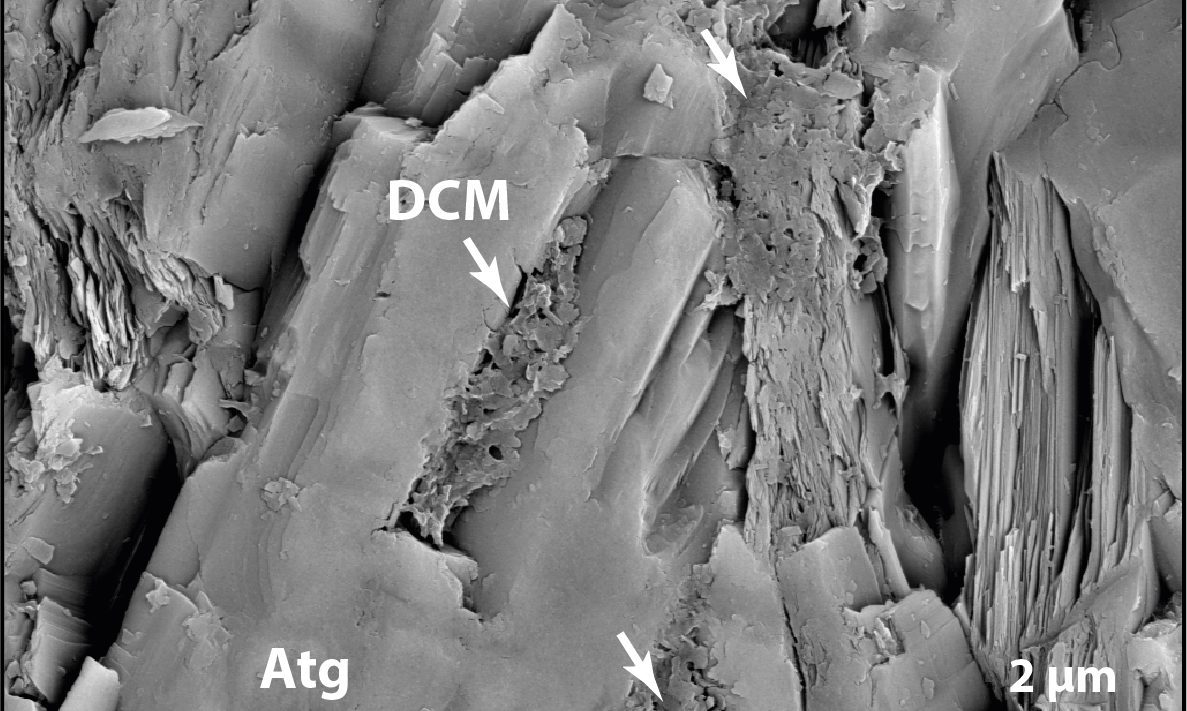
Organic carbon (DCM) trapped in a high-pressure phase (antigorite) / @ Baptiste Debret

Publication date: 06/05/2026

Research

Organic carbon is traditionally associated with biological activity. However, a significant fraction of this carbon can also form abiotically, during the hydrothermal alteration of the oceanic lithosphere. When seawater infiltrates rocks at depth, it triggers chemical reactions that produce solid organic compounds, independently of any living processes. These compounds are then buried in subduction zones and transported to great depths, where they are subjected to extreme pressure and temperature conditions.

Reinterpreting isotopic markers

Using a combination of advanced spectroscopic techniques and isotopic analyses, the researchers studied Alpine metamorphic rocks that record deep burial conditions. Their observations show that these abiotic compounds are remarkably well-preserved during metamorphism, undergo limited chemical transformation, and retain a light isotopic signature.

Until now, such signatures have largely been interpreted as indicators of biological origin. These results demonstrate that they can also arise from purely metamorphic processes.

A key role in the deep carbon cycle

The study shows that these abiotic compounds likely represent the main source of light carbon in rocks subjected to high-pressure, high-temperature conditions during subduction. This carbon can then be recycled into the deep mantle, contributing to the isotopic diversity observed in some diamonds formed at great depths.

These findings call into question a fundamental assumption: that light carbon isotopic signatures necessarily indicate a biological origin.

New perspectives for Earth sciences

Beyond improving our understanding of the deep carbon cycle, this discovery opens new perspectives on the formation of organic carbon in extreme environments, on interactions between Earths surface and interior, and on the processes that may generate organic carbon on other planets.

Source : 

Organic carbon recycling in subduction zones, Nature Communications, 2026


Latest news
Geoffrey C. P. King (1943 - 2026)
With great sadness that we are sharing the news that Geoffrey C. P. King, who worked at the Institut de physique du globe de Paris from 1995 until his...
Tribute from the Institut de Physique du Globe de Paris to Dr. Miguel Eduardo Bosch Blumenfeld (1959–2026)
The Institut de Physique du Globe de Paris pays tribute to Dr. Miguel Eduardo Bosch Blumenfeld, an esteemed geophysicist and distinguished alumnus of ...
From the first solids of the Solar System to planets: the decisive role of extreme and violent cooling
How do the first solid materials that give rise to planets emerge from the incandescent gas surrounding a young star? This transition from gas to soli...
Laëtitia Pantobe has been awarded the 2026 Thesis Prize by the French National Committee for Geodesy and Geophysics (CNFGG).
Laëtitia Pantobe, a PhD student in the Volcanic Systems team, successfully defended her thesis, "Identification and modelling of the physical processe...