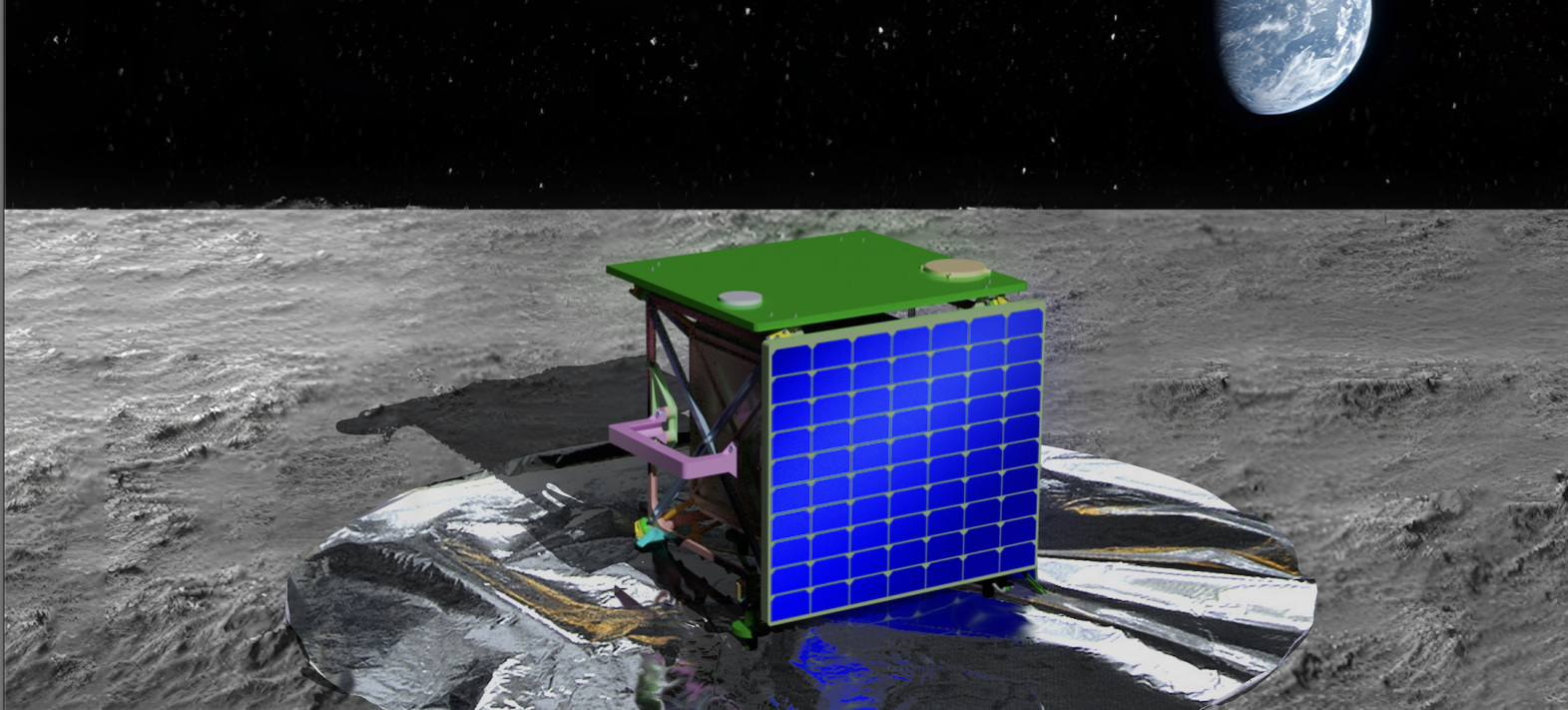
The French space agency CNES (Centre National d’Études Spatiales) and the Institut de physique du globe de Paris – Université Paris Cité are proud to announce that NASA has selected the SPSS instrument (South Pole Seismic Station) under a solicitation for scientific instruments to be developed for the Artemis IV mission. This seismology instrument, to be deployed by astronauts on the lunar surface, will mark a new step in the scientific exploration of the Moon. It will be the most sensitive seismic instrument ever built to measure tremors on planets other than Earth.
NASA’s Jet Propulsion Laboratory (JPL) is leading development of SPSS, designed to probe the inner structure and seismic activity of the lunar surface near the Moon’s south pole, with major contributions from CNES, the Japan Aerospace Exploration Agency (JAXA) and the University of Tokyo. Deployed by a crew on the surface of the Moon, SPSS will tie in with previous seismic experiments such as the Passive Seismic Experiment (PSE) on the Apollo missions and with NASA’s future Farside Seismic Suite (FSS) set to be sent to the Moon on an uncrewed mission at the end of 2027.
CNES will play a key role in developing SPSS, supplying:
• A Very Broad Band (VBB) seismometer derived from the flight spare of the SEIS instrument built for NASA’s InSight mission on Mars (2018), with its electronic box and signal conditioning boards, developed in partnership with the IPGP Earth physics institute in Paris Université Paris Cité, science co-lead for SPSS on the French side and the CNRS (Centre national de la recherché scientifique) ;
• Three geophones designed to measure local seismic properties of the lunar surface, developed in partnership with IPGP, SLB and ISAE-SUPAERO ;
• The instrument’s stowage, deployment and installation systems ;
• A solar array ;
• Support for deployment and routine operations, including processing of seismic data, in synergy with FSS operations and where IPGP will be responsible for the operation of the Lunar Quake Service and data distribution to the science team.
Working under JPL as science and technology lead, CNES, IPGP, JAXA and the University of Tokyo will be combining their high-level expertise to make SPSS a cutting-edge instrument. JAXA is contributing with the Portable Active Seismic Source (PASS) developed by the University of Tokyo as science co-lead for SPSS on the Japanese side. JPL is responsible for developing and operating the instrument.
The development of SPSS is the result of a prestigious international collaboration between CNES and JPL that began with the InSight mission on Mars in 2018, the first to set down a seismometer on the surface of another planet. SPSS will be adapted to the lunar surface and derived from instruments originally designed for the InSight lander, which recorded more than 1,300 “marsquakes” before the end of its mission in 2022. Thanks to the expertise of CNES, CNRS and IPGP, the SPSS project further confirms France’s prowess in designing high-precision planetary seismometers.
Planned for deployment by a crew on the lunar surface, SPSS will help to deliver new insights into the Moon’s geology by studying tremors and subsurface properties near the South Pole. SPSS embodies CNES’s commitment to space exploration and international cooperation, while paving the way for future scientific missions.
Finally, as part of the ERC LISTEN FLASH project and in collaboration with the OCA/CNRS, SPSS seismic measurements will be supplemented by monitoring lunar impact flashes from Earth. To this end, IPGP and OCA/CNRS will operate three infrared telescopes to date and locate impacts on the visible side of the Moon, enabling measurements of seismic velocities in the Moon’s crust and upper mantle with unprecedent accuracy.
For further information:
🔗 NASA’s official announcement: https://science.nasa.gov/missions/artemis/artemis-4/nasa-selects-2-instruments-for-artemis-iv-lunar-surface-science/
🔗 NASA/JPL – Farside Seismic Suite (FSS): https://www.jpl.nasa.gov/missions/farside-seismic-suite/
🔗 ERC LISTEN FLASH (LT-FLASH) project: https://cordis.europa.eu/project/id/101199624/fr