
• Home
  • News and agenda
  • News
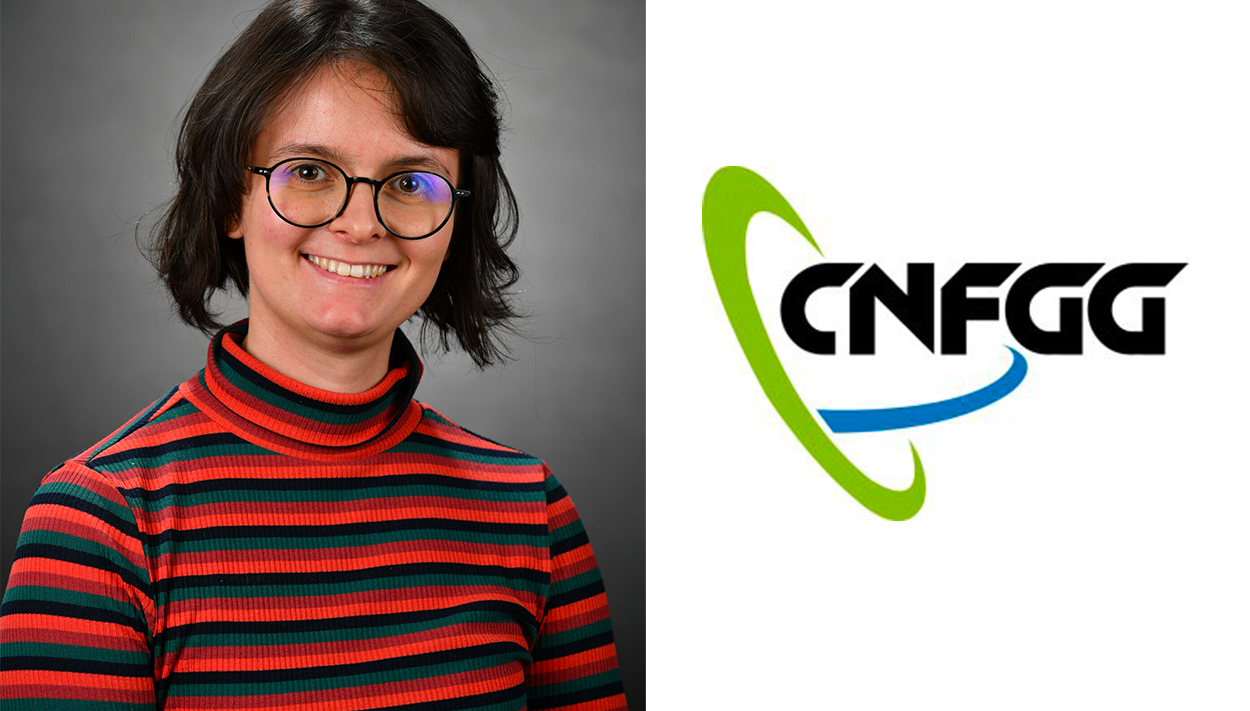
  • Congratulations to Marouchka Froment, winner of the 2025 French National Committee for Geodesy and Geophysics (CNFGG)
Citizen / General public
Researcher
Student / Future student
Company
Public partner
Journalist
Teacher / Pupil

Congratulations to Marouchka Froment, winner of the 2025 French National Committee for Geodesy and Geophysics (CNFGG)

This prestigious award recognizes the excellence of her PhD thesis entitled "Meteorite impacts on Mars: seismic observations, source theory, and modeling", defended on October 26, 2023. Her work was prepared under the supervision of Philippe Lognonné and the co-supervision of Carène Larmat, between IPGP and the Los Alamos National Laboratory in New Mexico, USA.
Congratulations to Marouchka Froment, winner of the 2025 French National Committee for Geodesy and Geophysics (CNFGG)

Publication date: 08/04/2025

Awards and Distinctions, Research

In her research, Marouchka developed an original method for modeling the seismic sources generated by meteorite impacts on Mars, drawing on the “stress glut” theory.

This theory, rooted in continuum mechanics, allows scientists to describe the internal perturbation caused by permanent deformation and momentum transfer within a medium – such as the Martian surface – surrounding a source – such as an impact, a fault or an explosion.

Beyond classical seismic models that use a point-source representation, the stress glut approach provides a more realistic description, where the impact-generated impulse and stress are distributed in time and space.   

Marouchka combined this innovative framework with high-fidelity numerical modeling of the impact, using the the HOSS hydrocode developed in the US, and applied probabilistic Monte Carlo inversion methods. Together, her investigations deepened our understanding of how seismic waves are generated by impacts on Mars, and how the associated shock wave propagates in the atmosphere. She also took part in the identification of new impact craters by linking seismic signals recorded by NASA’s InSight mission to orbital imagery.

Congratulations to Marouchka on this well-deserved recognition, which highlights the quality, precision, and creativity of her work in planetary geophysics!

Read her thesis: https://theses.hal.science/tel-04510069v1/document

Discover the 2025 CNFGG Prize winners: https://site.cnfgg.fr/prix-geophysique


Latest news
Guillaume Avice: CNRS bronze medal for his work on noble gases in the atmospheres of terrestrial planets
Guillaume Avice, a geochemist and cosmochemist, is a research fellow at the IPGP (CNRS/IPGP/University of Paris Cité). He uses mass spectrometry to st...
MAJIS on board JUICE: a key instrument for exploring Jupiter’s icy moons
As part of the team involved in the development and validation of the MAJIS instrument, the Paris Institute of Earth Physics is contributing to the sc...
Frédéric Moynier elected member of the Academia Europaea
Frédéric Moynier, professor at the Institut de physique du globe de Paris (IPGP) and Université Paris Cité, and Deputy Director for Research at IPGP, ...
Can we listen to Titan’s heartbeat?  Icequakes as a window into a hidden ocean.
Can we listen to Titan’s heartbeat? Icequakes as a window into a hidden ocean.
What lies beneath the surface of Titan, Saturn’s largest moon? This question is central to the upcoming Dragonfly mission, which will deploy a drone e...