
Citizen / General public
Researcher
Student / Future student
Company
Public partner
Journalist
Teacher / Pupil

From the first solids of the Solar System to planets: the decisive role of extreme and violent cooling

How do the first solid materials that give rise to planets emerge from the incandescent gas surrounding a young star? This transition from gas to solid, known as “condensation,” remains one of the major open questions in the formation of the Solar System. It took place 4.5 billion years ago. A study published in Nature by an international team led by the Institut de physique du globe de Paris (Institut de Physique du Globe de Paris/CNRS/Université Paris Cité), in collaboration with the Institut de minéralogie, de physique des matériaux et de cosmochimie (CNRS/MNHN/Sorbonne Université), the Institute of Geochemistry and Petrology (ETH Zürich), and the Centre de recherches pétrographiques et géochimiques (CNRS/Université de Lorraine), now offers new insight into this foundational moment.

From the first solids of the Solar System to planets: the decisive role of extreme and violent cooling

Image of the protostar L1527, observed by the James Webb Space Telescope. A protoplanetary disk is forming. @NASA

Publication date: 22/04/2026

Research

A sudden and extreme cooling, driving material diversity…
For decades, models have described the formation of the first minerals as a slow condensation process governed by chemical equilibrium: as it cooled gradually, the gas of the solar nebula would have given rise to well-ordered mineral assemblages. However, this view struggles to account for the diversity of meteorites—ancient fragments that record the earliest stages of planetary formation.

The researchers explored an alternative hypothesis. Using a new model that describes the condensation of solar gas out of equilibrium, they show that in an environment with intense heating and rapid cooling, matter does not have time to follow the laws of thermodynamic equilibrium. Instead, it becomes “frozen” in transient states… and minerals that should not appear at equilibrium naturally emerge under non-equilibrium conditions.

This framework yields only three major types of mineral assemblages, consistent with the three main families of meteorites known in the Solar System. The diversity of planetary materials may therefore not necessarily result from large-scale compositional variations in the solar nebula, but could instead be largely explained by local formation conditions—particularly the rapidity of cooling episodes. This points to a highly dynamic solar nebula, marked by violent motions and intense heating events within the first hundred thousand years.

…And the early incorporation of oxygen into the first solids
These results also shed new light on another major question: the origin of oxygen and water in terrestrial planets. In classical models, the formation of oxidized or hydrated minerals from a gas of solar composition is difficult to explain without invoking external inputs. Here, by contrast, the researchers show that during rapid cooling, certain elements remain available at low temperatures and can be incorporated into forming solids. This mechanism thus provides a natural pathway for incorporating oxygen—and potentially water—from the very earliest stages of planetary material formation.

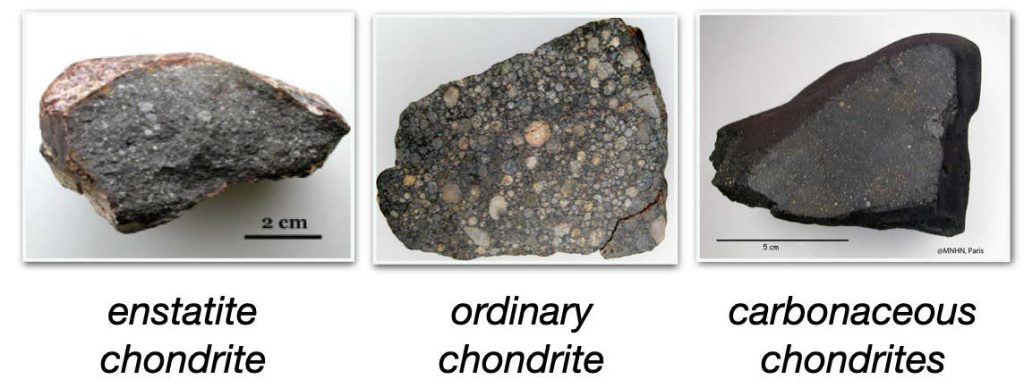
The three classes of chondrites—enstatite chondrites, ordinary chondrites, and carbonaceous chondrites—display slight differences in the concentrations of the most abundant non-volatile elements relative to solar composition (Si, Mg, Al, Ca, and Fe). @IPGP

The emerging picture is that of a young solar nebula far from tranquil. Rather than a homogeneous environment evolving slowly, it appears as a dynamic medium, punctuated by episodes of intense heating and rapid cooling. Recent observations of protoplanetary disks—particularly those made possible by the James Webb Space Telescope—indeed reveal that such phenomena are common in forming stellar systems, lending strong support to this new interpretation.

By reproducing both the mineralogical diversity and the oxidation states of meteorites from a single initial gas, this work offers a significant shift in perspective. It suggests that the composition of planets does not depend solely on their position within the protoplanetary disk, but also on the physical and dynamical conditions—especially the rates of heating and cooling—that governed the formation of their earliest building blocks.

Led by teams from the Institut de physique du globe de Paris and its partners, with support from the Centre national de la recherche scientifique, this study thus opens a new pathway for understanding the earliest stages in the history of the Solar System, and more broadly, those of planetary system formation.

Référence

Non-equilibrium condensation of the first Solar System solids, Nature (2026)
Sébastien Charnoz, Jérôme Aléon, Marc Chaussidon, Paolo A. Sossi, Yves Marrocchi, Patrick Franco
DOI : 10.1038/s41586-026-10257-5

Latest news
Laëtitia Pantobe has been awarded the 2026 Thesis Prize by the French National Committee for Geodesy and Geophysics (CNFGG).
Laëtitia Pantobe, a PhD student in the Volcanic Systems team, successfully defended her thesis, "Identification and modelling of the physical processe...
Guillaume Avice: CNRS bronze medal for his work on noble gases in the atmospheres of terrestrial planets
Guillaume Avice, a geochemist and cosmochemist, is a research fellow at the IPGP (CNRS/IPGP/University of Paris Cité). He uses mass spectrometry to st...
MAJIS on board JUICE: a key instrument for exploring Jupiter’s icy moons
As part of the team involved in the development and validation of the MAJIS instrument, the Paris Institute of Earth Physics is contributing to the sc...
Frédéric Moynier elected member of the Academia Europaea
Frédéric Moynier, professor at the Institut de physique du globe de Paris (IPGP) and Université Paris Cité, and Deputy Director for Research at IPGP, ...