Citizen / General public
Researcher
Student / Future student
Company
Public partner
Journalist
Teacher / Pupil

Geomagnetic tremors finally reproduced and explained

The Earth's magnetic field experiences unpredictable, rapid and intense anomalies known as geomagnetic jolts. The mechanisms behind these phenomena remained mysterious until recent work by a CNRS researcher at the Institut de Physique du Globe de Paris.
Geomagnetic tremors finally reproduced and explained

Publication date: 23/04/2019

Press, Research

Related teams :
Geological Fluid Dynamics

With a colleague in Denmark, and thanks to the supercomputers at the Grand équipement national de calcul intensif (GENCI), they have succeeded in computer modelling and explaining the appearance of these geomagnetic tremors. Their work will be published in Nature Geoscience on April 22nd 2019.

First described in 1978, geomagnetic jolts are unpredictable events that suddenly accelerate the evolution of the Earth’s magnetic field and distort its predictions on the scale of a few years. However, our magnetic field plays a part in many human activities, from determining the heading in mobile phones to low-altitude satellite flight. It is therefore vital to be able to predict its evolution accurately. But geomagnetic tremors have been a problem for geophysicists for over forty years.

The Earth’s magnetic field is produced by the circulation of matter inside its metallic core from the energy released when the core cools. Researchers are familiar with two types of movement that give rise to two types of variations in the magnetic field: those resulting from the slow convection movement, which can be detected on a century-scale, and those resulting from “fast” hydromagnetic waves, which can be detected on a scale of a few years. It was suspected that the latter could play a role in the tremors, but the interaction of these waves with the slow convection and their propagation and amplification mechanism remained to be elucidated.

To solve this mystery, Julien Aubert from the IPGP’s Geological Fluid Dynamics team and a colleague from the Technical University of Denmark (DTU) developed a computer simulation that comes as close as possible to the physical conditions of our core. Requiring the equivalent of 4 million computing hours, this simulation was made possible by GENCI’s supercomputers.

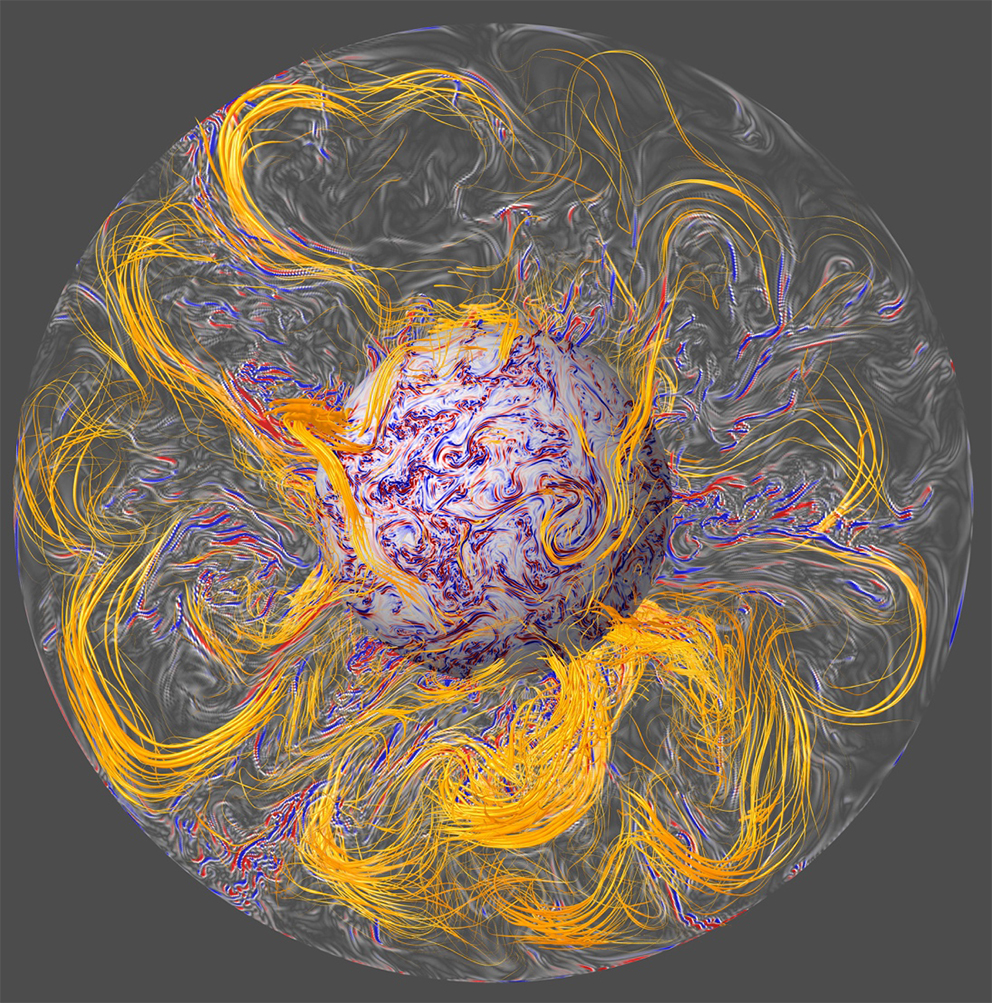
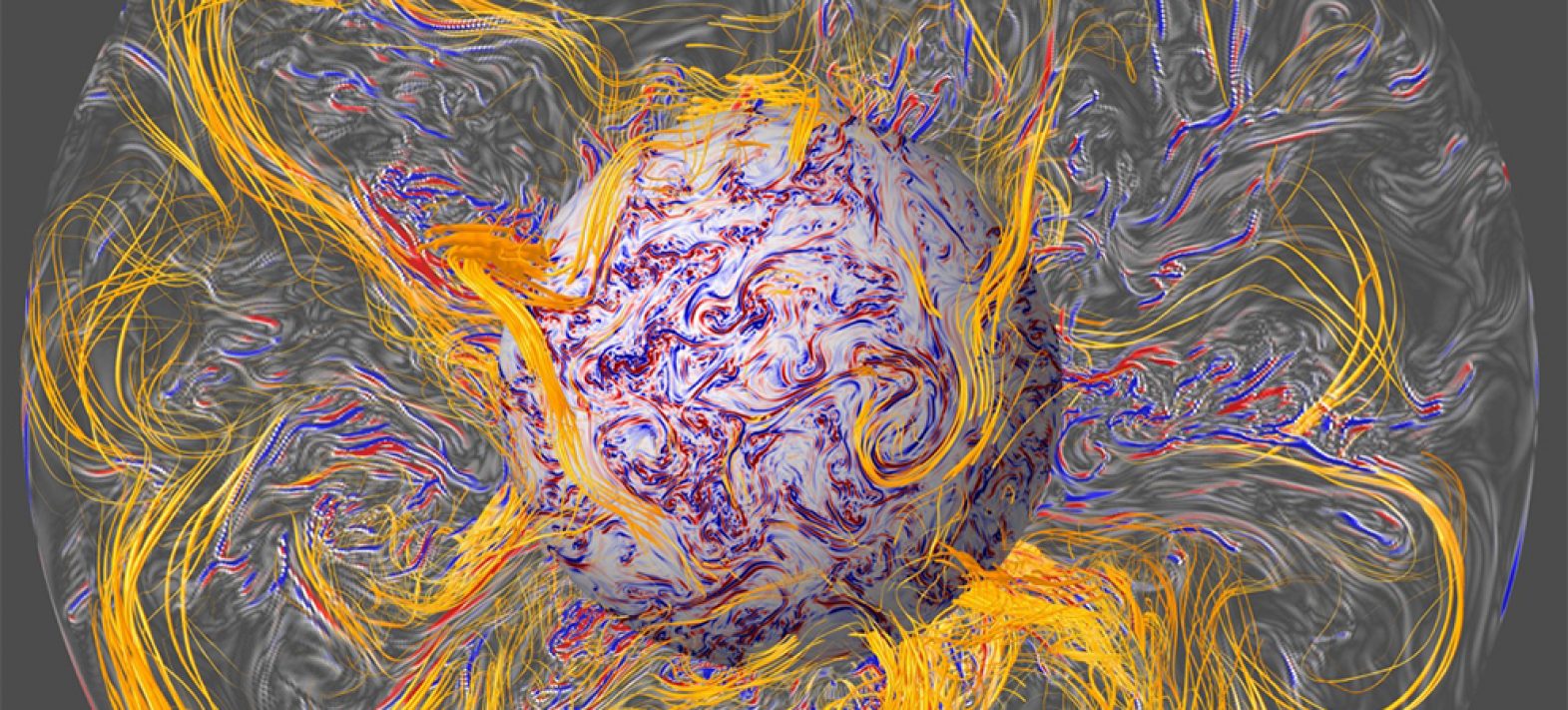
Visualization of the interior of the Earth's core, as modeled in the numerical simulation. Magnetic field lines (orange) are stretched by turbulent convection (blue and red). (© Aubert et al./IPGP/CNRS Photothèque)

The researchers were thus able to reproduce the sequence of events that leads to geomagnetic tremors. In the simulation, geomagnetic tremors originate from hydromagnetic waves emitted at depth. As these waves approach the surface of the core, they are focused and amplified to give rise to magnetic disturbances that are comparable in every way to the tremors observed.

The digital reproduction and understanding of these tremors opens the way to better prediction of the Earth’s magnetic field. Identifying the origins of magnetic field variations will also help geophysicists to study the physical properties of the Earth’s core and deep mantle.

This research project was funded by the Simone and Cino Del Duca Foundation of the Institut de France, which through one of its scientific grants supports fundamental research in the Earth sciences.

Ref:

Latest news
“Jerk”, a promising new method for early warning of volcanic eruptions
Forecasting volcanic eruptions in time to alert authorities and populations remains a major global challenge. In a study published in Nature Communica...
CNES and IPGP to supply SPSS instrument as France’s contribution
 to U.S. Artemis IV mission
CNES and IPGP to supply SPSS instrument as France’s contribution
 to U.S. Artemis IV mission
The French space agency CNES (Centre National d’Études Spatiales) and the Institut de physique du globe de Paris – Université Paris Cité are proud to ...
Kristel Chanard receives the 2025 Irène Joliot-Curie Prize in the “Young Female Scientist” category.
Awarded by the Ministry of Higher Education, Research, and Space, the Academy of Sciences, and the Academy of Technologies, this prize has been recogn...
International honours for Daniel Neuville in the field of glass science
Daniel Neuville, CNRS research director at IPGP, was awarded the Morey Prize in 2025 and was elected chair of the technical committees of the Internat...