
Citizen / General public
Researcher
Student / Future student
Company
Public partner
Journalist
Teacher / Pupil

Guillaume Avice: a bronze medal for his work on noble gases in the atmospheres of terrestrial planets

Guillaume Avice, a geochemist and cosmochemist, is a research fellow at the IPGP (CNRS/IPGP/University of Paris Cité). He uses mass spectrometry to study noble gases in the atmospheres of terrestrial planets.
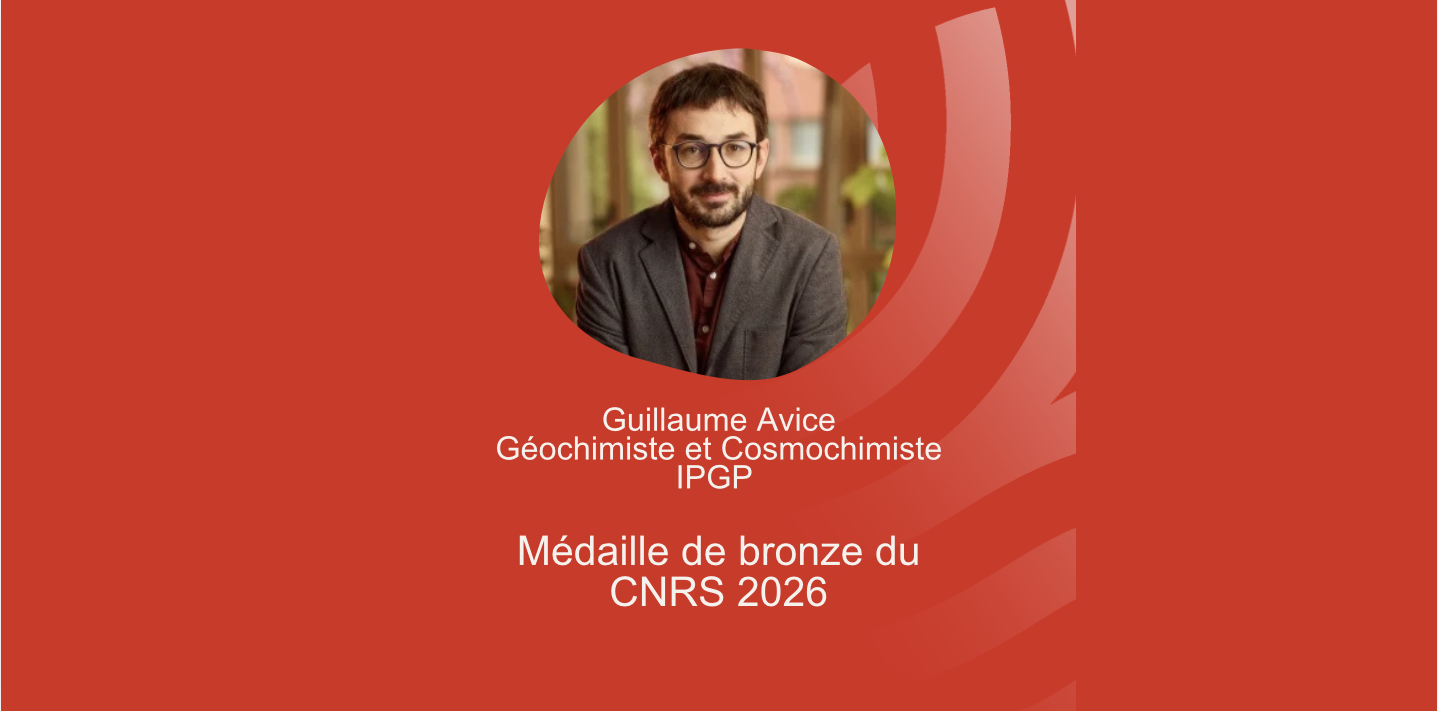
Guillaume Avice: a bronze medal for his work on noble gases in the atmospheres of terrestrial planets

Publication date: 16/04/2026

Research

Guillaume Avice, a research fellow at the Paris Institute of Earth Physics (IPGP, CNRS/IPGP/Univ. Paris Cité), studies the cosmochemistry of noble gases to understand the evolution of terrestrial planets, such as Earth, Venus and Mars. “I use noble gases as a tool to understand the origin and evolution of planetary atmospheres,” explains the researcher, who employs static vacuum noble gas mass spectrometry for this purpose.

“A planet’s atmosphere is an archive of its geological history”

“On Venus, measurements of noble gases were carried out in the 1970s and 1980s, but their accuracy was limited,” laments Guillaume Avice. He began by reviewing the current state of knowledge regarding Venus’s rare gases. He also proposes a concept for space missions to bring back samples from Venus’s atmosphere and study them in the laboratory, with a level of precision that cannot be matched by on-board probes.

“I spend 99% of my research time measuring noble gases in various samples. It’s a single measurement technique that requires time and expertise, but one that can be applied to a wide range of scientific questions.”

During his first postdoctoral fellowship, Guillaume Avice helped develop a new type of mass spectrometer for noble gases, so compact that it is about the size of a fist. He is also the recipient of an ERC Starting Grant, ATTRACTE, which focuses on extracting noble gases from hydrothermal minerals found in impact craters.

Guillaume Avice trained at the École nationale supérieure de géologie (ENSG) in Nancy and the University of Lorraine, and was awarded his PhD in 2016 at the Centre for Petrographic and Geochemical Research (CRPG, CNRS/University of Lorraine). He carried out his postdoctoral research at the California Institute of Technology (Caltech, USA) and the Jet Propulsion Laboratory (JPL, USA), then at the IPGP, where he was subsequently recruited by the CNRS in 2020.


Latest news
MAJIS on board JUICE: a key instrument for exploring Jupiter’s icy moons
As part of the team involved in the development and validation of the MAJIS instrument, the Paris Institute of Earth Physics is contributing to the sc...
Frédéric Moynier elected member of the Academia Europaea
Frédéric Moynier, professor at the Institut de physique du globe de Paris (IPGP) and Université Paris Cité, and Deputy Director for Research at IPGP, ...
Can we listen to Titan’s heartbeat?  Icequakes as a window into a hidden ocean.
Can we listen to Titan’s heartbeat? Icequakes as a window into a hidden ocean.
What lies beneath the surface of Titan, Saturn’s largest moon? This question is central to the upcoming Dragonfly mission, which will deploy a drone e...
Lithium isotopes unveil the hidden chemistry of Guadeloupe's volcanic waters
IPGP researchers present the first systematic lithium isotope survey of Guadeloupe's surface waters, revealing that a single small island can host a r...