Citizen / General public
Researcher
Student / Future student
Company
Public partner
Journalist
Teacher / Pupil

Heading for Phobos: IPGP at the heart of Japan’s MMX mission

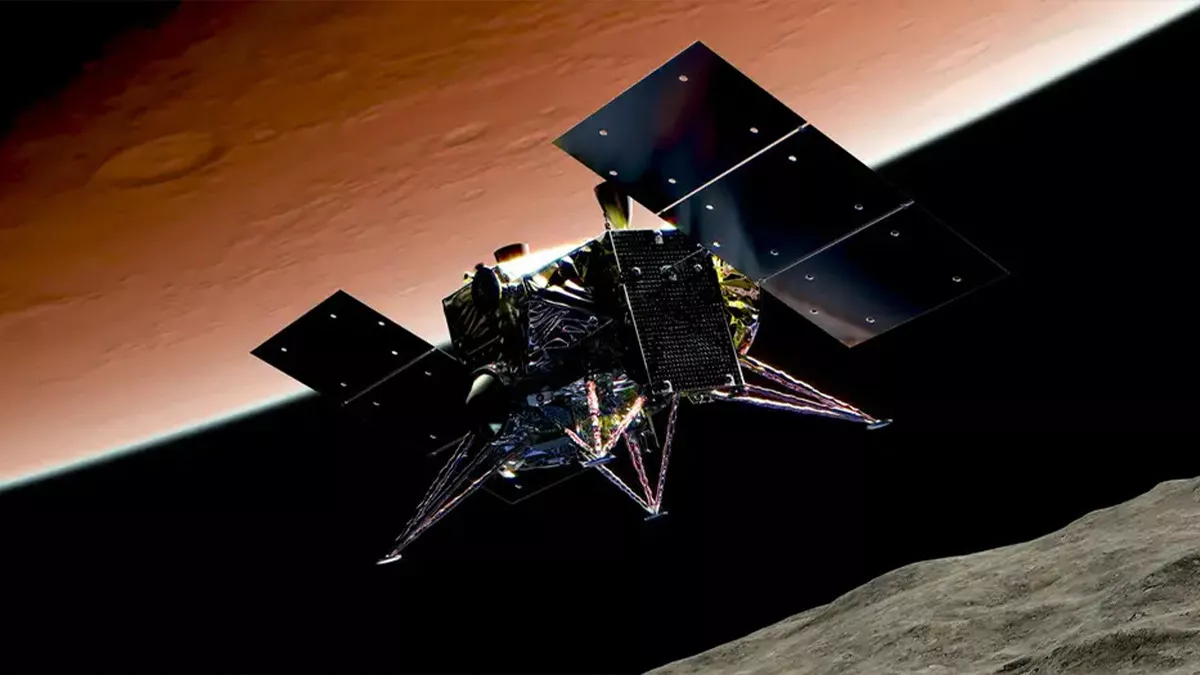
On 19 October 2026 at 9:41 p.m. Paris time, Japan’s MMX space mission will lift off towards Mars and its two moons, Phobos and Deimos, from the Tanegashima Space Center in Japan. Its objective is to better understand their origin and, above all, bring back to Earth samples collected from the surface of Phobos. Three IPGP researchers are taking part in this scientific adventure: Sébastien Charnoz, Marc Chaussidon and Frédéric Moynier.
Heading for Phobos: IPGP at the heart of Japan’s MMX mission

Publication date: 19/10/2026

Research

Led by the Japan Aerospace Exploration Agency (JAXA), the MMX mission — Martian Moons eXploration — is expected to reach the Martian system in 2027. The spacecraft will remain there for several years to observe Phobos and Deimos, study their composition and collect samples, before returning to Earth in 2031.

A mystery surrounding Mars

Phobos is a small, irregularly shaped moon, approximately 22 kilometres in diameter, that closely resembles an asteroid. However, its origin remains poorly understood.
Two main scenarios are currently being considered: Phobos and Deimos may be former asteroids captured by Mars, or they may have formed from debris generated by a giant impact early in the red planet’s history.
The second hypothesis has long been investigated at IPGP. In 2016, Sébastien Charnoz and Pascal Rosenblatt published a study in Nature Geoscience proposing a scenario in which Phobos and Deimos formed from a disk of debris created by a giant impact on Mars. This work, now recognised as one of the leading models for the origin of the two Martian moons, was supported by the Labex UnivEarthS programme at Université Paris Cité.
MMX will now make it possible to test these models against observations and, ultimately, through direct analysis of material from Phobos.

MIRS: a first look at the composition of Phobos

The first decisive findings are expected to come from MIRS, the near-infrared spectrometer carried aboard MMX.
Under the scientific leadership of Antonella Barucci, from LIRA at the Observatoire de Paris, MIRS will identify the minerals present on the surface of Phobos. These observations could provide the first clues about the materials that make up the moon and the conditions under which it formed.
Frédéric Moynier, Marc Chaussidon and Sébastien Charnoz are all co-investigators of MIRS. The instrument also has close ties with Université Paris Cité: Sonia Fornasier, a professor at Université Paris Cité, is expected to take over its scientific leadership in the near future.
MIRS will therefore mark the first major scientific milestone of the mission: observing the composition of Phobos from orbit, before its surface is explored by the rover and, a few years later, the samples returned to Earth are analysed.

The Idefix rover sets out to explore Phobos

Before sample collection begins, the surface of Phobos will also be explored by Idefix, a small rover developed by the French space agency CNES and the German Aerospace Center (DLR).
Sébastien Charnoz is also involved in this part of the mission, as a member of the scientific team working in particular on the rover’s cameras. The images will provide close-up views of the surface of Phobos and help researchers better understand how dust and rocky fragments are distributed and organised across it.
These observations will build on research conducted at IPGP over several years into the surface and evolution of Phobos.

Samples from Phobos in the laboratory

The final stage will also be the most spectacular: MMX is expected to collect more than 10 grams of material from the surface of Phobos and bring it back to Earth in 2031.
At IPGP, Frédéric Moynier and Marc Chaussidon will be among the scientists responsible for the preliminary analysis of these samples as soon as they return to Earth. Their chemical and isotopic composition will help determine whether Phobos is a captured asteroid or formed from material originating from Mars following a giant impact.
Moreover, the samples returned from Phobos may contain material ejected from Mars itself, potentially making them the first Martian samples ever brought back to Earth. The MMX project at IPGP is coordinated by Frédéric Moynier.
Only a portion of the samples will initially be analysed, with the remainder preserved for future generations of researchers and new analytical techniques.
Together, these different stages should provide a better understanding of the origin of Phobos, the early history of Mars and the processes that have shaped the solar system.

Latest news
From Tokyo to Mount Fuji: a Franco-Japanese week at the crossroads of Earth sciences and music
From 9 to 17 November 2026, several scientific events in Japan will bring together IPGP researchers and their Japanese partners. The programme include...
Using neutrinos to probe the composition of Earth’s deep interior
What if neutrinos could offer a new way of looking inside our planet? An interdisciplinary team involving researchers from the IPGP is exploring the u...
Planetary Research: a new open-access journal for planetary sciences
Led by an international community of researchers, with strong involvement from IPGP scientists, the new journal Planetary Research offers an alternati...
What if the next stars of recycling were… bacteria?
A new comic book from IPGP takes us behind the scenes of metal bio-recovery. Featuring bacteria, precious metals and a generous dose of humour, it rev...