Earth’s deep interior still holds many mysteries. For several decades, seismology has revealed its structure with increasing precision by analysing the propagation of waves generated by earthquakes. However, translating these observations into an accurate description of the temperature and, above all, the chemical composition of Earth’s interior remains difficult: variations in seismic velocity can in fact have several different causes.
To overcome this ambiguity, a team bringing together specialists in seismology, neutrino physics and inverse methods proposes exploiting a radically different source of information: atmospheric neutrinos.
Particles capable of travelling through the Earth
Neutrinos are extremely light elementary particles that interact only very weakly with matter. This property allows them to travel through virtually the entire planet.
They have recently gained particular scientific prominence: the 2026 Nobel Prize in Physics was awarded to Francis Halzen for his contributions to the development of the IceCube Observatory and to the discovery of high-energy neutrinos originating from astrophysical sources.
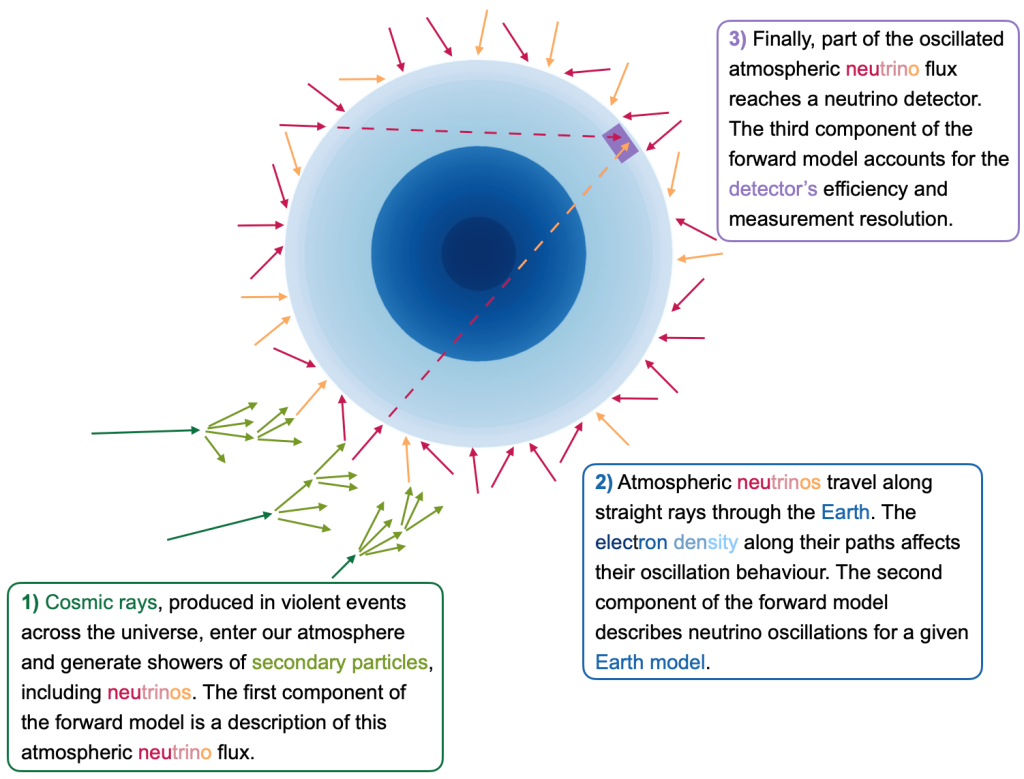
The approach developed in this new study, however, focuses on a different population of neutrinos. Rather than neutrinos coming from the distant Universe, it considers neutrinos continuously produced in the Earth’s atmosphere when cosmic rays interact with it.
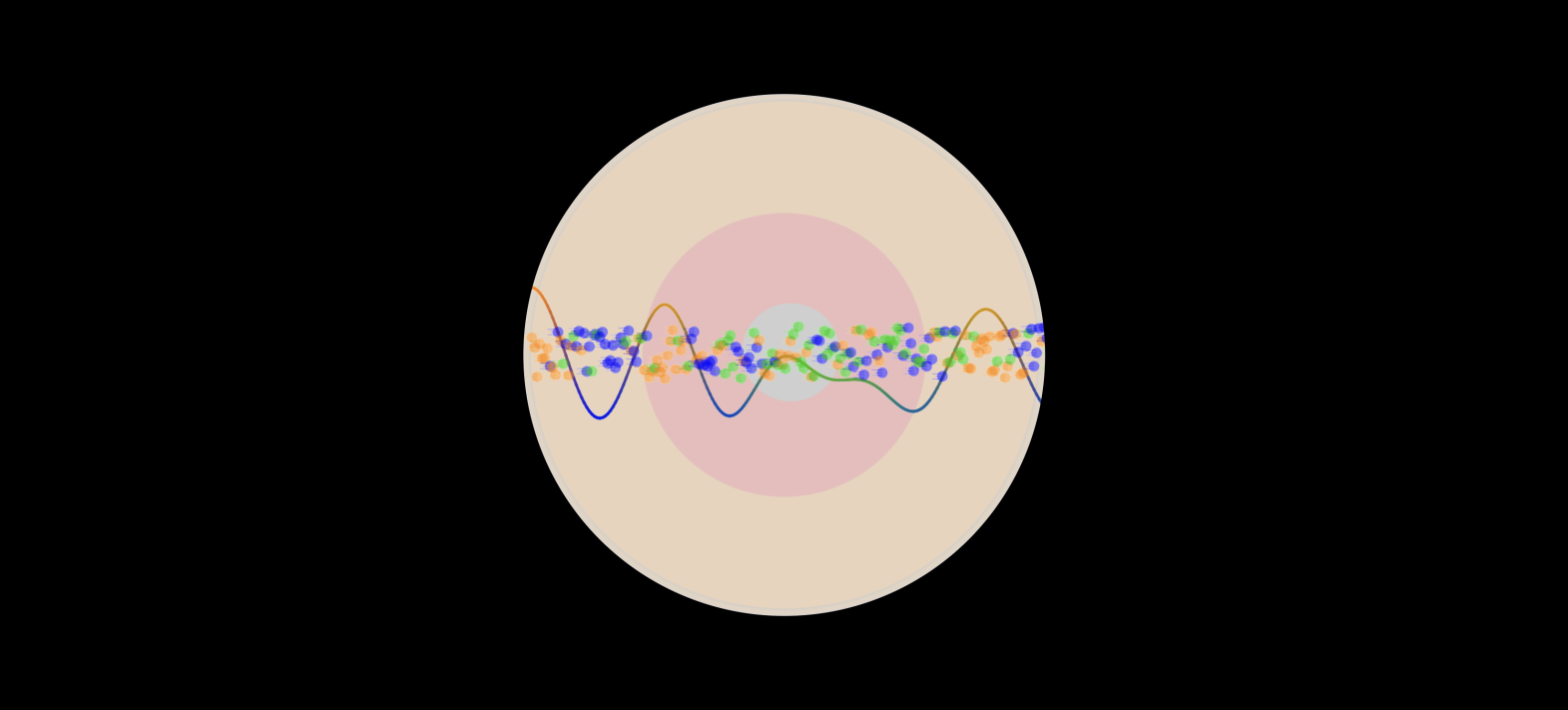
As they travel through the Earth, these neutrinos undergo a phenomenon known as oscillation. These oscillations are influenced by the number of electrons encountered along their path.
It is precisely this property that could make neutrinos a new probe of the Earth’s interior.
Information complementary to seismic observations
The electron density of a material depends on both its mass density and its chemical composition. Neutrinos are therefore sensitive to the properties of the Earth in a way that differs from seismic waves.
The longer-term objective is to combine seismic observations and neutrino measurements within a joint inversion framework, making it possible to better disentangle the effects of temperature, density and chemical composition.
As a first step, the researchers developed the forward model required for this approach. It allows them to calculate how a given electron-density structure within the Earth modifies the neutrino signal expected in detectors.
They then assessed how small variations in electron density would affect the number of neutrinos measured. These calculations notably make it possible to establish the sensitivity kernels required for future tomographic inversion methods.
The mantle within reach of future detectors
The results show that the next generation of large neutrino detectors, including KM3NeT/ORCA, Hyper-Kamiokande and DUNE, should be sensitive to density variations within the Earth.
Sensitivity appears particularly promising in the mantle. Although the expected spatial resolution remains on the order of several hundred to around one thousand kilometres, this new approach could help test some of the large-scale chemical heterogeneities that are currently difficult to characterise using seismology alone.
In the longer term, one of the main goals would be to constrain the presence of light elements, and hydrogen in particular, within the mantle and the transition zone, located at depths of approximately 410 to 660 kilometres.
Such observations could provide new insights into the storage and circulation of water deep within the planet, as well as into its early history and the processes that ac