Citizen / General public
Researcher
Student / Future student
Company
Public partner
Journalist
Teacher / Pupil

How do planets acquire their water?

What if water, that essential ingredient for life, originated at the very heart of planets when they were formed? This is what a new study published in Nature by a team from the US and France Carnegie Institution for Science, IPGP, UCLA) reveals, bringing together James Badro, Nicolas Wehr, and Stephan Borensztajn from the Institut de Physique du Globe de Paris (Université Paris Cité/CNRS).
How do planets acquire their water?

Publication date: 05/11/2025

Research

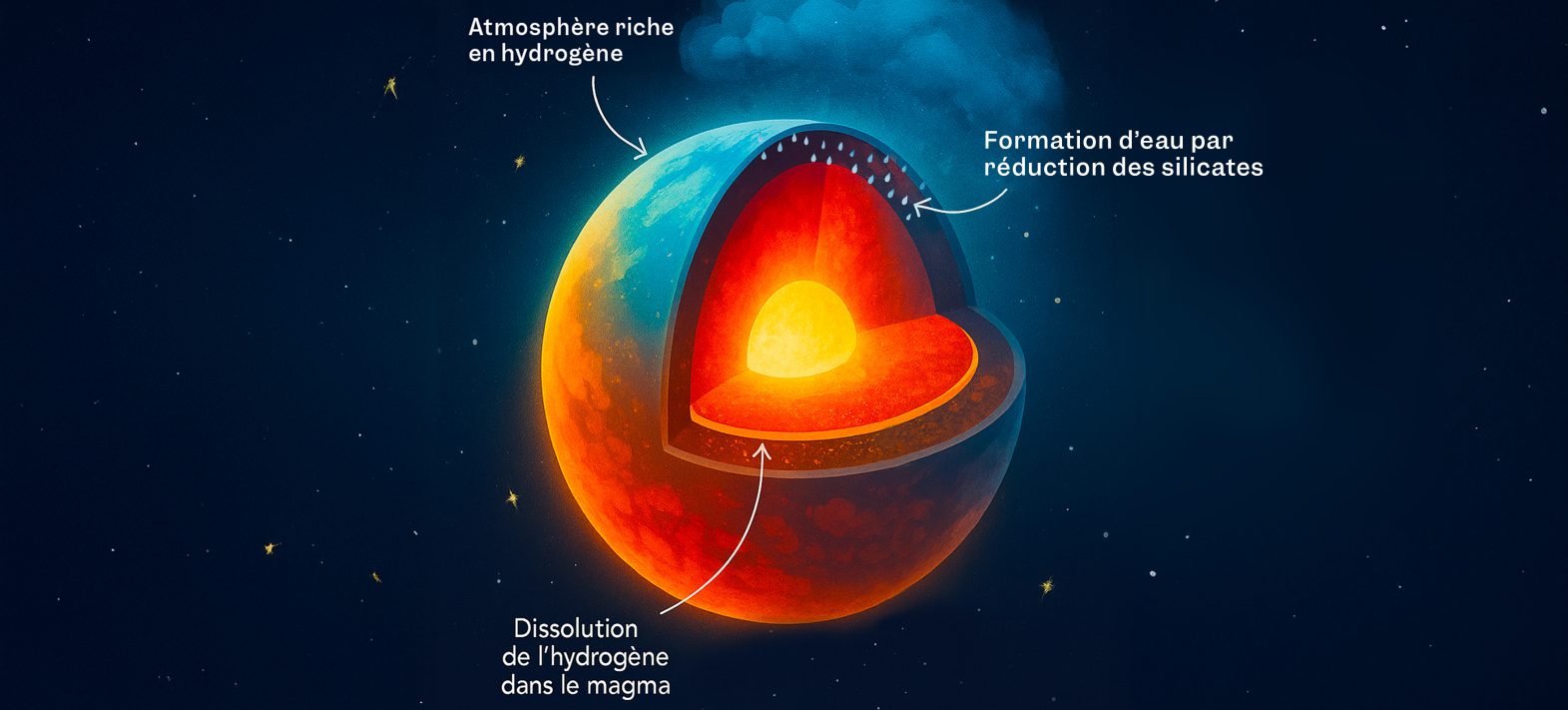
The researchers have shown that chemical interactions between magma oceans and primitive hydrogen-rich atmospheres can lead to the creation of water during the formation of planets. These findings shed new light on the origin of water on Earth—and on the possible habitability of other worlds.

Among the more than 6,000 exoplanets discovered to date, sub-Neptunes,smaller than Neptune but more massive than Earth, are the most common. Their internal structure, consisting of a rocky core enveloped by a dense hydrogen atmosphere, makes them ideal models for studying how water can form from deep interactions between rocks and gases.

Until now, this hypothesis has been based mainly on theoretical models. For the first time, the team has experimentally reproduced these extreme conditions in the IPGP’s high-pressure laboratory:

silicates of mantle composition were compressed to 600,000 times atmospheric pressure and heated to over 4,000°C in the presence of molecular hydrogen.

The experiments revealed two key processes:

  • strong dissolution of hydrogen in magma,
  • and the direct formation of water through the reduction of iron oxide contained in silicates.

This work provides the first experimental evidence that a planet can generate water during its formation. This internal production of water could play a major role in the composition of the mantle, core, and atmosphere of young planets—and, ultimately, in their ability to harbor liquid water, an essential condition for life. These results show that water can be a natural and inevitable product of planetary formation.

This discovery opens up new perspectives for understanding the origin of water on Earth—and for exploring the diversity of potentially habitable worlds in our galaxy.


Latest news
“Jerk”, a promising new method for early warning of volcanic eruptions
Forecasting volcanic eruptions in time to alert authorities and populations remains a major global challenge. In a study published in Nature Communica...
CNES and IPGP to supply SPSS instrument as France’s contribution
 to U.S. Artemis IV mission
CNES and IPGP to supply SPSS instrument as France’s contribution
 to U.S. Artemis IV mission
The French space agency CNES (Centre National d’Études Spatiales) and the Institut de physique du globe de Paris – Université Paris Cité are proud to ...
Kristel Chanard receives the 2025 Irène Joliot-Curie Prize in the “Young Female Scientist” category.
Awarded by the Ministry of Higher Education, Research, and Space, the Academy of Sciences, and the Academy of Technologies, this prize has been recogn...
International honours for Daniel Neuville in the field of glass science
Daniel Neuville, CNRS research director at IPGP, was awarded the Morey Prize in 2025 and was elected chair of the technical committees of the Internat...