

“Jerk”, a promising new method for early warning of volcanic eruptions
Forecasting volcanic eruptions in time to alert authorities and populations remains a major global challenge. In a study published in Nature Communications, researchers and engineers from the Institut de Physique du Globe de Paris (IPGP) and the GFZ Helmholtz Centre for Geosciences present a new detection method, called “Jerk,” capable of identifying, in real time, very early precursor signals of volcanic eruptions using a single seismological instrument.
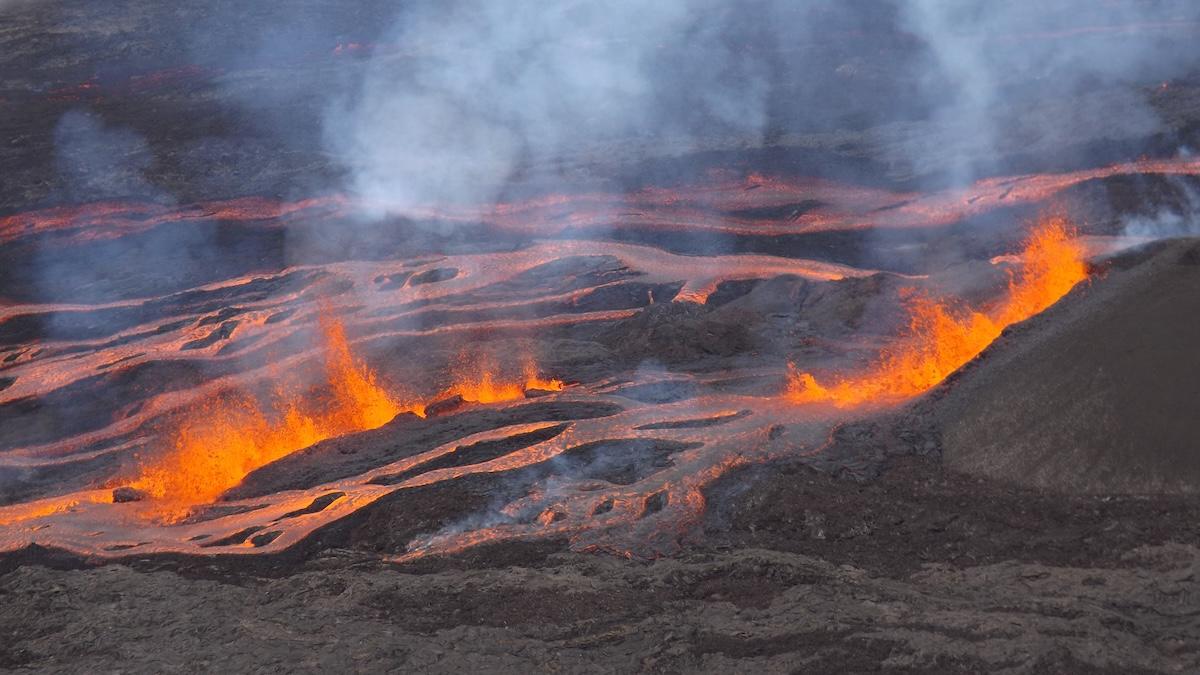
© A. Peltier / OVPF-IPGP, 2015
Publication date: 19/12/2025
Research
Related observatories : Volcanological Observatory of Piton de la Fournaise (OVPF-IPGP)
Related teams :
Volcanic Systems
The “Jerk” method enables real-time detection of extremely subtle ground motions associated with deep magma injections. These so-called Jerk signals appear as very low-frequency transients observed in horizontal ground motion, both in acceleration and tilt. The authors show that they are likely generated by dynamic rock-fracturing processes preceding an eruption. With amplitudes on the order of a few nanometers per second cubed (nm/s³), these signals can be detected using a single very broadband seismometer, provided that specific data processing is applied, including correction for Earth tides.
In April 2014, the tool was implemented at the Piton de la Fournaise volcanological observatory of the IPGP (OVPF-IPGP, Reunion Island) as a fully automated module of the WebObs system, using data from a seismological station of the global Geoscope network located 8 km from the summit of the volcano (Rivière de l’Est). From June 20, 2014, a first alert was sent 1 hour and 2 minutes before the start of the eruption. For more than 10 years, this Jerk signal detection and analysis system operated continuously, issuing automatic alerts for 92% of the 24 eruptions that occurred between 2014 and 2023. Warning times vary from a few minutes to 8.5 hours before the magma reaches the surface. The method was also tested a posteriori on data from 24 old eruptions between 1998 and 2010, showing that the Jerk alert works systematically.
The great originality of this work lies in the fact that the Jerk method was tested and validated in real time in an automatic and unsupervised manner for more than 10 years, and not in post-processing of data as is the case in the vast majority of studies of eruptive precursors published in the literature.
The system, however, sometimes produced “false positives” – clear alerts but not followed by eruptions – which all turned out to be real magma intrusions or “abortive eruptions”, an interpretation consolidated by all the other observables such as seismicity, deformations and analyzes of volcanic gases. In addition to the effectiveness of the Jerk alert for eruptions, the tool proves to be a perfect and unequivocal detector of magmatic intrusions.
During the last seismic crisis at Piton de la Fournaise on December 5, 2025, associated with low deformations and gas anomalies, a small Jerk signal was emitted (only 0.1 nm/s3), confirming that a magma intrusion had indeed taken place.
As Piton de la Fournaise is a highly instrumented and monitored laboratory volcano, the Jerk tool is used by the OVPF-IPGP as a complementary indicator to the numerous warning signs of other observables, making it possible to confirm the reality of a magmatic intrusion and therefore, a high probability of eruption. On other poorly instrumented volcanoes, the Jerk tool could be used as a simple and effective method of early warning of volcanic eruptions. Much remains to be done and in particular to test the method on other active volcanoes, starting with Etna (Italy) where a project aimed at detecting the Jerk signal using a new network of seismometers from the GIPP (Geophysical Instrumental Pool of Potsdam) should begin in 2026, in collaboration with the INGV (Italy).
To find out more about this study:
François Beauducel, Geneviève Roult, Valérie Ferrazzini, Aline Peltier, Philippe Jousset, Patrice Boissier & Nicolas Villeneuve. Jerk, a promising tool for early warning of volcanic eruptions. Nat Commun (2025). https://doi.org/10.1038/s41467-025-66256-z
To keep informed of the activity of Piton de la Fournaise and the GIPP project:
https://www.ipgp.fr/observation/ovs/ovpf/
https://www.facebook.com/ObsVolcanoPitonFournaise
https://bsky.app/profile/ovpf.bsky.social
https://www.gfz.de/en/section/geophysical-imaging/infrastructure/geophysical-instrument-pool-potsdam-gipp