

Oceans on the verge of an asthma attack?
Is it correct to compare the future ocean to an asthma attack? To answer this question, Giovanni Aloisi, a CNRS researcher and geochemist at IPGP, has studied the use of the human body to explain how oceans function. In an article published on October 30 in The Anthropocene Review, he shows that the carbon cycles in the human body and in the ocean are governed by the same mathematical equations, and thus proposes this analogy as a new communication tool to raise awareness of the detrimental effects of ocean acidification and deoxygenation caused by anthopogenic climate disruption.
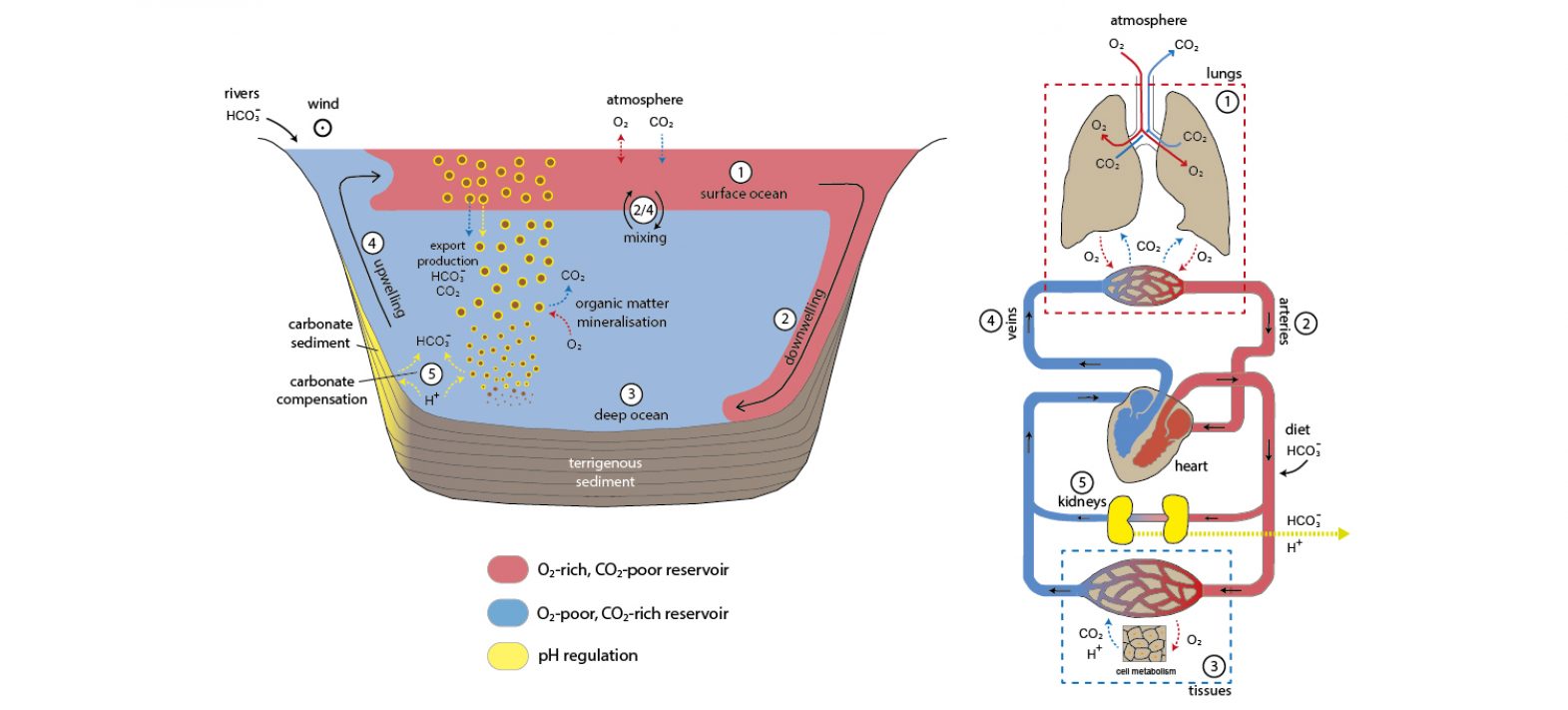
The carbon cycle in the ocean is in many ways analogous to the carbon cycle in the human body (see detailed legend at bottom of page).
Publication date: 15/11/2023
Research
Related teams :
Stable Isotope Geochemistry
Related themes : Earth System Science
Ocean acidification and deoxygenation are important consequences of anthropogenic CO2 emissions. The complexity of the physical and chemical processes behind these phenomena, however, makes them difficult for the general public to understand. Following the same conceptual framework used since antiquity by premodern thinkers such as Hippocrates, Leonardo da Vinci and Paracelsus, a new study shows that it is still relevant to use the ancient metaphor of the microcosm (the human body) and the macrocosm (the Earth, the Universe) to explain oceanic CO2 and O2 cycles.
In this study, published on October 30 in the journal The Anthropocene Review, Giovanni Aloisi, a CNRS researcher and geochemist at IPGP, shows that one single system of mathematical equations can be used to calculate the chemical composition of the human body and the ocean, linking these two apparently very different systems by a very strong analogy.
Communication with the general public and decision-makers is a major challenge in raising awareness of the climate crisis. G. Aloisi thus proposes a new conceptual tool for popularizers, based on a series of analogies (ocean currents and blood vessels, ocean absorption and lungs… ) which present the ocean as the Earth’s circulatory system and shows how ocean acidification and deoxygenation can be seen as the consequence of a planetary-scale asthma attack acting.
> Figure legend:
The carbon cycle in the ocean is in many ways analogous to the carbon cycle in the human body: both systems exchange CO2 between a relatively CO2-poor reservoir (1: lungs; surface ocean) and a relatively CO2-rich reservoir (3: body tissues; deep ocean); this exchange involves the transfer of a CO2-rich fluid (4: veins, upwelling currents), as well as a CO2-poor fluid (5: arteries, downwelling currents); in both systems, acidity is produced by metabolic processes in one of the reservoirs (3: tissue metabolism in the human body; mineralization of organic matter in the deep ocean); both systems have a means of stabilizing acidity by adding HCO3– and removing H+ (5: kidneys in the human body; carbonate compensation in the ocean).
> References :
Aloisi, G. (2023). What the future ocean has in common with an asthma attack. The Anthropocene Review.
DOI: 10.1177/20530196231204340