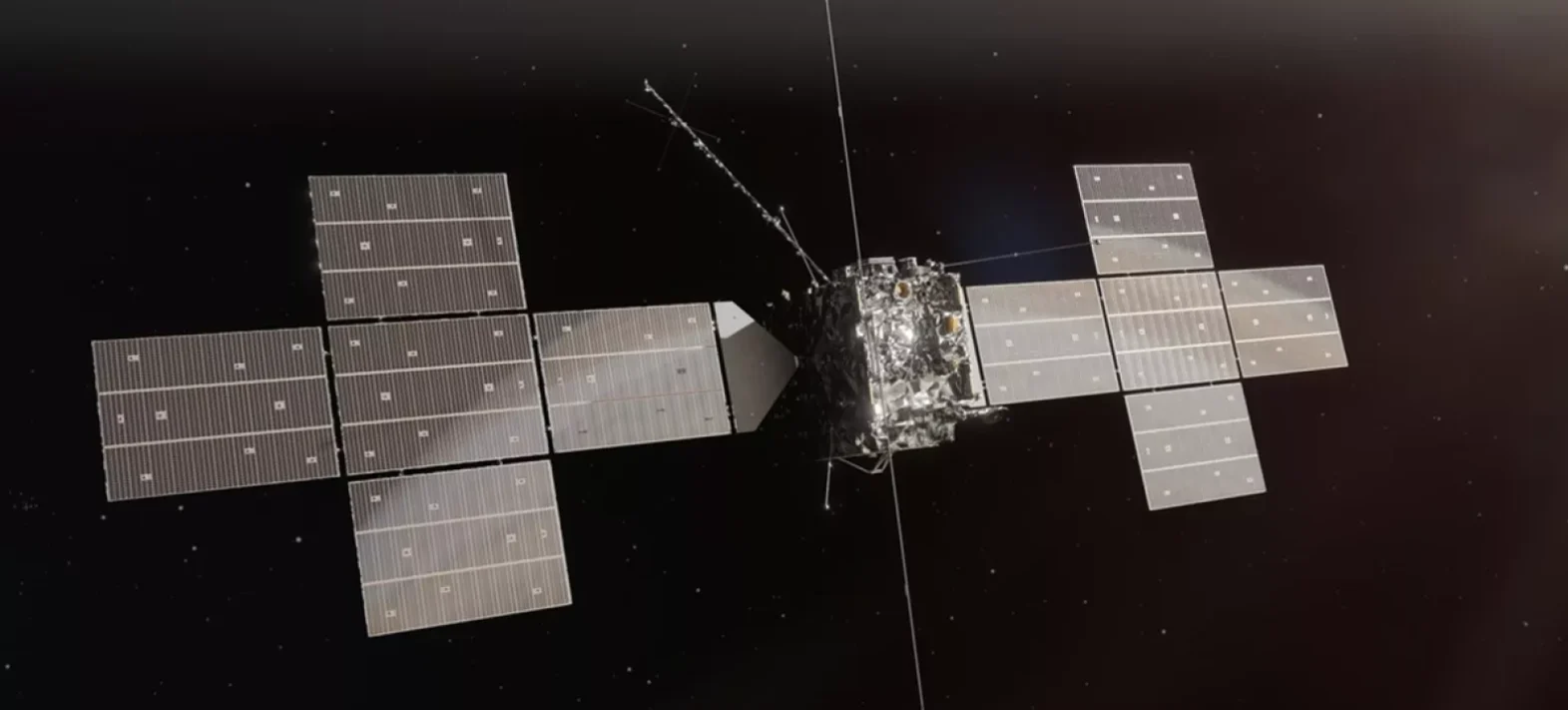
The MAJIS visible and infrared spectro-imager, for which the IAS (France) is responsible for scientific and technical oversight as Principal Investigator (PI), with the IAPS (Italy) as co-PI, is one of JUICE’s key instruments. It will enable the mission to achieve a wide range of scientific objectives: characterisation of surface composition, study of geological and cryovolcanic activity, and analysis of the exosphere of the moons Europa, Ganymede and Callisto. MAJIS will also contribute to the study of Jupiter’s atmosphere, the surface of Io, as well as the minor moons and Jupiter’s rings.
Launched in April 2023, the JUICE probe is scheduled to enter orbit around Jupiter in July 2031. A mission of this scale requires particularly rigorous preparatory work. Before being installed on the probe, the instruments underwent ground-based calibration campaigns designed to replicate, under controlled conditions, the environments encountered in flight.
Testing and validating the instrument prior to scientific observations
In this context, the IPGP, with Sébastien Rodriguez in particular acting as co-investigator, contributed to the design of a simulation code for the test bench, the definition of the testing strategy (environmental parameters, conditions and measurement sequences) and the analysis of the data. In particular, the institute was responsible for characterising and validating the spectral performance of MAJIS.
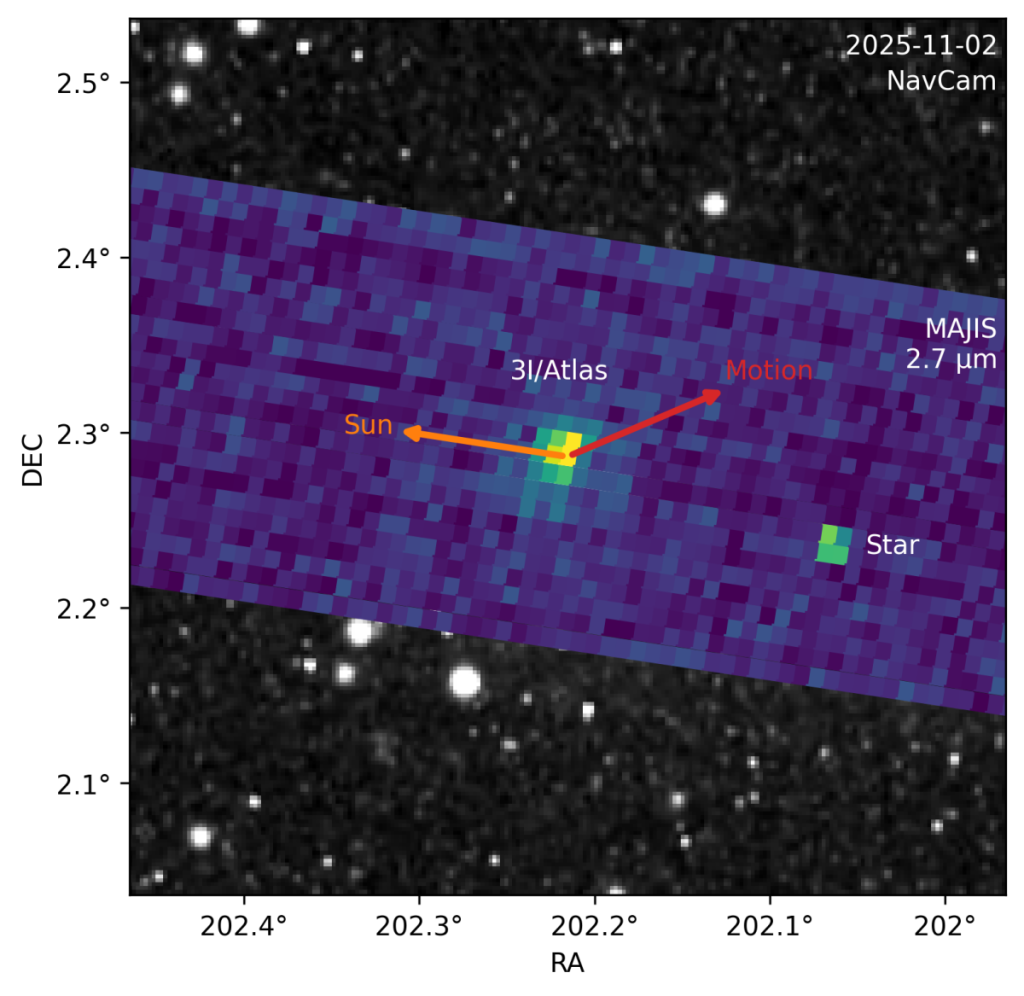
These analyses, which began as soon as the calibration campaigns were completed, are continuing today during the mission’s cruise phase. Several milestones provide opportunities to test the instrument under conditions similar to those of future scientific observations: flybys of the Moon and Earth in August 2024, flybys of Earth scheduled for September 2026 and January 2029, as well as opportunistic observations such as that of the interstellar comet 3I/ATLAS.
These various campaigns serve both to verify that the instrument complies with the requirements defined during its design phase and to better assess its performance in a real space environment.
Finally, as a member of the MAJIS scientific team, the IPGP is also preparing for the analysis of future observations.
The aim is to gain a better understanding of the composition and surface structure of Jupiter’s icy moons, as well as the geological processes that shape them, which may be linked to the presence of subsurface oceans of liquid water. To this end, the institute is involved in planning observation sequences and developing analysis tools, in collaboration with the IAS PI team and the mission’s ground segment at ESA (ESAC, Madrid).