Afin d'être accessible au plus grand nombre, nous vous informons que vous avez la possibilité de modifier la taille d’affichage du contenu de notre site.
Pour cela, voici les commandes à reproduire à l'aide de votre clavier :
Zoom in
CTRL +
+
Zoom out
CTRL +
-
Reset to zero
CTRL +
0
Optical Cathodoluminescence
Publication date: 04/03/2026
Research
The cathodoluminescence system of the PARI platform reveals in minutes the internal structures of minerals that are invisible under conventional optical microscopy, enabling precise targeting of zones for geochemical analysis.
Cathodoluminescence (CL) is an imaging technique that exploits the emission of light by certain materials when subjected to an electron beam. The colour and intensity of this emission are governed by the concentration of trace activator elements and by crystalline defects within the material, making CL a qualitative to semi-quantitative chemical mapping tool, complementary to direct chemical analyses.
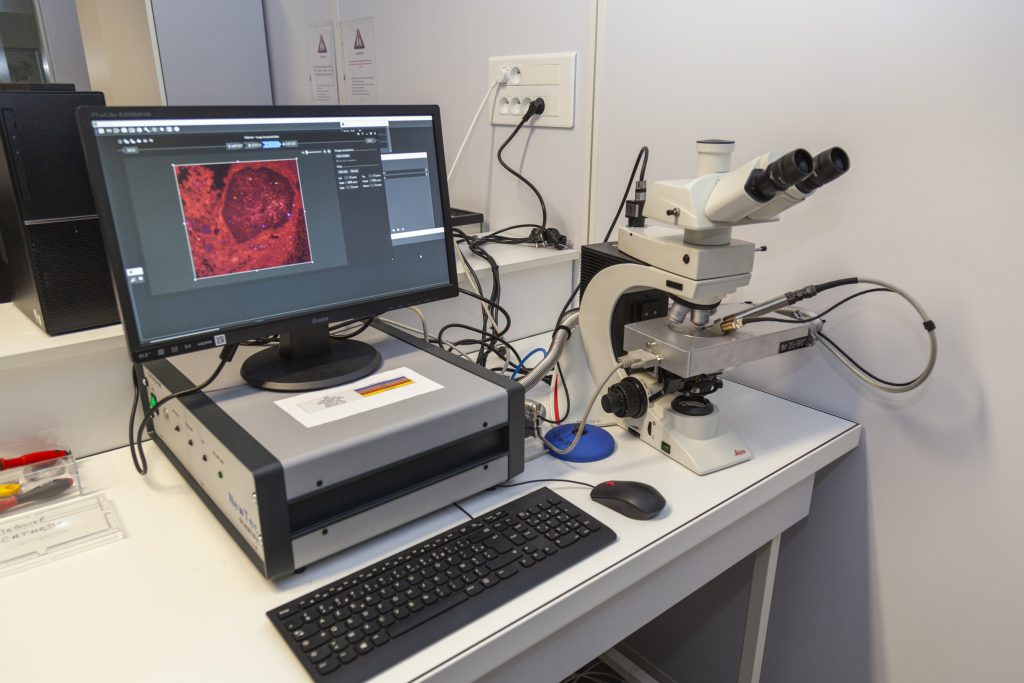
The Cathodyne system (Newtec Scientific), coupled to a Leica optical microscope, enables the observation and mapping of the natural luminescence of minerals under electron excitation, from the centimetre down to the micrometre scale. The technique reveals chemical, structural and textural heterogeneities – growth zoning, oscillations, recrystallisation, grain organisation – that are invisible under conventional optical microscopy.
Main analytical capabilities
High spatial resolution CL imaging of textures and internal structures
Optical and luminescence mapping of polished sections or thin sections
Detection of growth zoning, oscillations and grain morphology
Qualitative identification of mineral phases: quartz, feldspars, carbonates, zircon, apatite, fluorite…
Targeting of zones of interest for downstream geochemical analyses (ICP-MS, electron microprobe, SEM)
Mineral separates and polished sections: quartz, feldspars, calcite, zircon, apatite, fluorite, volcanic glass
Biological and environmental materials: speleothems, shells, biominerals
Why use the PARI platform CL system?
Cathodoluminescence is the instrument of choice for visualising and interpreting internal structures that are inaccessible by other optical imaging techniques. It is routinely used as a preliminary reconnaissance step: by rapidly identifying zoning patterns, mineral phases and heterogeneities within a sample, it enables precise selection of target areas for higher-resolution analyses – scanning electron microscopy (SEM), electron microprobe, or geochemical analyses on the PARI platform (ICP-MS, LA-ICP-MS).
CL thus constitutes an essential complementary tool for investigating textures, crystallisation processes and the diagenetic or magmatic history of geological materials.
Caption : Optical Cathodoluminescence — Cathodyne System / Leica Microscope.
Planetary Research: a new open-access journal for planetary sciences
Led by an international community of researchers, with strong involvement from IPGP scientists, the new journal Planetary Research offers an alternati...
What if the next stars of recycling were… bacteria?
A new comic book from IPGP takes us behind the scenes of metal bio-recovery. Featuring bacteria, precious metals and a generous dose of humour, it rev...
Mapping regolith migration on Phobos to support the MMX sample-return mission
Researchers from the Institut de Physique du Globe de Paris (IPGP), in collaboration with the Centro de Astrobiología (Spain) have published a new stu...
Lorraine Delaroque and Ines Ouar, two IPGP PhD students, receive awards at international conferences
Two doctoral students from the Planetology and Space Sciences team were recently recognized for their research at two international conferences.