
Citizen / General public
Researcher
Student / Future student
Company
Public partner
Journalist
Teacher / Pupil

Tracking organics in (bio)carbonates – A step forward in the search for biosignatures
Tracking organics in (bio)carbonates – A step forward in the search for biosignatures

Publication date: 15/10/2025

Research

Related themes : Origins

An innovative analytical method conducted by researchers from IPGP, in collaboration with Laboratoire Interuniversitaire des Systèmes Atmosphériques (LISA, UMR 7583, Université Paris Cité / Université Paris-Est Créteil) and the Institut des Sciences de la Terre de Paris (ISTeP , UMR 7193, Sorbonne Université) has been applied recently to (bio)carbonates with the aim to detect and characterize organic compounds preserved within carbonate minerals — a crucial step toward identifying biosignatures of past or present life.

Carbonates, whether abiotic or influenced by biological processes or the presence of organics (a process known as organomineralization), can trap organic molecules during their formation. These minerals thus represent potential records of biological activity. However, distinguishing between biogenic and abiotic origins remains challenging, particularly when using instruments designed for space missions.

In this study, the team developed a modified Rock-Eval thermal analysis protocol, inspired by the instruments on planetary missions such as NASA’s Mars Science Laboratory (SAM) and ESA’s ExoMars (MOMA). By combining sequential air and nitrogen heating cycles, this approach distinguishes between organic compounds on mineral surfaces and those trapped within the crystal lattice.

Analyses of more than sixty natural and synthetic carbonate samples revealed distinct CO, CO₂, and SO₂ gas profiles, characteristic of different formation mechanisms. This new method enables the rapid identification of potential biosignatures under analytical conditions similar to those of in situ planetary instruments, contributing to future astrobiological explorations on Mars, Enceladus, and Europa.

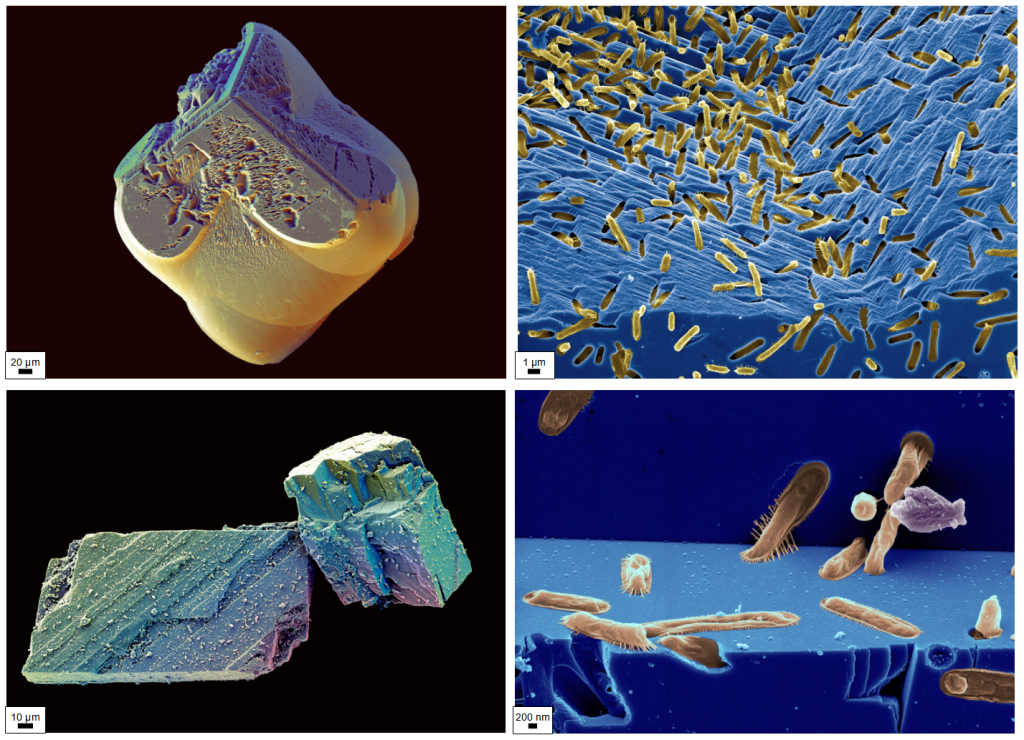
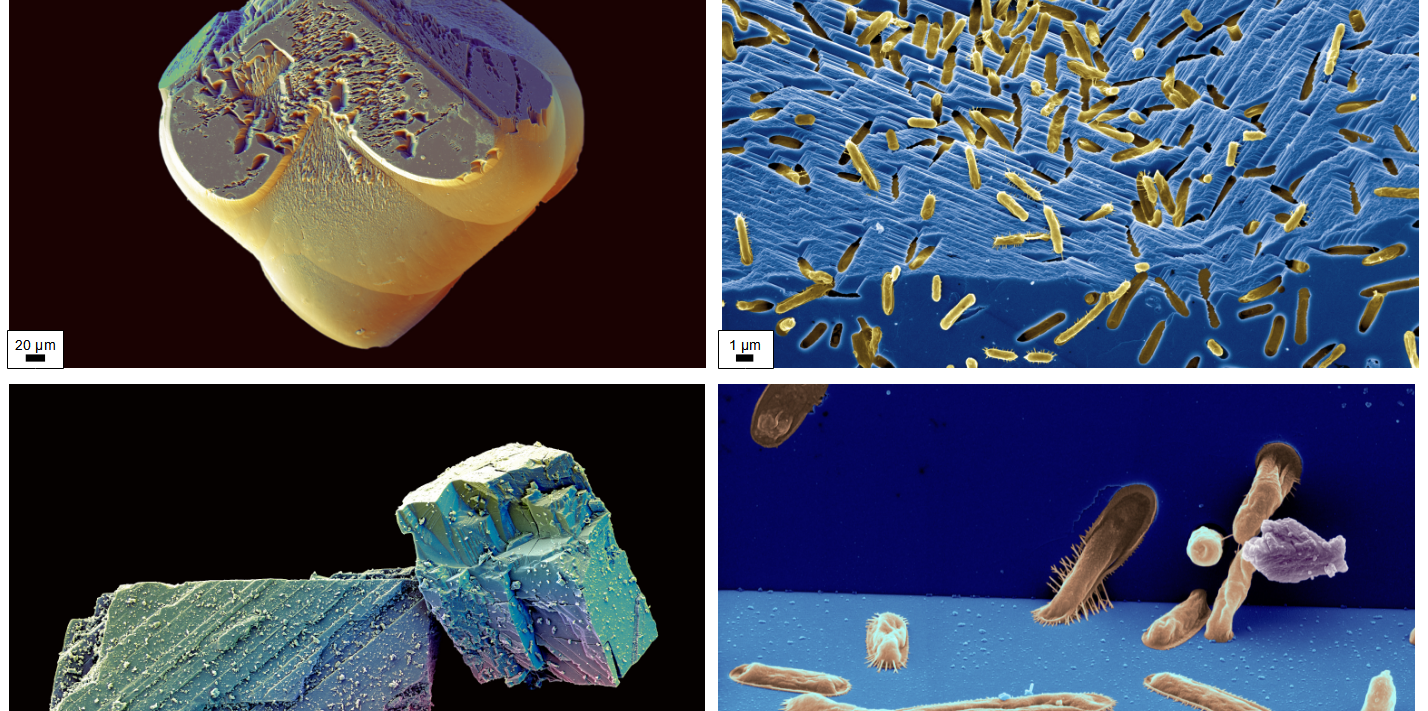
False-colored scanning electron microscopy images showing, at the top left, an organo-carbonate formed in the presence of abiotic amino acids; at the bottom left, an abiotic carbonate formed without any biological influence and in the absence of organic compounds; and on the right, two views of a biologically induced carbonate (in blue) formed through the activity of bacterial cells (in yellow and orange), which became trapped within the growing crystals.

These carbonates display different degrees of crystallinity, with more structural defects and organic residues in the biologically influenced samples, affecting both the gases released during pyrolysis and the temperature of their thermal decomposition. Crédits: A. Perron, S. Borensztajn

Reference article : Perron, A., Ménez, B., Baudin, F. & Stalport, F. A modified Rock-Eval approach to track organics in (bio)carbonates. Chemical Geology 690, 122815 (2025) – doi : 10.1016/j.chemgeo.2025.122815

Latest news
MAJIS on board JUICE: a key instrument for exploring Jupiter’s icy moons
As part of the team involved in the development and validation of the MAJIS instrument, the Paris Institute of Earth Physics is contributing to the sc...
Frédéric Moynier elected member of the Academia Europaea
Frédéric Moynier, professor at the Institut de physique du globe de Paris (IPGP) and Université Paris Cité, and Deputy Director for Research at IPGP, ...
Can we listen to Titan’s heartbeat?  Icequakes as a window into a hidden ocean.
Can we listen to Titan’s heartbeat? Icequakes as a window into a hidden ocean.
What lies beneath the surface of Titan, Saturn’s largest moon? This question is central to the upcoming Dragonfly mission, which will deploy a drone e...
Lithium isotopes unveil the hidden chemistry of Guadeloupe's volcanic waters
IPGP researchers present the first systematic lithium isotope survey of Guadeloupe's surface waters, revealing that a single small island can host a r...