
Citizen / General public
Researcher
Student / Future student
Company
Public partner
Journalist
Teacher / Pupil

Two IPGP PhD Students Join a NSF Oceanographic Expedition on a equatorial Transform Fault!

Publication date: 10/11/2025

Research

Related teams :
Marine Geosciences

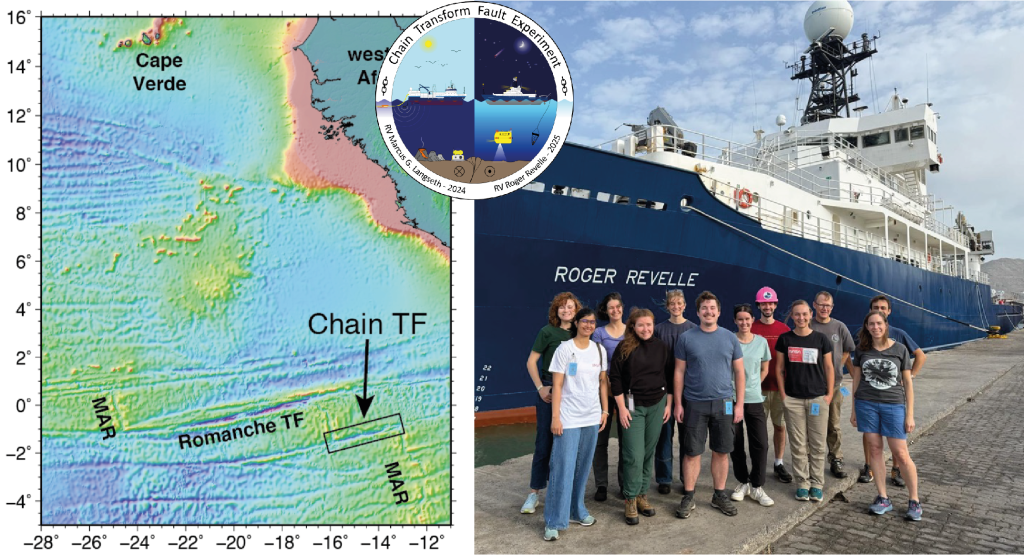
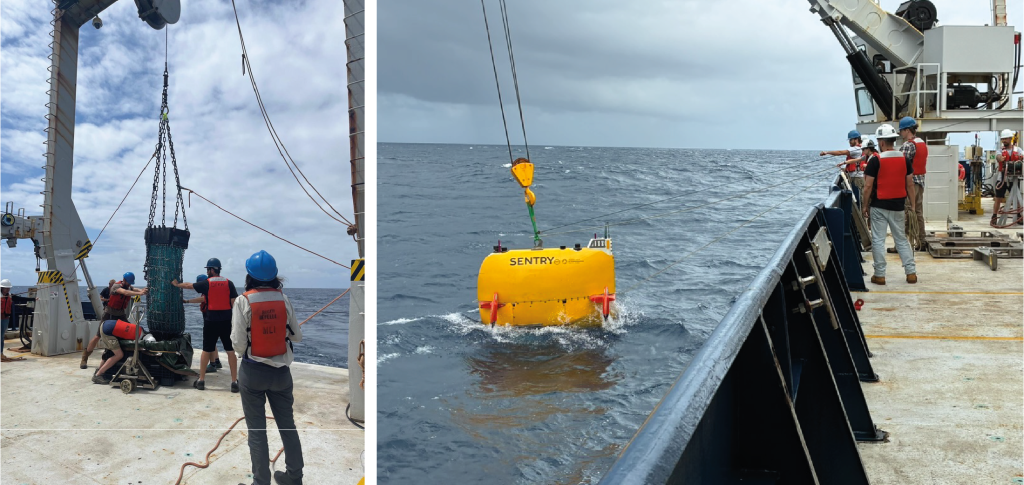
The oceanographic cruise is the third and final cruise of “Chain Transform Fault Experiment”, onboard R/V Roger Revelle, spanning from 10th October to 13th November, 2025. The main scientific goal of the expedition, led by Jessica Warren (University of Delaware), is to understand the dynamic behavior of a slow-slipping oceanic transform system from the study of the Chain Atlantic fault zone. Its composition, rheology, seismicity, structure, and magmatism will be characterized through acquisition of active and passive seismic data, high-resolution geophysical surveys using autonomous underwater vehicle (AUV) Sentry and dredging of rocks targeting active fault zone.

Location of Chain Transform Fault; Right: The science party in front of R/V Roger Revelle in Sao Vincente harbor of Cabo Verde

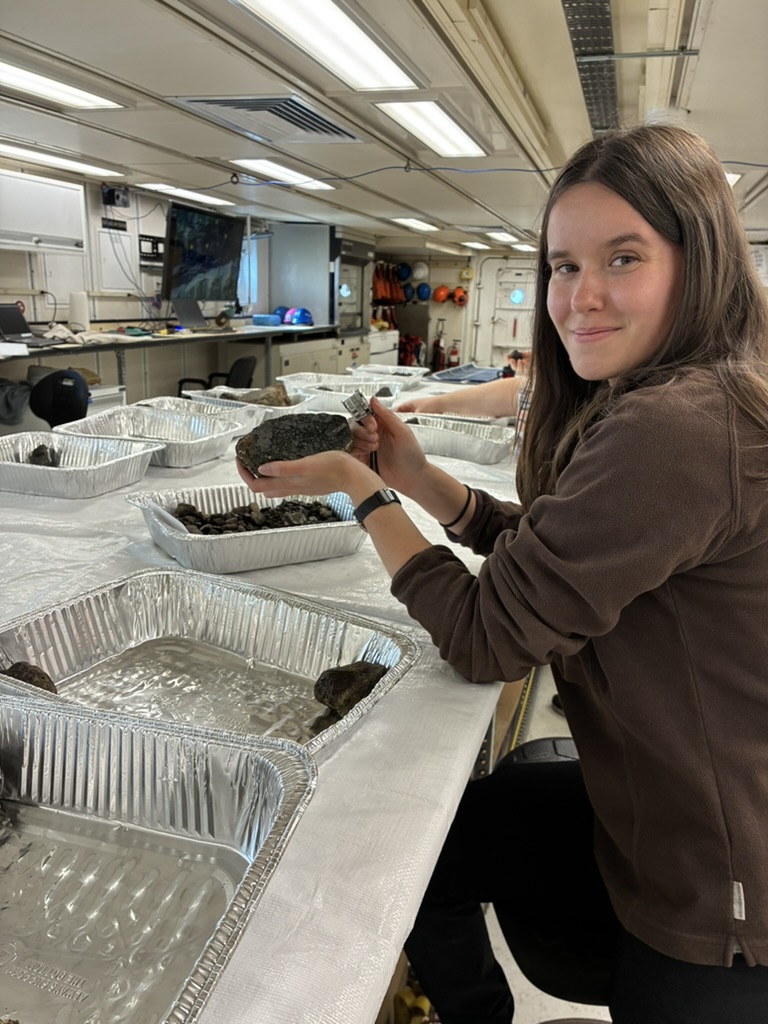
For Suzanne, this expedition represents a unique opportunity to complement her PhD research on fluid–rock interactions and the deep carbon cycle along transform faults. She will gain valuable field experience, develop new analytical skills, and collaborate with international experts. The collection and analysis of samples will provide new insights into fluid circulation in these environments and its impact on carbon dynamics, directly contributing to her research on the origin of organic matter in these still little-studied systems.


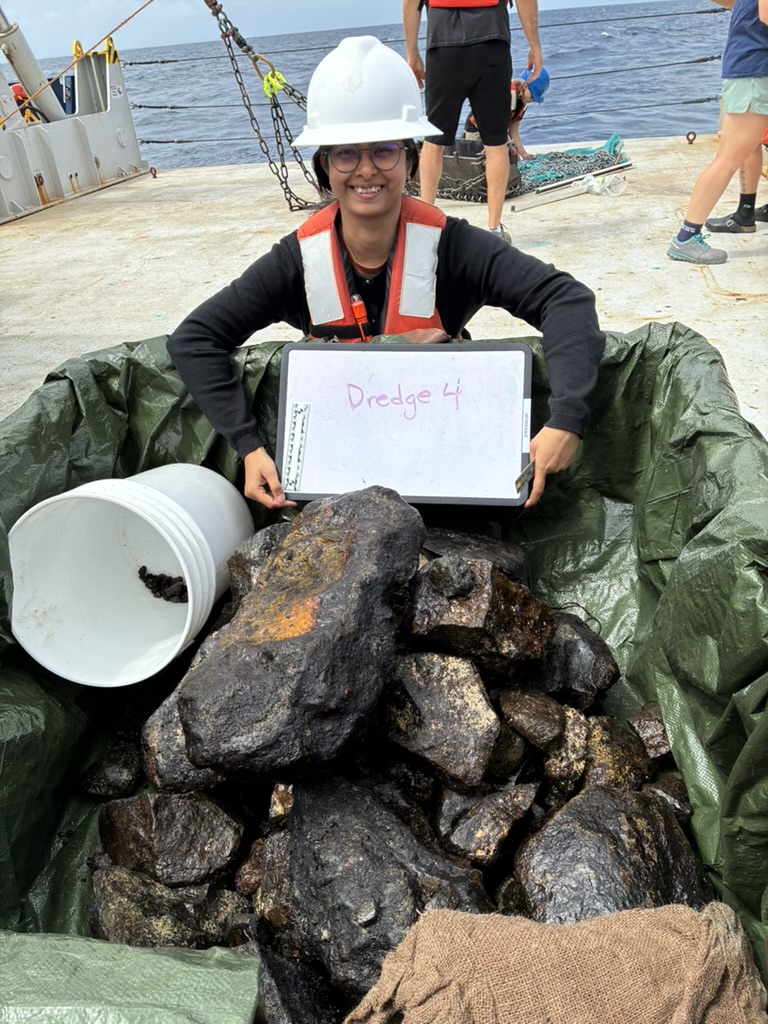
For Sampriti, this experiment will be an enriching experience, complementing her PhD thesis on the composition, hydration and deformation of magmatic rocks at oceanic transform faults. She will learn novel data collection methods in marine expeditions expand her technical expertise in marine research and foster international collaboration. Analysis of the active fault zone rocks recovered from the dredges will help to understand along-strike variations in lithologies and deformation and study the role of seawater and melt on oceanic transform fault

                                      Dredge coming from ocean’s bottom; Right: Sentry on its way to explore the ocean depth

                Their expedition expenses are covered by NSF and International mobility support of IPGP PhD students. 

                More info : https://ui.adsabs.harvard.edu/abs/2024nsf….2318855B/abstract

Latest news
MAJIS on board JUICE: a key instrument for exploring Jupiter’s icy moons
As part of the team involved in the development and validation of the MAJIS instrument, the Paris Institute of Earth Physics is contributing to the sc...
Frédéric Moynier elected member of the Academia Europaea
Frédéric Moynier, professor at the Institut de physique du globe de Paris (IPGP) and Université Paris Cité, and Deputy Director for Research at IPGP, ...
Can we listen to Titan’s heartbeat?  Icequakes as a window into a hidden ocean.
Can we listen to Titan’s heartbeat? Icequakes as a window into a hidden ocean.
What lies beneath the surface of Titan, Saturn’s largest moon? This question is central to the upcoming Dragonfly mission, which will deploy a drone e...
Lithium isotopes unveil the hidden chemistry of Guadeloupe's volcanic waters
IPGP researchers present the first systematic lithium isotope survey of Guadeloupe's surface waters, revealing that a single small island can host a r...