Citizen / General public
Researcher
Student / Future student
Company
Public partner
Journalist
Teacher / Pupil

Are the hidden currents of Ganymede’s ocean finally detectable?

A study conducted by researchers from the Institut de physique du globe de Paris (IPGP) and CNRS shows that the convection motions driving the hidden ocean beneath Ganymede’s icy surface could generate weak magnetic signals detectable from space. These signatures could be measured by the European mission Juice, currently en route to Jupiter, opening a new way to explore this inaccessible ocean and better understand its dynamics as well as its potential habitability. Ganymede, the largest moon of Jupiter and of the Solar System, hides beneath a thick ice layer a vast ocean of salty water. For several decades, scientists have suspected its existence, but studying it re-mains difficult since it is completely inaccessible to direct observations.

Are the hidden currents of Ganymede’s ocean finally detectable?

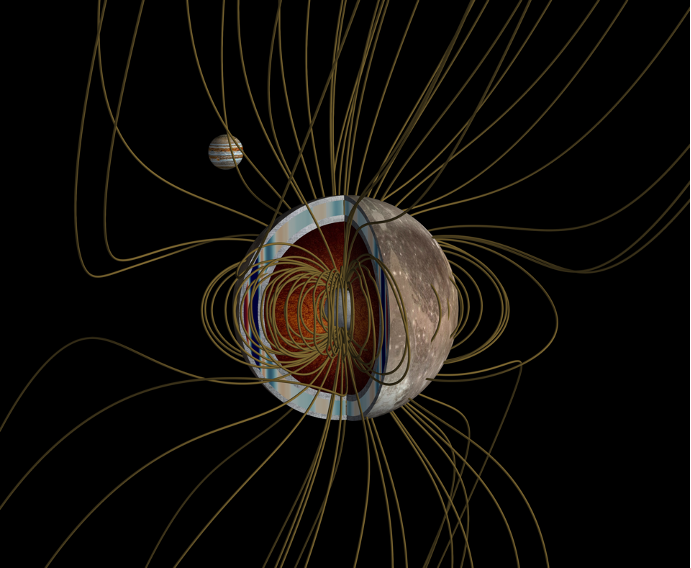
Ganymede’s magnetosphere (yellow lines) results from a magnetic balance between its internal dy-namo, generated by its metallic core, Jupiter’s magnetic field, and interactions induced by its subsur-face ocean.

Publication date: 15/06/2026

Research

In a study published in Geophysical Research Letters, researchers from IPGP and CNRS show that it may be possible to learn more about this ocean thanks to the weak magnetic perturbations it produces. Their work suggests that the motions stirring Ganymede’s deep waters leave a detectable signature from space.

When the ocean leaves a magnetic imprint

Ganymede’s ocean would be driven by convection movements linked to heat transfer within its interior. These currents move water that is likely rich in dissolved salts, making it electrically conductive.

As it moves within Ganymede’s magnetic field, this conductive fluid can generate electric currents which in turn produce a weak magnetic field. To evaluate this phenomenon, the researchers combined ocean circulation simulations with magnetic models adapted to the specific conditions of this Jovian moon.

Their results show that the signal produced remains very weak, but could nevertheless reach a level detectable by current instruments. The intensity of the signal depends in particular on the depth of the ocean, its salinity, and the speed of the currents flowing through it.

Beyond the simple detection of the ocean, these magnetic signatures could also provide information about its internal structure and how it transports heat.

A target for the Juice mission

These results come as the European mission Juice (Jupiter Icy Moons Explorer), launched in 2023, continues its journey toward Jupiter. Once there, the probe will carry out several flybys of Ganymede before entering orbit around the moon.

Among the onboard instruments is a particularly sensitive magnetometer. According to the study’s authors, it could be capable of detecting the weak signals produced by the oceanic currents simulated in their models.

If this signature is indeed observed, it would provide a novel way to study an ocean buried beneath hundreds of kilometers of ice. More broadly, this method could be applied to explore other ocean worlds in the Solar System, such as Europa or certain moons of Saturn, which are among the most promising environments in the search for conditions favorable to life.

Ganymede’s magnetosphere (yellow lines) results from a magnetic balance between its internal dynamo, generated by its metallic core, Jupiter’s magnetic field, and interactions induced by its subsurface ocean.

 

Latest news
Discovery of CO₂ hydrates off the coast of Mayotte: a unique site for studying carbon storage in the ocean
More than 120 CO₂ hydrate deposits were discovered at the Fer à Cheval site, 10 km east of Petite Terre (Mayotte), during the Geoflamme campaign co-le...
Publication of the IPGP 2025 Annual Report
The IPGP Annual Report, published in both French and English, aims to share with the widest possible audience our enthusiasm for the research carried ...
SOUFRIÈRE_50: a week to revisit fifty years of scientific progress and meet the challenges of 21st-century volcanology
Press Release - Fifty years after the 1976–1977 eruption of La Soufrière de Guadeloupe—an event that left a profound mark on Guadeloupe, as well as on...
QVCT Week is back at the IPGP from 15 to 19 June 2026!
For the second year running, Quality of Life and Working Conditions Week (QVCT) is back at the IPGP. It’s an opportunity to strengthen bonds between c...