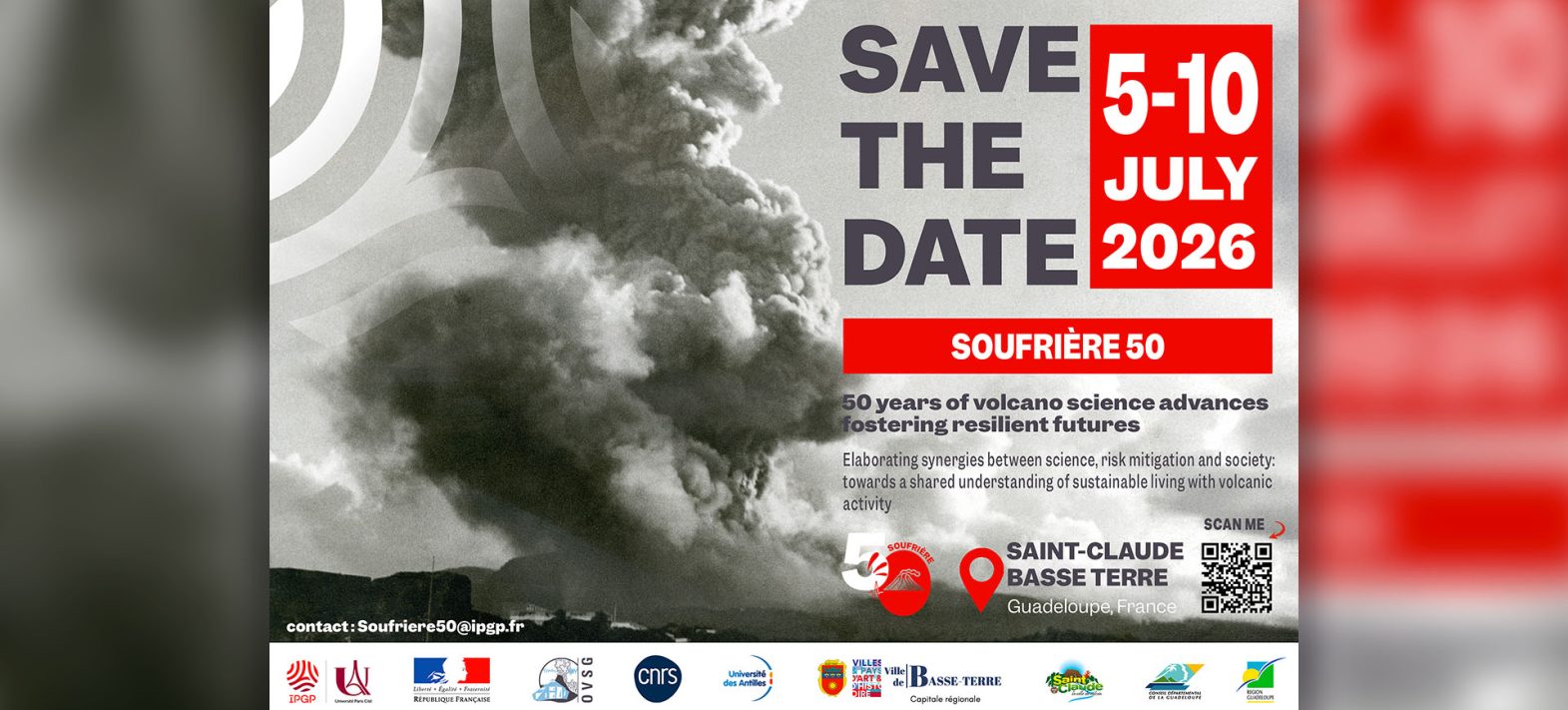
Held in Saint-Claude on the campus of the Université des Antilles, this exceptional event will bring together researchers, natural hazard specialists, civil protection officials, local and regional authorities, government services, institutions, territorial partners, and experts from around the world. Over the course of a week, participants will take stock of fifty years of scientific progress and reflect on the challenges ahead in volcano monitoring, crisis management, and territorial resilience.
The La Soufrière crisis remains one of the defining episodes in the recent history of volcanology. The scientific debates it sparked, the decisions taken amid uncertainty, the evacuation of tens of thousands of residents, and the lessons drawn from the event continue to inform international thinking on volcanic processes and risk management.
Through SOUFRIÈRE_50, Guadeloupe will become, for one week, a major forum for dialogue between science, expertise, public decision-making, and society.
An international scientific event looking toward the future
Beyond commemoration, SOUFRIÈRE_50 aims to place half a century of scientific and operational progress in volcanology into perspective.
The scientific program will be structured around four main themes:
- advances in understanding phreatic eruptions;
- volcanic activity in the Caribbean and in comparable volcanic environments;
- risk and uncertainty management;
- living in proximity to active volcanoes.
Keynote lectures, scientific sessions, roundtables, lessons learned, and field excursions will address some of the most pressing issues in contemporary volcanology: volcano monitoring, the interpretation of precursor signals, decision-making in times of crisis, and risk adaptation for populations living near active volcanoes.
A mobilization extending beyond the scientific community
Because volcanic hazards directly concern territories and the people who inhabit them, SOUFRIÈRE_50 has been designed as a unifying event, bringing together scientific communities, public authorities, and local stakeholders.
Throughout the week, discussions will foster dialogue among researchers, observatories, government services, local authorities, crisis managers, and representatives of the social and economic sectors. Together, they will examine issues related to prevention, preparedness, crisis response, and resilience in the face of natural hazards.
This multidisciplinary and partnership-based approach is one of the defining features of the event.
A week of events across Guadeloupe
In addition to the scientific sessions, several highlights will mark this anniversary week.
Institutional meetings, public lectures, science outreach activities, field visits, and events organized with the conference partners will extend the reach of this anniversary well beyond the academic sphere.
The Prefecture, local and regional authorities, municipalities, institutional actors, government services, cultural organizations, and scientific partners will all contribute to making this week a moment of dialogue and shared reflection on the history of La Soufrière, the advances of volcanology, and today’s challenges in natural hazard management.
As part of this program, the Institut de physique du globe de Paris, the Guadeloupe Volcanological and Seismological Observatory, and DEAL Guadeloupe will host a major public outreach day on Wednesday, July 8, 2026, at Fort Delgrès in Basse-Terre. Organized exactly fifty years to the day after the eruption of July 8, 1976, this exceptional event will bring together numerous scientific, institutional, and nonprofit partners for a rich program of discovery and exchange: interactive workshops, educational activities, film screenings, debates, meetings with key witnesses, and talks by leading figures.
This program will serve as a reminder that La Soufrière remains not only a major scientific object of study, but also a central element in the history, memory, and identity of Guadeloupe.
Press kit
A full press kit will soon be made available to the media.
It will include, in particular:
- the scientific program of the conference;
- the events organized alongside the conference;
- the institutional and territorial partners involved in this anniversary.
Journalists wishing to cover the event are encouraged to contact the IPGP teams now in order to prepare their visit and reporting.