

Airglow Observations and Associated Rayleigh Wave Modeling
Start: 01 October 2022
End: 12 January 2026
Supervisors :
Philippe Lognonné
Related teams :
Planetology and Space Sciences
Related themes :
Earth and Planetary Interiors, Natural Hazards
Status: Defended
Earth and its atmosphere form closely coupled systems. Earthquakes produce surface waves and/or tsunamis that propagate over long distances and generate forced atmospheric waves whose amplitude increases with altitude, leading to measurable perturbations in the ionosphere (80-300 km altitude). Airglow, the light emitted by the upper atmosphere at night, is as a tracer of high-altitude dynamics.
Following the first detection of a tsunami signature in O+ airglow emission (red airglow at 250 km) in 2011, several studies have proposed airglow as a means to directly image the propagation of Rayleigh waves at tele-seismic distances, both on Earth and on Venus. The OH emission in the shortwave infrared (SWIR) at 87 km is the brightest of the airglow emissions. Although located at a lower altitude, where atmospheric amplification is weaker, it remains the most favorable layer for this type of observation because its intensity allows the detection of short-period signals, such as seismic waves.
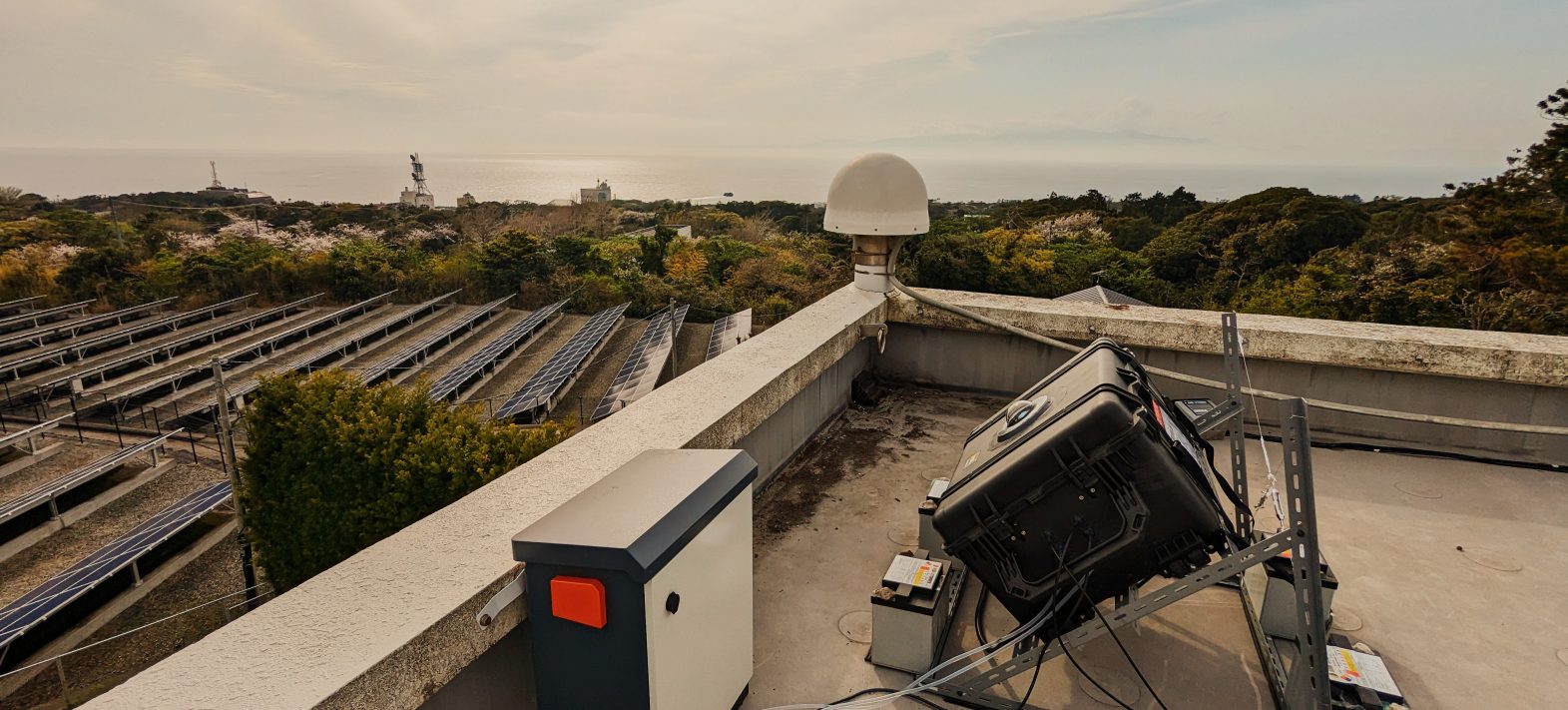
To conduct the first direct observation of seismic wave propagation using a SWIR camera, we characterized and
deployed two permanent observatories in La Réunion and Japan to observe OH airglow. The collected data made it possible to measure noise within the Rayleigh-wave frequency band and to characterize upper atmospheric dynamics at these two sites. The measured noise level, combined with modeling of a Rayleigh-wave signature in OH airglow and advanced filtering and analysis techniques, enables us to define a detection threshold corresponding to a moment magnitude of 8.0. These results therefore demonstrate the feasibility of detecting seismic waves through airglow imaging, a capability that the continuity of observations and the expansion of observatories in active seismic zones should make possible in the coming years.