

Super-resolution mapping and surface composition of Titan: preparing for future observations by the Dragonfly mission
Start: 01 December 2026
End: 30 November 2029
Supervisors :
Sébastien Rodriguez
Related teams :
Planetology and Space Sciences
Related themes :
Earth System Science, Origins
Status: In progress
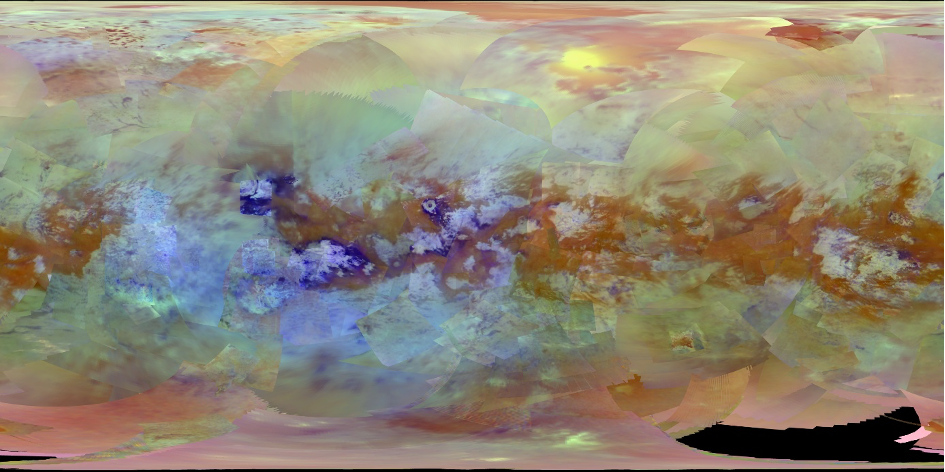
The objectives of this thesis are to produce super-resolved maps and estimate the surface composition of Titan—at both regional and global scales—using data from the Cassini mission and the James Webb Space Telescope (JWST), in preparation for the Dragonfly mission. Specifically, this work involves utilizing radiative transfer and super-resolution mapping algorithms—developed by our team in Fortran90, C, IDL, and Python—to create a global, super-resolved surface reflectance map of Titan. This map will be corrected for atmospheric contributions (absorption and scattering by gases and aerosols) and derived from the entire dataset of infrared hyperspectral images of Titan acquired by the Cassini VIMS instrument between 2004 and 2017—a task that entails processing and analyzing several hundred million spectra. This reflectance map can subsequently be used to identify candidate materials that may constitute the surface.When combined with high-spatial-resolution Cassini RADAR observations of features such as dunes, mountains, rivers, and seas, this knowledge of surface materials will help us better constrain the geological and climatic history that shaped these landscapes (e.g., through mechanical and/or chemical erosion driven by wind and/or methane rain). Furthermore, observations from the JWST’s NIRSPEC instrument—which covers the same wavelength range as VIMS but with significantly higher spectral resolution—will allow for the verification (and, if necessary, correction) of the atmospheric inputs used in the radiative transfer model, while also assisting in the identification of the materials present on Titan’s surface. This work will help in preparing for future observations of Titan’s lower atmosphere and surface by the cameras that will equip the Dragonfly drone—specifically, observations of its landing site (Selk crater) and the surrounding area.