Comprendre les premières heures de
Understanding the first hours of the eruption on 18 January 2026
Thanks to one of the densest networks of monitoring instruments in the world, the Piton de la Fournaise Volcanological Observatory (OVPF-IPGP) continuously monitors the activity of the volcano on Réunion Island.
Yesterday in the middle of the afternoon, these instruments identified, step by step, the precursor signals of a new eruption, from the first signs of magma movement to its arrival on the surface.
Start of the seismic crisis: the first signals recorded
On 18 January 2026 at 4:34 p.m. (local time), the OVPF-IPGP monitoring networks recorded the start of a seismic crisis, characterised by a rapid succession of low-magnitude earthquakes beneath the volcanic edifice.
This type of signal generally indicates that magma is beginning to move, fracturing the rocks as it leaves the magma reservoir. At the same time, deformation instruments show rapid deformation of the volcano, a sign of pressurisation of the magmatic system.
All of these observations indicate that an eruption is likely in the short term, within the next few minutes or hours. The alert level is then raised to Alert 1 by the Prefect of Réunion.
Appearance of volcanic tremor: magma is approaching the surface
From 7:42 p.m. (local time), seismological stations recorded volcanic tremors, a continuous signal associated with the circulation of magma and gases at shallow depths.
The appearance of these tremors marked a key stage: it indicated that the magma was now close to the surface. The OVPF-IPGP teams then stepped up visual and instrumental monitoring of the edifice.
Start of the eruption: opening of fissures in the Enclos Fouqué
The first visual observations of the eruption were recorded at 7:48 p.m. (3:48 p.m. GMT) by the OVPF-IPGP webcam located at Piton Partage.
Analysis of the data and images shows that one or more eruptive fissures have opened on the northern flank of the volcano, inside Enclos Fouqué. Lava reaches the surface: the eruption begins.
Given the location of the activity, confined to the Enclos, and the absence of any immediate threat to inhabited areas, the alert level was raised to Alert 2-1 by the Prefect of Réunion, corresponding to an eruption in the Enclos with no particular danger to people, property or the environment.
Rapidly evolving eruptive activity
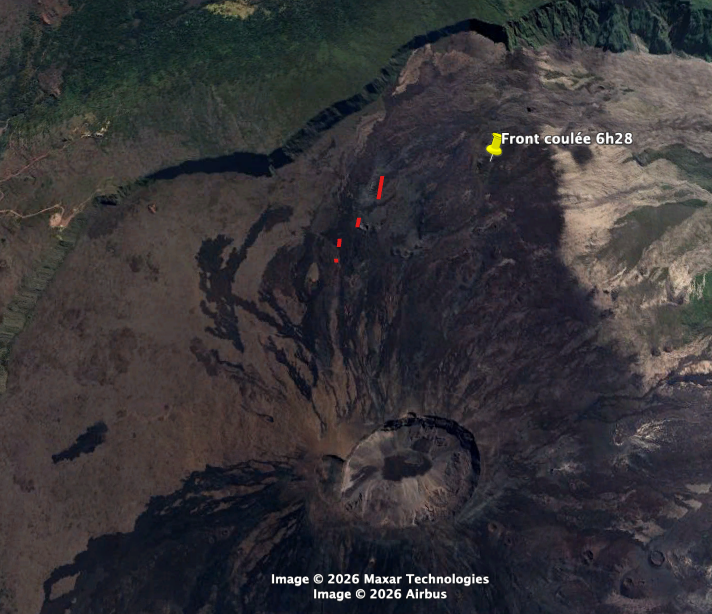
Between 7:45 p.m. and 8:54 p.m., the activity evolves rapidly with the successive opening of four eruptive fissures:
– an initial fissure,
– two additional fissures further downstream,
– a fissure further upstream.
These fissures remain localised in the Enclos Fouqué, on the northern flank of the terminal cone of Piton de la Fournaise. The most downstream fissure is located approximately 700 metres from the northern edge of the Enclos.
Continued sustained seismic activity indicates that the system remains active and that new fissures may open, particularly further downstream.
Observations from 19 January: status of eruptive activity
This morning, the eruption continues. Three fissures remain active, although one of them, backing onto Piton Jacob, is showing signs of weakening.
On the most active fissures:
– eruptive cones are being built up by the accumulation of projections,
– the lava fountains observed remain low, not exceeding 20 metres.
At 6:28 a.m. (local time), the flow front was located approximately 600 metres from the Grandes Pentes break. The flows, consisting mainly of lava fragments, are progressing slowly.
At noon, only the most downstream fissure was still active.
Instrumental data and lava flows
When the fissures opened, the amplitude of volcanic tremors increased sharply at the end of the day on 18 January, before gradually decreasing from 9 p.m. (local time). Seismic activity remains sustained, with an average of around ten earthquakes per hour, indicating that the magmatic system remains dynamic.
Lava flow estimates, established by satellite using the HOTVOLC platform (OPGC – Clermont Auvergne University), indicate values between 2 and 27 m³ per second over the last 24 hours.
Continuous scientific monitoring
The OVPF-IPGP teams are continuing to monitor the situation 24 hours a day, mobilising all observation networks (seismology, deformation, geochemistry, visual and satellite observations).
This eruption once again illustrates the central role of instrumental monitoring in understanding volcanic processes and informing the authorities and the public.
🔔 Alert level in force: Alert 2-1