
Citizen / General public
Researcher
Student / Future student
Company
Public partner
Journalist
Teacher / Pupil

A connected seabed observatory to study seismicity in Les Saintes

After more than a year of operation of the new seabed seismometer installed as close as possible to the faults responsible for the seismicity of Les Saintes, the teams of the Interreg PREST project and the IPGP observatories in the West Indies are deploying two new types of sensor, also linked by optical fiber, to complete this innovative underwater observatory.
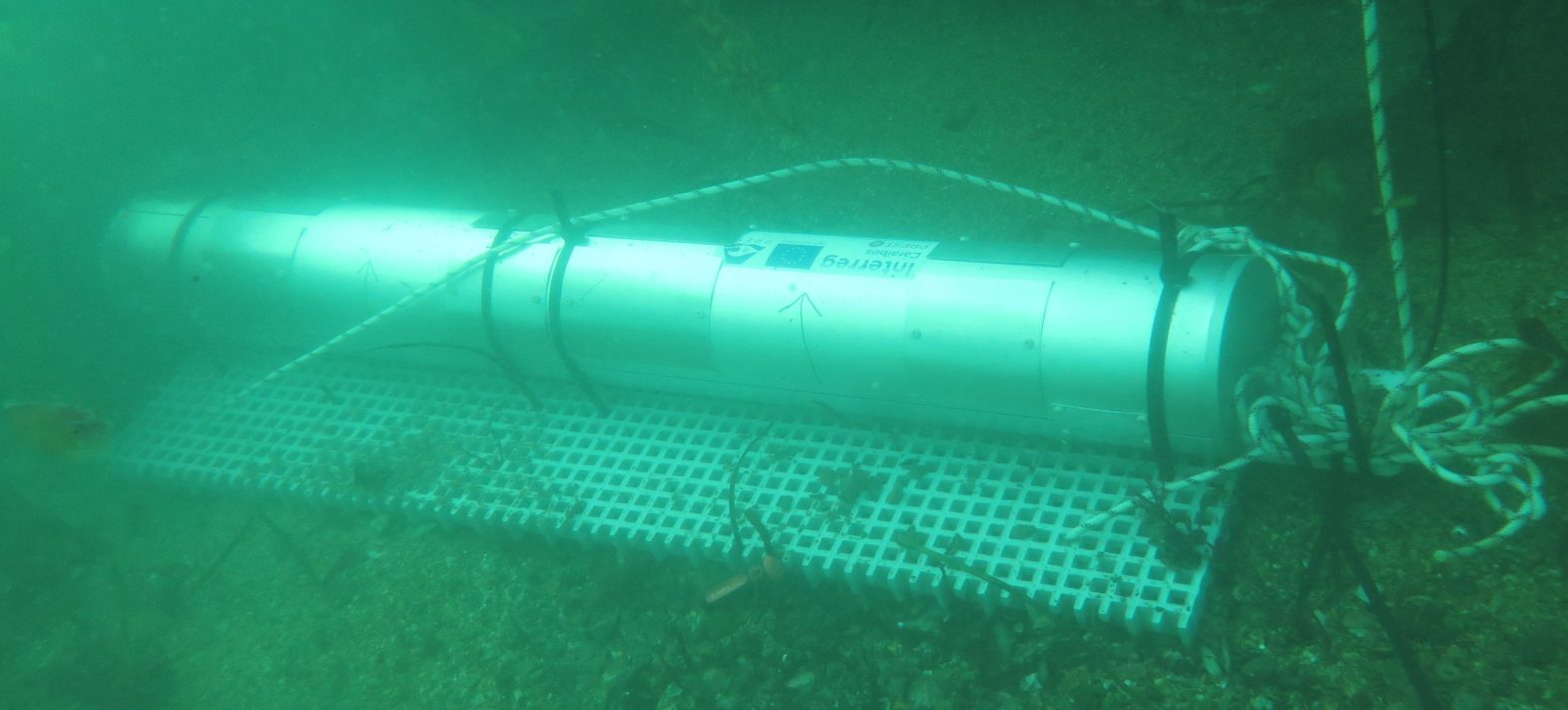
A connected seabed observatory to study seismicity in Les Saintes

Optical pressure meter measuring hydrostatic pressure

Publication date: 14/12/2022

Events, General public, Observatories, Press
The scientists are organising two public meetings, on 13 December in Les Abymes, Guadeloupe, and on 16 December in Fort-de-France, Martinique, to present this technological feat, which foreshadows the observations of tomorrow, and to discuss with the public current knowledge of seismicity in the Les Saintes region and, more broadly, throughout the Lesser Antilles.

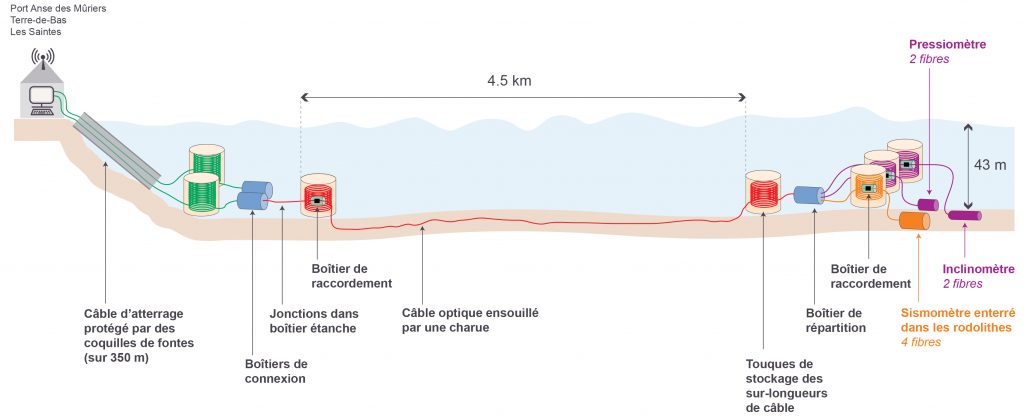
As part of the Interreg V Caribbean program, the PREST project led by the Observatoire volcanologique et sismologique de Martinique of the Institut de physique du globe de Paris (OVSM-IPGP) has taken up a daring challenge: to develop a series of three prototypes of innovative fiber-optic end-of-fiber sensors, and operate them under real-time operational monitoring conditions, in the experimental underwater observatory of Les Saintes (Guadeloupe), located 5 kilometers south of the island of Terre de Bas and 43 m deep.

After a year and a half of recording seismicity in the Les Saintes area, the seabed seismometer installed in June 2021 confirms the success of the fiber-tip optical sensors developed by IPGP and ESEO, as part of the PREST project, for real-time monitoring of seismic activity as close as possible to submerged faults.

To complete the instrumental set-up, from December 3 to 13, 2022, two new sensors developed by ENS – an optical inclinometer and a pressure meter that measure seabed deformation and hydrostatic pressure respectively – will be installed off the coast of Les Saintes for real-time monitoring of this seismic zone. This technological demonstrator opens up exciting prospects for underwater geophysical instrumentation worldwide.


Teams from the PREST project and IPGP’s volcanological and seismological observatories (OVSG and OVSM) are organizing two public events to present these innovative devices and their implications for monitoring regional telluric phenomena:

  • Tuesday December 13 at 6pm, in the amphitheater of the Espace Régional du Raizet, in Les Abymes, Guadeloupe
  • Friday December 16 at 6pm, at the CTM Assembly Hall, Fort-de-France, Martinique. This public meeting will also be an opportunity to look back on the 2 years since Montagne Pelée was placed under yellow volcanic alert.

For further information :

Latest news
Heading for Phobos: IPGP at the heart of Japan’s MMX mission
On 19 October 2026 at 9:41 p.m. Paris time, Japan’s MMX space mission will lift off towards Mars and its two moons, Phobos and Deimos, from the Tanega...
From Tokyo to Mount Fuji: a Franco-Japanese week at the crossroads of Earth sciences and music
From 9 to 17 November 2026, several scientific events in Japan will bring together IPGP researchers and their Japanese partners. The programme include...
Using neutrinos to probe the composition of Earth’s deep interior
What if neutrinos could offer a new way of looking inside our planet? An interdisciplinary team involving researchers from the IPGP is exploring the u...
Planetary Research: a new open-access journal for planetary sciences
Led by an international community of researchers, with strong involvement from IPGP scientists, the new journal Planetary Research offers an alternati...