
Citizen / General public
Researcher
Student / Future student
Company
Public partner
Journalist
Teacher / Pupil

Abyssal serpentinites, evidence of the geochemical variety of the Earth’s ocean floor

By comparing the geochemical record of different types of abyssal serpentinites, a French team has revealed major chemical disparities in the rocks that make up the ocean floor around the world.
Abyssal serpentinites, evidence of the geochemical variety of the Earth’s ocean floor

© Ifremer

Publication date: 30/10/2024

Research

Serpentinites are ubiquitous1 seafloor rocks, formed by hydration of mantle peridotites (transformation of the minerals olivine and pyroxene into serpentine by reaction with hydrothermal fluids). In recent decades, it has been recognised that their formation changes the rheology and composition of the lithosphere, playing a major role in the Earth’s geodynamic and geochemical cycles. However, until now, these studies have focused on regional contexts. A French team led by an IPGP researcher has now compiled existing geochemical data on serpentinites collected in different oceans around the world by drilling, dredging or using submersibles. These scientists have highlighted major chemical heterogeneities as a function of geodynamic and tectonic contexts.

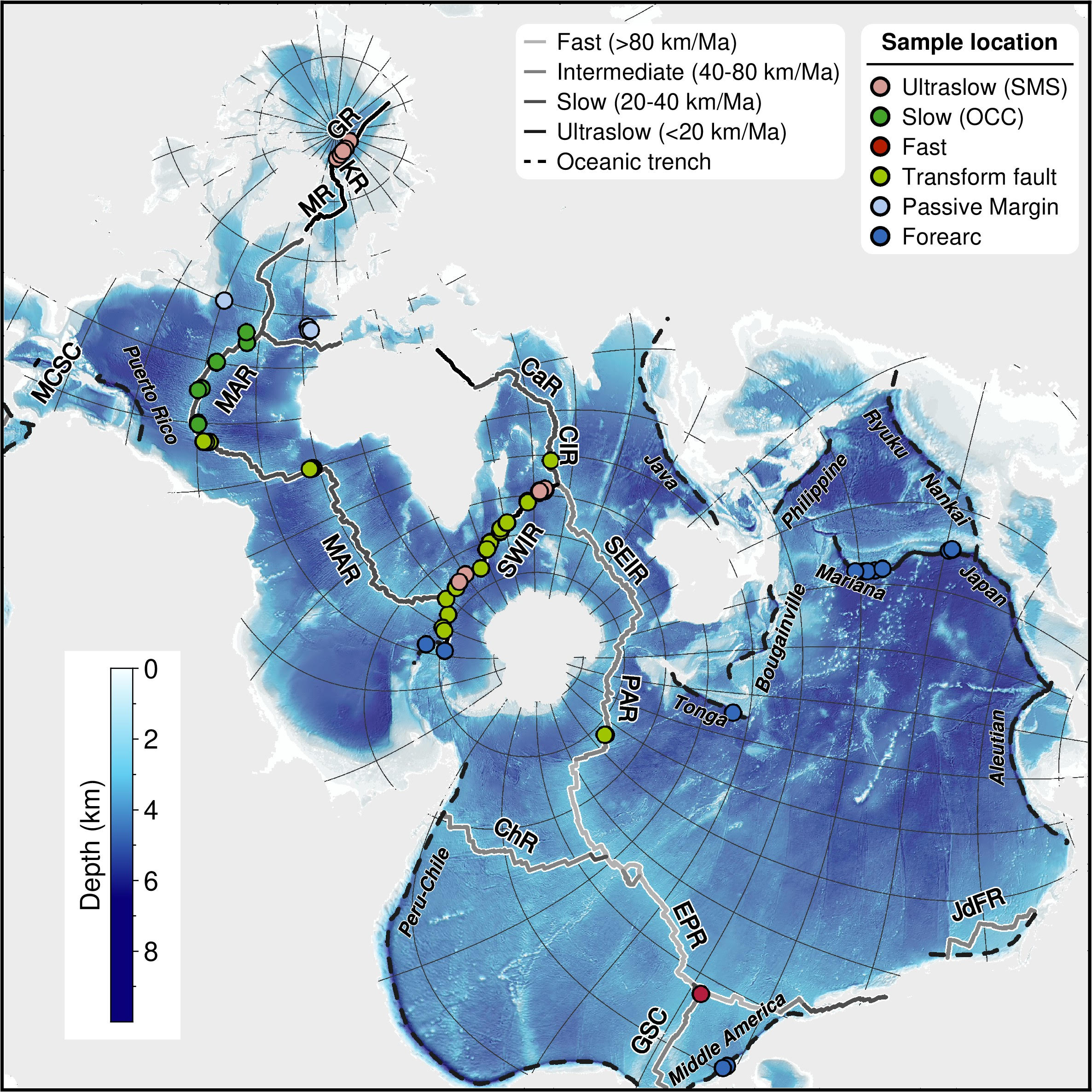
Spilhaus projection showing the distribution of existing geochemical data (major, trace, volatile and isotopic elements) on abyssal serpentinites as a function of geodynamic and tectonic context.
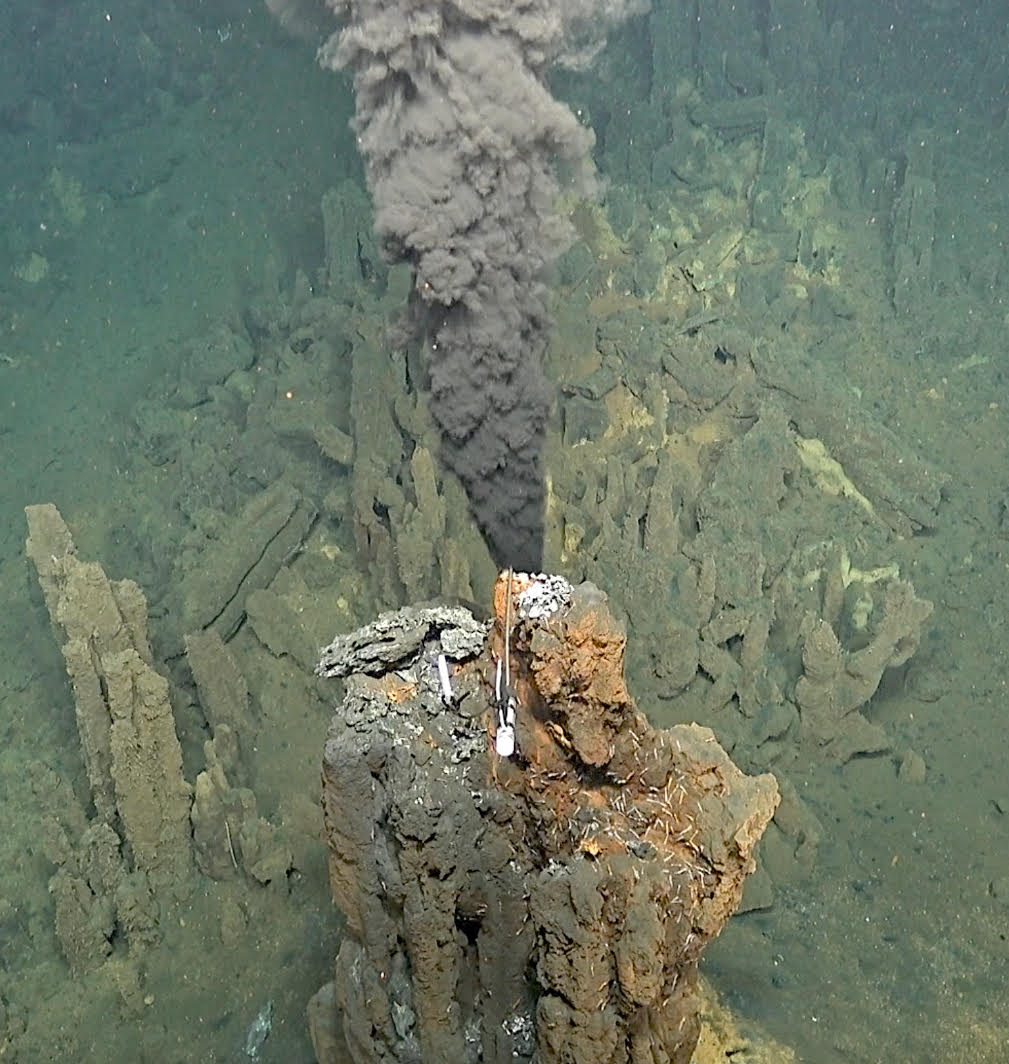
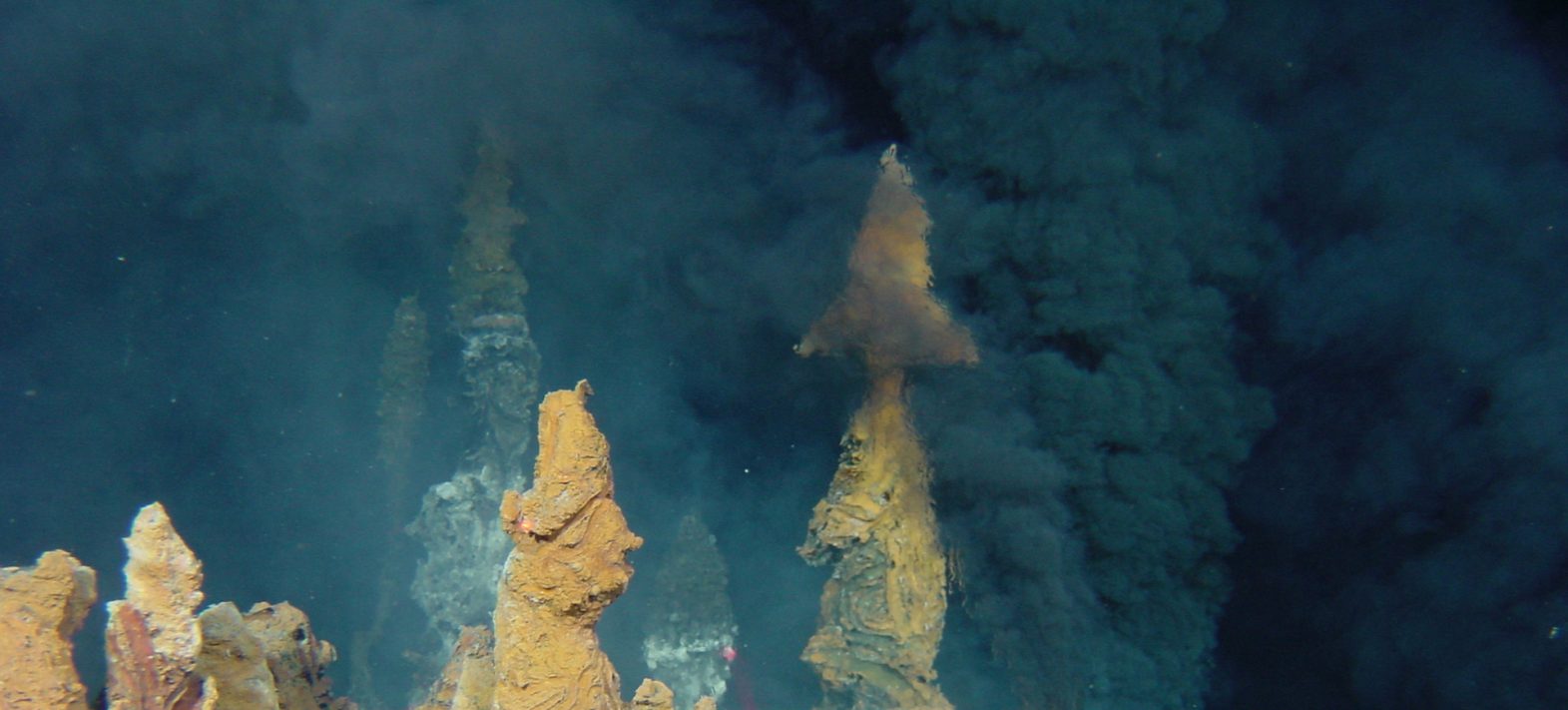
H2-rich black smoker on serpentinite substrates, Rainbow site, mid-ocean ridge (36°N). Arc-en-sub campaign, Andreani & Escartin, 2022, doi.org/10.17600/18000663

Near ridges, the thermal regime of the oceanic lithosphere is generally proportional to the abundance of magmatic rocks, playing a major role in the nature of geochemical exchanges during serpentinisation. At ultra-slow ridges and transform faults, low magmatic activity favours serpentinisation by slightly modified seawater, which is imprinted in the geochemical signature of the rocks. Conversely, at slow or fast ridges, high-temperature interaction between seawater and abundant magmatic rocks modifies the physico-chemical properties of the fluids, which are then more inclined to the mobility and storage of redox-sensitive elements (U, Eu, Ce, As, Sb), including metals (Zn, Cu). These differences lead to contrasting geochemical signatures of serpentinites around the world, reflecting the variability of chemical exchanges. On the other hand, the behaviour of elements that are not redox-sensitive but are mobile in fluids (Cs, Ba, Rb, B or Li) is little affected by these variations in context, leading to a homogeneous geochemical record of these elements in serpentinites. Serpentinisation of peridotites in forearc2 contexts, where fluid chemistry is largely influenced by the underlying subduction, appears to be an exception in abyssal contexts.

In addition, these observations show that the geodynamic and tectonic contexts of serpentinisation influence the iron (Fe) oxidation processes, and therefore the production of hydrogen (H2) at the bottom of the oceans. In particular, the distribution of Fe3+ in serpentinites is influenced by the magnesium content of the rocks, a high level favouring the formation of brucite and preventing the oxidation of Fe and the production of H2.

  1. Ubiquitous rocks = rocks found in many different places around the globe
  2. Forearc basin = hollow submarine space located on the thrust plate of a subduction zone between the volcanic arc and the sedimentary accretionary prism.

Ref : B. Debret, M. Andreani, M. Godard, A review of abyssal serpentinite geochemistry and geodynamics, Earth-Science Reviews, Vol. 258, 2024, 104910, DOI : 10.1016/j.earscirev.2024.104910

Latest news
MAJIS on board JUICE: a key instrument for exploring Jupiter’s icy moons
As part of the team involved in the development and validation of the MAJIS instrument, the Paris Institute of Earth Physics is contributing to the sc...
Frédéric Moynier elected member of the Academia Europaea
Frédéric Moynier, professor at the Institut de physique du globe de Paris (IPGP) and Université Paris Cité, and Deputy Director for Research at IPGP, ...
Can we listen to Titan’s heartbeat?  Icequakes as a window into a hidden ocean.
Can we listen to Titan’s heartbeat? Icequakes as a window into a hidden ocean.
What lies beneath the surface of Titan, Saturn’s largest moon? This question is central to the upcoming Dragonfly mission, which will deploy a drone e...
Lithium isotopes unveil the hidden chemistry of Guadeloupe's volcanic waters
IPGP researchers present the first systematic lithium isotope survey of Guadeloupe's surface waters, revealing that a single small island can host a r...