
Citizen / General public
Researcher
Student / Future student
Company
Public partner
Journalist
Teacher / Pupil

Antarctica is home to the largest dune field on our planet

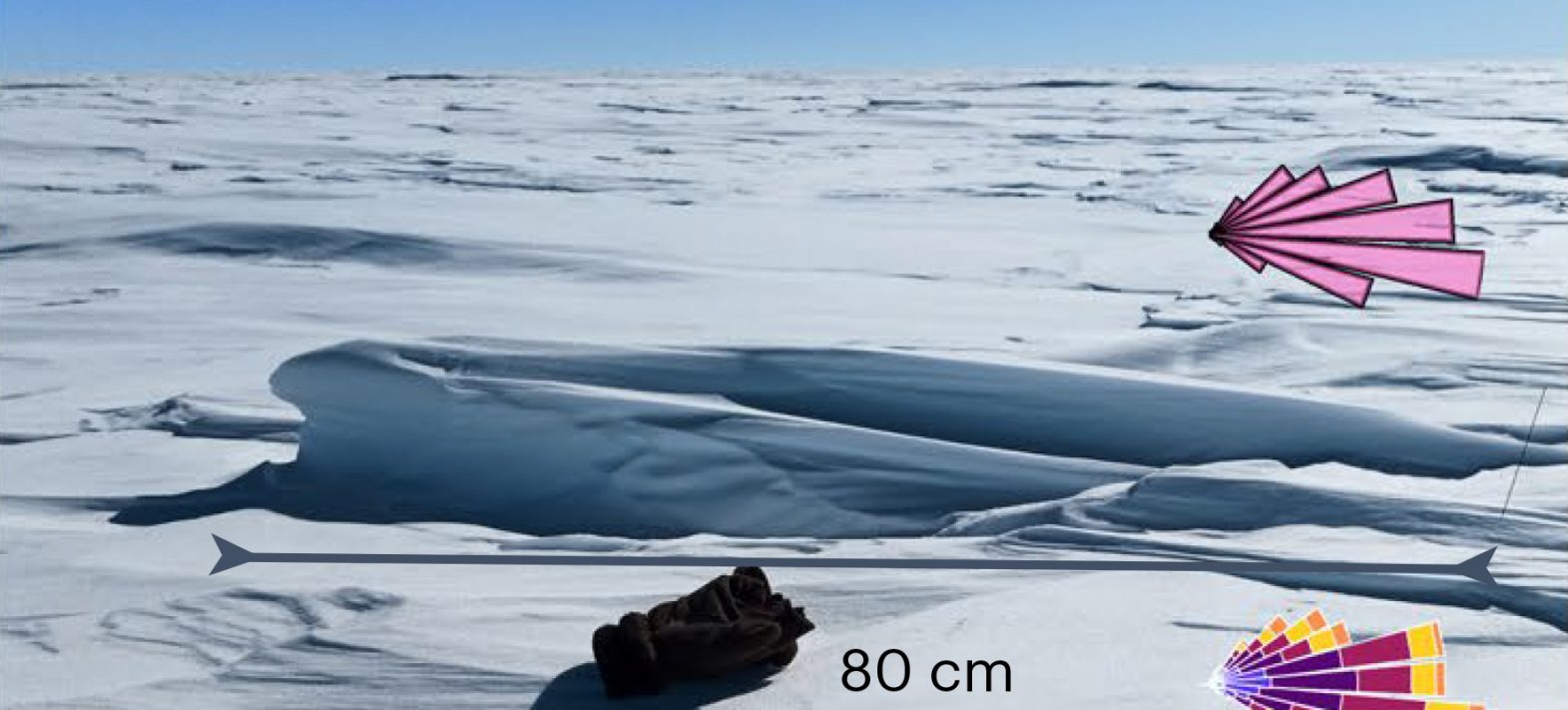
At the heart of the southernmost and coldest continent on Earth lies an unexpected landscape. A team including researchers from the Institut des géosciences de l'environnement (IGE - OSUG) and the IPGP has just revealed that Antarctica is home to the largest field of dunes on our planet. Unlike hot deserts, these dunes are made up of snow. This surprising discovery opens up new perspectives on the dynamics of snow in Antarctica and the interpretation of climate signals from ice cores.
Antarctica is home to the largest dune field on our planet

Publication date: 30/08/2024

Research

Related teams :
Geological Fluid Dynamics

Related themes : Earth System Science
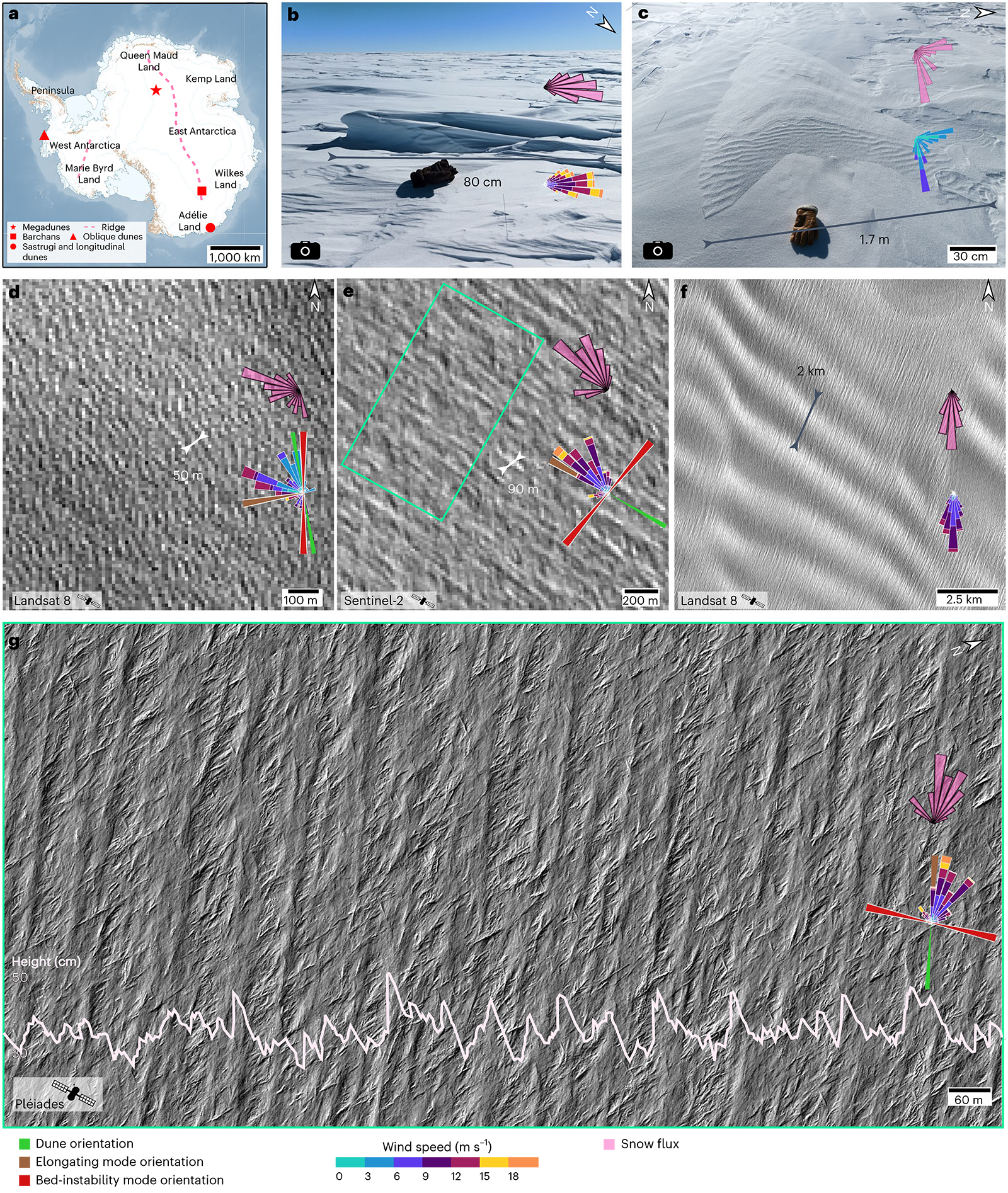
To unravel this mystery, scientists analysed satellite images covering the entire Antarctic continent. This approach made it possible to map the distribution, shape and orientation of snow dunes on an unprecedented scale. By comparing these observations with models developed for sand dunes, the team revealed both similarities and crucial differences in the formation mechanisms.

The study reveals that Antarctic snow is surprisingly resistant to wind transport, mainly due to its high cohesion. This property has a significant influence on snow dynamics on the continent. Indeed, the movement of snow by wind is an important, but until now poorly understood, factor in this context. This breakthrough in our understanding of the processes that shape the structure of the snow could help refine models of the evolution of the Antarctic ice cap. It also opens up new prospects for improving our knowledge of the ice cap’s mass balance1 in the face of climate change, a crucial step in predicting its future impact on sea levels.

1. Mass balance: difference between the accumulation (snowfall, frost) and ablation (melting, sublimation, iceberg calving) of ice on an ice cap. It is crucial for understanding the evolution of ice caps and their contribution to rising sea levels.

a, Map of Antarctica with locations of the bedform images. b, Sastrugi (metre-scale erosional structures). c, Barchans (metre-scale crescent dunes). d, Dunes oblique with respect to the main wind. e, Longitudinal dunes. f, Megadunes (transverse kilometre-wavelength antidunes). g, Expanded image of longitudinal dunes in e with the overlaid height profile. The wind roses correspond to the wind regimes since the last snowfall (d,e,g) or the annual wind regime (f) from the ERA5 reanalysis. Credit: g, Pléiades © CNES (2022), Distribution Airbus DS.

Ref: M. Poizat, G. Picard, L. Arnaud, C. Narteau, C. Amory & F. Brun, Widespread longitudinal snow dunes in Antarctica shaped by sintering. Nat. Geosci. (2024). DOI : 10.1038/s41561-024-01506-1

News originally published on the CNRS Terre & Univers website.

Latest news
MAJIS on board JUICE: a key instrument for exploring Jupiter’s icy moons
As part of the team involved in the development and validation of the MAJIS instrument, the Paris Institute of Earth Physics is contributing to the sc...
Frédéric Moynier elected member of the Academia Europaea
Frédéric Moynier, professor at the Institut de physique du globe de Paris (IPGP) and Université Paris Cité, and Deputy Director for Research at IPGP, ...
Can we listen to Titan’s heartbeat?  Icequakes as a window into a hidden ocean.
Can we listen to Titan’s heartbeat? Icequakes as a window into a hidden ocean.
What lies beneath the surface of Titan, Saturn’s largest moon? This question is central to the upcoming Dragonfly mission, which will deploy a drone e...
Lithium isotopes unveil the hidden chemistry of Guadeloupe's volcanic waters
IPGP researchers present the first systematic lithium isotope survey of Guadeloupe's surface waters, revealing that a single small island can host a r...