
• Home
  • News and agenda
  • News
  • Discovery of a crustal lithosphere-asthenosphere boundary (LAB) topping a large magma reservoir at Axial volcano in the Eastern Pacific
Citizen / General public
Researcher
Student / Future student
Company
Public partner
Journalist
Teacher / Pupil

Discovery of a crustal lithosphere-asthenosphere boundary (LAB) topping a large magma reservoir at Axial volcano in the Eastern Pacific

A team from the United States and Institut de physique du globe de Paris (IPGP) has imaged a crustal lithosphere-asthenosphere boundary (LAB) as the top of a large magma reservoir in the Eastern Pacific. Their work, published in Nature on 23 April 2025, opens new perspectives on crustal magma reservoirs, magma plumbing, and volcanic eruptions.
Discovery of a crustal lithosphere-asthenosphere boundary (LAB) topping a large magma reservoir at Axial volcano in the Eastern Pacific

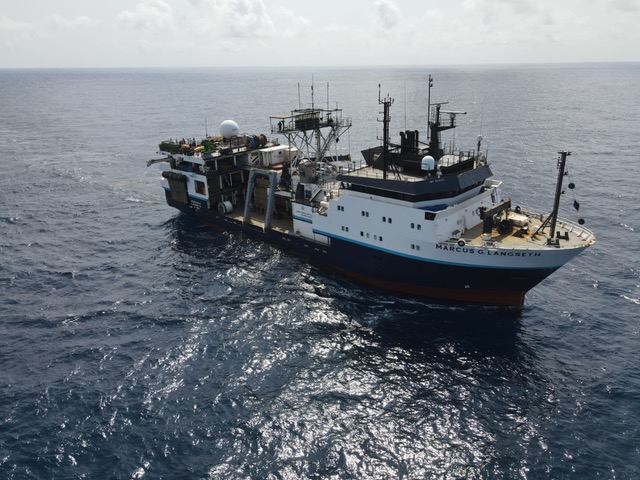
US Research Vessel Marcus G. Langseth - Office of Marine Operations, Lamont-Doherty Earth Observatory

Publication date: 14/05/2025

Press, Research

Related teams :
Marine Geosciences

The lithosphere-asthenosphere boundary (LAB) is fundamental to plate tectonics, with the overriding, brittle lithosphere floating on a ductile, convecting asthenosphere, allowing for plate motion at the surface of the Earth, especially plate divergence at mid-ocean spreading centers. The nature of this boundary in the vicinity of spreading centres has hitherto remained largely unknown, except for the presence of a narrow, 1-2 km wide mid-crustal axial magma lens (AML) observed beneath the axis at intermediate- to fast-spreading centers, separating the brittle upper crust from the lower-crustal mush zone. Using three-dimensional (3D) seismic reflection data, the team has imaged this boundary within the newly-created oceanic crust from about 1.2 km down to ~6 km below seafloor continuously beneath a large mid-ocean ridge volcano.

The 3D seismic reflection data were acquired in 2019 on board the United States marine seismic vessel, R/V Marcus Langseth (Fig. 1), at the Axial volcano in the eastern Pacific Ocean. Axial volcano, which sits at the intersection of the intermediate-spreading Juan de Fuca Ridge and Cobb-Eickelberg hotspot, has a flat-topped summit with a horseshoe-shaped 8 km x 3 km caldera lying at about 1.4 km water depth. It hosts several hydrothermal fields, and has been the site of three eruptions in the last decades, in 1998, 2011 and 2015. During the 2019 marine survey, the Langseth was equipped with four 6-km long streamers spaced at 150 m and two sound sources spaced at 75 m, acquiring a 300-m wide swath at each vessel pass. The total area covered is 40 km by 16 km surface area, and the images provide information down to ~6 km depth below seafloor.

Figure. 1. 3D view presenting a seismic image extracted from the processed volume and located along the caldera axis, showing the LAB and melt sills underneath.

The processed 3D seismic reflection volume shows the shallowest expression of the LAB (coinciding with the AML) as well as other melt sills underneath and reservoir flank reflections, over an area of 25 x 5 km down to ~ 6 km depth below seafloor. The LAB forms the top of a large magma reservoir in the crust beneath the volcano; specifically, it embodies funnel-shaped structures at different depths, slightly offset with respect to one another. The underlying melt sills are bounded by the funnel-shaped LAB and often are truncated by it, suggesting that the LAB represents a melt migration front: the melt moves up along the LAB surface towards the shallowest point of the LAB, from where volcanic eruptions initiate (Fig. 2). Fresh magma supplied from the deeper part of the magma reservoir invigorates the hydrothermal circulation. The LAB is also the site of assimilation of upper crustal rocks, controlled by changes in the vertical position of the magma reservoir (depending whether the system is in a strong magmatic phase like at present, or not), resulting in changes of the chemistry of the erupted lavas.

This study at Axial volcano opens new perspectives on the dynamics of crustal magma reservoirs, magma plumbing, volcanic eruption and hydrothermal circulation and could help to better understand other volcanic systems. It was carried out with the support of the United States National Science Foundation.

Figure 2. A schematic diagram illustrating the LAB geometry and its role as an assimilation front.

More information : ">Hélène Carton

Kent, G.M., Arnulf, A., Singh, S.C., Carton, H., Harding, A.J., Saustrup., S. (2025). Melt focusing along the lithosphere-asthenosphere boundary beneath Axial volcano, Nature, Vol. 641, 380-387

Latest news
From Tokyo to Mount Fuji: a Franco-Japanese week at the crossroads of Earth sciences and music
From 9 to 17 November 2026, several scientific events in Japan will bring together IPGP researchers and their Japanese partners. The programme include...
Using neutrinos to probe the composition of Earth’s deep interior
What if neutrinos could offer a new way of looking inside our planet? An interdisciplinary team involving researchers from the IPGP is exploring the u...
Planetary Research: a new open-access journal for planetary sciences
Led by an international community of researchers, with strong involvement from IPGP scientists, the new journal Planetary Research offers an alternati...
What if the next stars of recycling were… bacteria?
A new comic book from IPGP takes us behind the scenes of metal bio-recovery. Featuring bacteria, precious metals and a generous dose of humour, it rev...