Afin d'être accessible au plus grand nombre, nous vous informons que vous avez la possibilité de modifier la taille d’affichage du contenu de notre site.
Pour cela, voici les commandes à reproduire à l'aide de votre clavier :
Zoom in
CTRL +
+
Zoom out
CTRL +
-
Reset to zero
CTRL +
0
DMA-80 evo Milestone
Publication date: 14/04/2026
Research
The mercury analyzer (DMA-80 evo, Milestone), funded through the 2025 “Small and Medium Equipment” call of Université Paris Cité, enables rapid mercury concentration analyses without chemical preparation, with a precision of ~1% on extremely small quantities (< 0.1 ng) in both solid and liquid samples.
This analyzer can process a wide variety of matrices, including rocks, minerals, soils, and sediments, as well as water and biological samples (tissues, hair, urine, blood). One of the main analytical challenges lies in measuring very small samples (on the order of a milligram), particularly in cases where only a few grains are available. The first application of this method was the measurement of mercury concentration in samples from the asteroid Bennu, returned to Earth by the NASA OSIRIS-REx mission. As Bennu is considered one of the most primitive materials in the Solar System accessible on Earth, this analysis allows for the first time to estimate mercury concentrations in the early Solar System.
The addition of this mercury analyzer to the PARI platform will open new research avenues, extending investigations of this critical element across environmental science, medical research, and cosmochemistry, particularly in anticipation of future extraterrestrial sample-return missions.
Caption : sample of asteroïd brought back to Earth by the NASA OSIRIS-REx mission and analysed at IPGP using DMA-80 evo (Milestone).
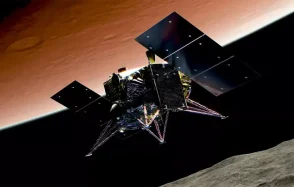
Heading for Phobos: IPGP at the heart of Japan’s MMX mission
On 19 October 2026 at 9:41 p.m. Paris time, Japan’s MMX space mission will lift off towards Mars and its two moons, Phobos and Deimos, from the Tanega...
From Tokyo to Mount Fuji: a Franco-Japanese week at the crossroads of Earth sciences and music
From 9 to 17 November 2026, several scientific events in Japan will bring together IPGP researchers and their Japanese partners. The programme include...
Using neutrinos to probe the composition of Earth’s deep interior
What if neutrinos could offer a new way of looking inside our planet? An interdisciplinary team involving researchers from the IPGP is exploring the u...
Planetary Research: a new open-access journal for planetary sciences
Led by an international community of researchers, with strong involvement from IPGP scientists, the new journal Planetary Research offers an alternati...