
Citizen / General public
Researcher
Student / Future student
Company
Public partner
Journalist
Teacher / Pupil

Earth may have incorporated its volatile elements during core formation

A study published in Science Advances shows, based on very high-pressure and high-temperature experiments conducted at the Institut de physique du globe de Paris (IPGP), that volatile elements—key ingredients for planetary habitability—were incorporated earlier than previously thought, during the earliest stages of Earth’s formation. These findings challenge the prevailing scenario in which most of these elements were added later by a volatile-rich meteoritic “late veneer.”
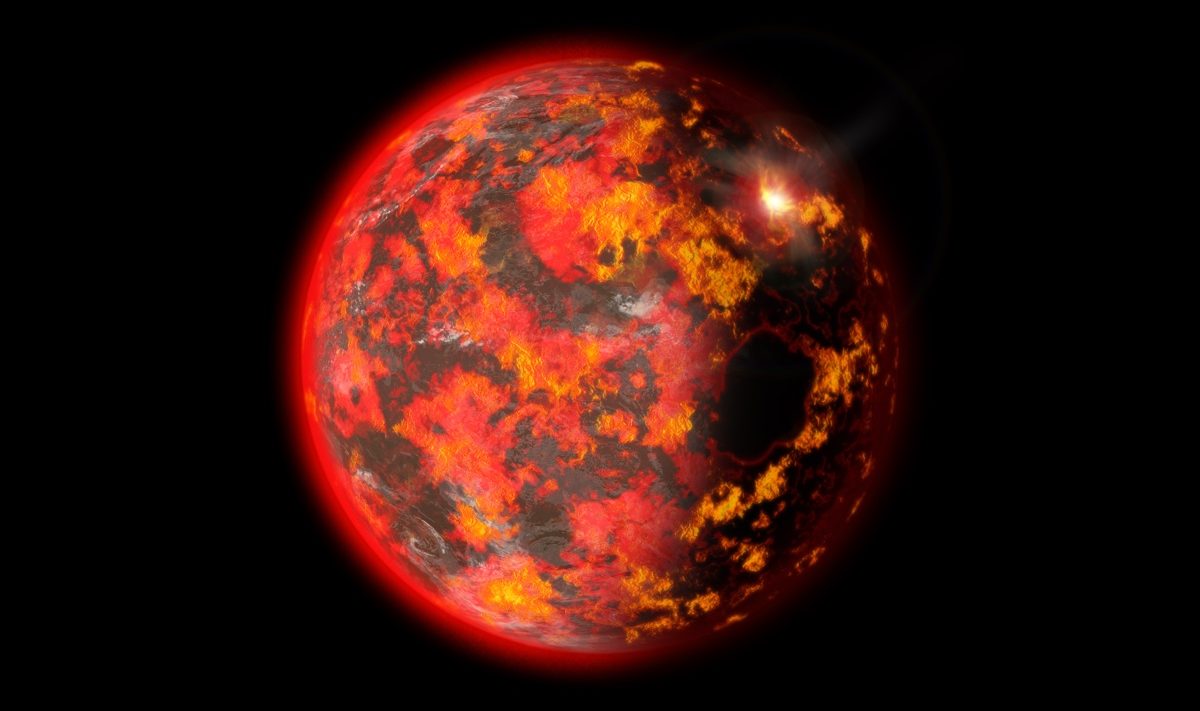
Earth may have incorporated its volatile elements during core formation

Earth’s Formation / @IPGP

Publication date: 26/02/2026

Research

The late veneer hypothesis challenged
For more than fifty years, the so-called late veneer model has occupied a central place in theories of Earth’s formation. According to this hypothesis, during the planet’s initial differentiation—when the metallic core separated from the mantle—elements with a strong affinity for iron would have been almost entirely drawn into the center. The mantle would therefore have been strongly depleted in volatile elements such as sulfur (S), selenium (Se), and tellurium (Te).
To explain their present-day abundances, a later addition of extraterrestrial material, notably carbonaceous meteorites, would have been required to enrich the Earth after core formation. The new experiments indicate that this scenario must be substantially re-evaluated.

Reproducing extreme conditions of the early Earth
To directly test this hypothesis, the researchers reproduced in the laboratory the extreme pressure and temperature conditions prevailing during Earth’s core formation, comparable to those of a deep magma ocean. The experiments were performed at IPGP using a laser-heated diamond anvil cell. Nanoscale analyses of element partitioning between metal and silicate were carried out at the European Synchrotron Radiation Facility (ESRF) in Grenoble.
These results are now based on measurements obtained under conditions directly relevant to core formation, rather than on probabilistic estimates derived from lower-pressure and lower-temperature experiments that previously supported the hypothesis of a massive late veneer.

A volatile-rich early Earth 
The results show that, under these realistic core formation conditions, sulfur, selenium, and tellurium are less strongly partitioned into the core than previously indicated by lower-pressure experiments. In other words, Earth’s mantle could have retained a significant fraction of these elements during the planet’s initial differentiation.
Models based on the new data indicate that the late veneer—if it occurred—would have been limited to about 0.1% of Earth’s mass, four to five times lower than classical estimates.
These findings therefore suggest that Earth’s volatile inventory—and potentially a significant fraction of its water—was established primarily during early accretion, while the planet was still growing, rather than during a major late addition.

Implications for the origin of habitability
This revision of the terrestrial accretion scenario significantly reshapes our understanding of the origin of life-essential elements.
If volatiles were incorporated progressively during the earliest stages of planet formation, planetary habitability may depend more strongly on early accretion history than on an exceptional late delivery event.
These results open new perspectives on the formation of terrestrial planets and the distribution of volatile elements in the Solar System.

Source

Lucas Calvo, Julien Siebert, Dongyang Huang, Ingrid Blanchard, Edith Kubik, Valentina Bonino, Anja Schreiber, Guillaume Avice, Jabrane Labidi

Accretion of volatile elements on Earth without the need of a late veneer
, Science Advances, 2025.

DOI : https://doi.org/10.1126/sciadv.ady8018

Latest news
Geoffrey C. P. King (1943 - 2026)
With great sadness that we are sharing the news that Geoffrey C. P. King, who worked at the Institut de physique du globe de Paris from 1995 until his...
Tribute from the Institut de Physique du Globe de Paris to Dr. Miguel Eduardo Bosch Blumenfeld (1959–2026)
The Institut de Physique du Globe de Paris pays tribute to Dr. Miguel Eduardo Bosch Blumenfeld, an esteemed geophysicist and distinguished alumnus of ...
From the first solids of the Solar System to planets: the decisive role of extreme and violent cooling
How do the first solid materials that give rise to planets emerge from the incandescent gas surrounding a young star? This transition from gas to soli...
Laëtitia Pantobe has been awarded the 2026 Thesis Prize by the French National Committee for Geodesy and Geophysics (CNFGG).
Laëtitia Pantobe, a PhD student in the Volcanic Systems team, successfully defended her thesis, "Identification and modelling of the physical processe...