
Citizen / General public
Researcher
Student / Future student
Company
Public partner
Journalist
Teacher / Pupil

Highlight of the importance of CO2 in the degassing of helium in the magma oceans of young planets

Researchers at the IPGP and the University of Oslo have revealed that the loss of volatile elements during the degassing of a magma ocean, in particular carbon and helium, is closely linked to the pressure, temperature and composition of the molten material. Their simulations show that CO2 favours the volatilisation of helium.
Highlight of the importance of CO2 in the degassing of helium in the magma oceans of young planets

Publication date: 31/10/2024

Press, Research

A collaboration between IPGP and the University of Oslo—partners within CircleU—offers new insights into the evolution of the early Earth’s atmosphere. Following the giant impact that led to the formation of the Moon, the Earth condensed as a hot molten sphere in the center of the protolunar disk. Volatile elements were trapped and condensed with heavier elements into a global magma ocean. As this ocean cooled and degassed, these volatiles played a crucial role in sculpting Earth’s secondary atmosphere.

Using state-of-the-art first-principles molecular dynamics calculations, the team simulated the behavior of carbon and helium in a pyrolite melt representative of the bulk silicate Earth composition, enriched with CO2 and helium. Their findings reveal that the loss of volatiles is intricately linked to the pressure, temperature, and composition of the melt. Above approximately 25 kbar pressure, the melt forms a continuously polymerized network, fully dissolving both carbon and helium. However, as pressure decreases, nanoscale cavities—nanobubbles—form within the liquid, acting as reservoirs for gas-like species vaporized from the melt.

These simulations show that CO2 enhances helium degassing by stabilizing the formation of nanobubbles and increasing their efficacy. The presence of carbon makes the melt less dense, facilitating the formation of channels through which helium can escape more readily. As carbon vaporizes, it not only assists in helium escape but also forms pathways that could have led to significant volatile losses from the magma ocean. This suggests an early Earth atmosphere richer in carbon and noble gases, and significantly hotter and thicker than previously estimated.

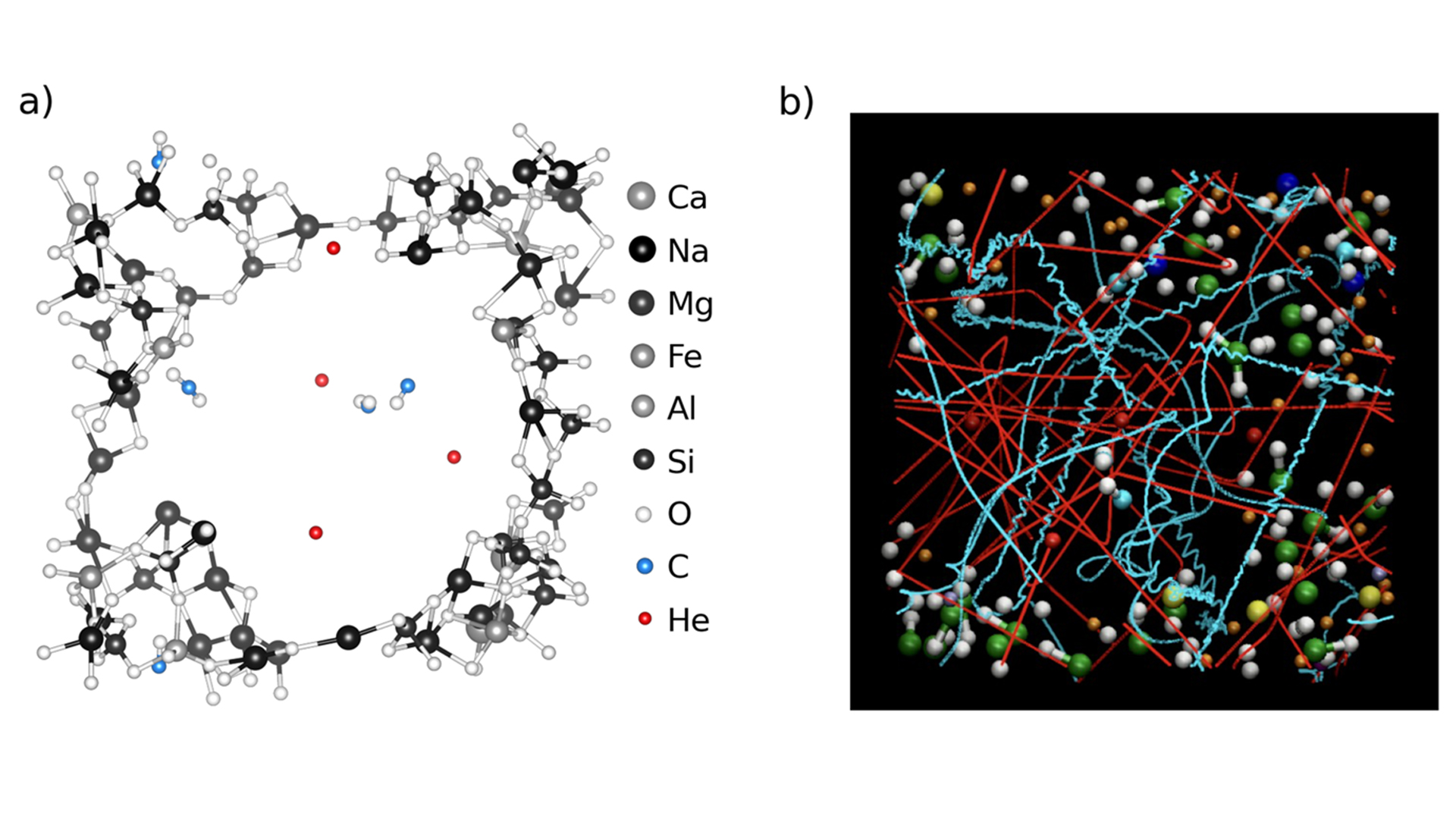
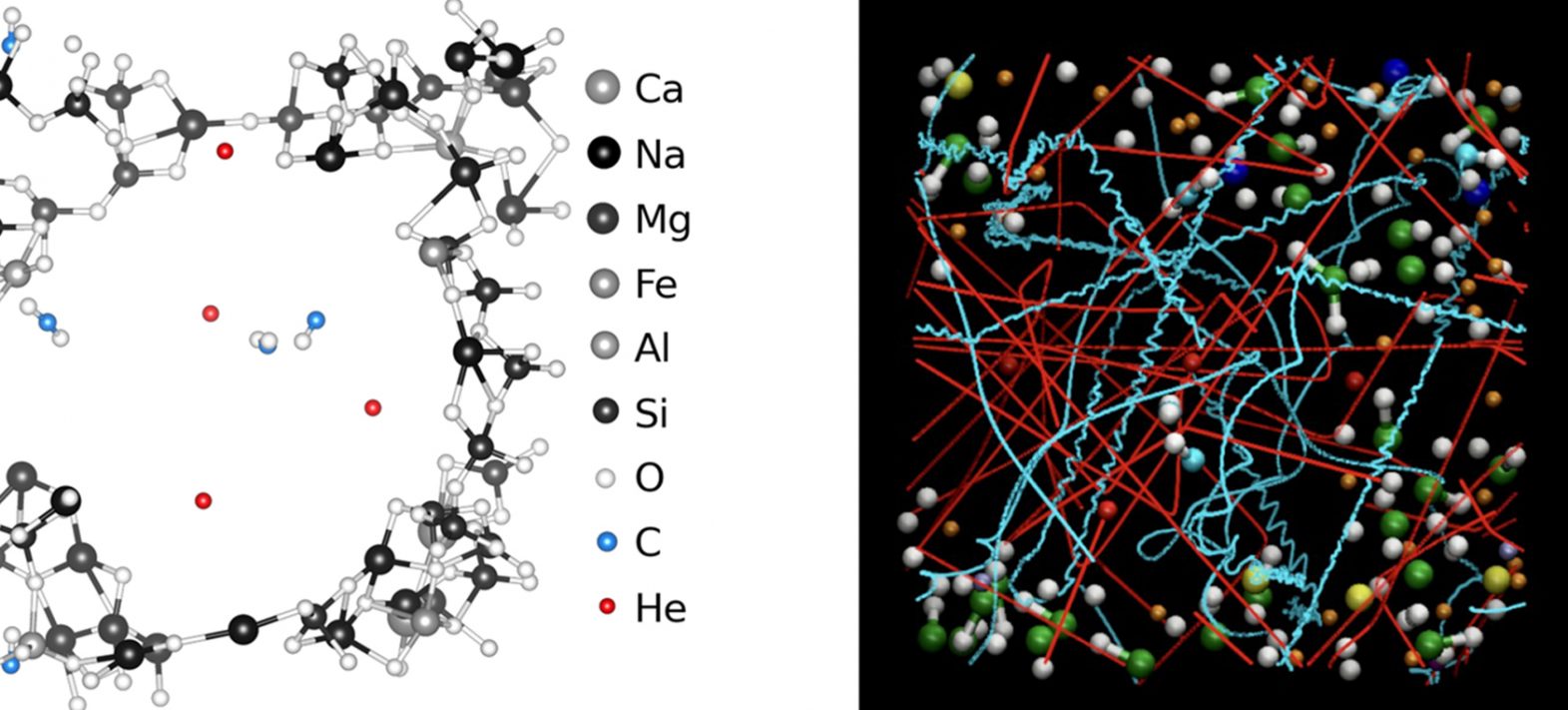
Representative snapshots of the simulation showing a nanobubble populated by CO, CO2, and He (left panel). Example trajectories of a helium atom (straight red line) and a carbon atom (oscillating blue line) over the length of one simulation (right panel). The volatile species traverse the length of the bubble and exchange and interact with atoms in the melt phase.

The implications of this research extend beyond our planet to molten exoplanets orbiting stars with varying carbon levels. Exoplanets around carbon-rich stars are likely to experience elevated degassing due to the prevalence of carbon-bearing vapor, resulting in thicker atmospheres and volatile-depleted interiors. Conversely, those orbiting carbon-poor stars would exhibit less degassing, leading to thinner atmospheres and volatile-rich interiors, potentially solidifying more quickly.

Planetary bodies forming a flotation crust early in their cooling histories would encapsulate their volatiles within their interior, profoundly influencing geochemical processes and planetary evolution. This study advances our understanding of planetary formation and highlights the intricate interplay of elements under extreme conditions, shaping the atmospheres and surfaces of young planets across the universe.

Ref: A.H. Davis & R. Caracas, Degassing of CO2 triggers large-scale loss of helium from magma oceans, Communications Earth and Environment, 2024, 5. DOI: 10.1038/s43247-024-01509-1

Latest news
Are the hidden currents of Ganymede’s ocean finally detectable?
A study conducted by researchers from the Institut de physique du globe de Paris (IPGP) and CNRS shows that the convection motions driving the hidden ...
Discovery of CO₂ hydrates off the coast of Mayotte: a unique site for studying carbon storage in the ocean
More than 120 CO₂ hydrate deposits were discovered at the Fer à Cheval site, 10 km east of Petite Terre (Mayotte), during the Geoflamme campaign co-le...
Publication of the IPGP 2025 Annual Report
The IPGP Annual Report, published in both French and English, aims to share with the widest possible audience our enthusiasm for the research carried ...
SOUFRIÈRE_50: a week to revisit fifty years of scientific progress and meet the challenges of 21st-century volcanology
Press Release - Fifty years after the 1976–1977 eruption of La Soufrière de Guadeloupe—an event that left a profound mark on Guadeloupe, as well as on...