
Citizen / General public
Researcher
Student / Future student
Company
Public partner
Journalist
Teacher / Pupil

IPGP and Terrensis sign partnership agreement for natural hydrogen research

On 4 March 2025, the Institut de Physique du Globe de Paris (IPGP) and Terrensis formalised a strategic partnership aimed at furthering research into natural hydrogen. The agreement was signed at the IPGP in the presence of Marc Chaussidon, Director of the IPGP, and Vincent Bordmann, CEO of Terrensis.
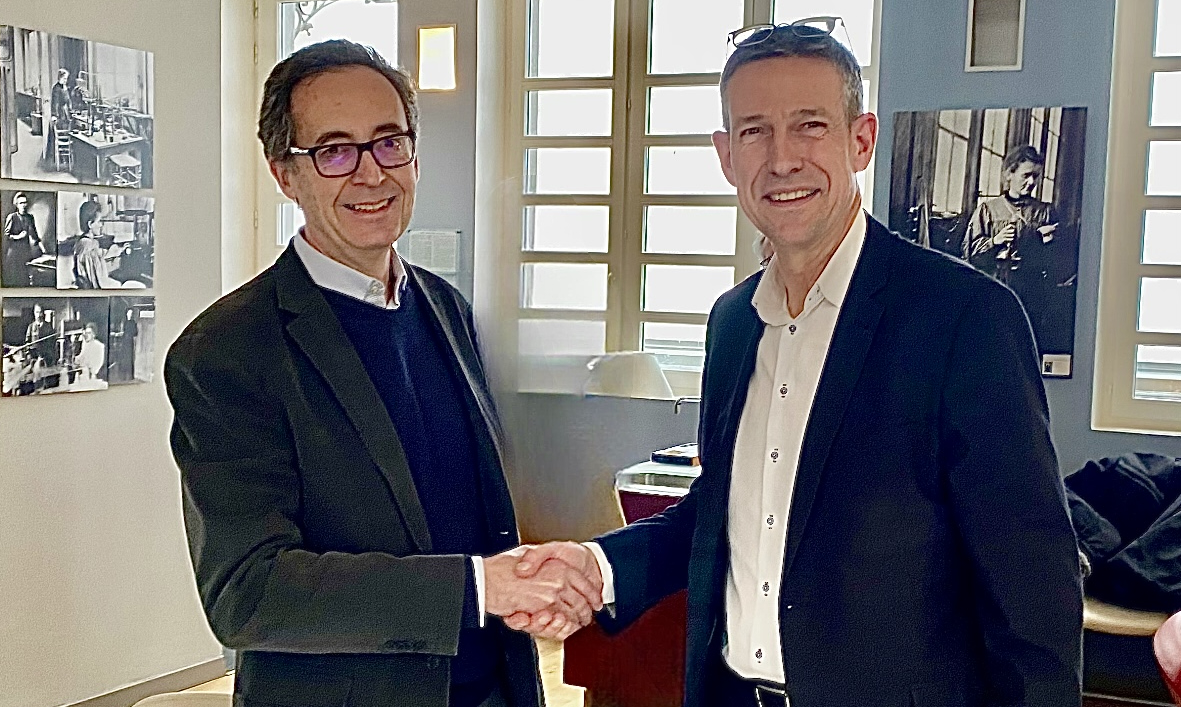
IPGP and Terrensis sign partnership agreement for natural hydrogen research

Marc Chaussidon and Vincent Bordmann

Publication date: 05/03/2025

Press, Research

This partnership marks an unprecedented step for the IPGP, which is welcoming a company to its premises for the first time, encouraging closer collaboration between researchers and industrial players. This cooperation is part of the current drive to explore and exploit natural hydrogen, a promising energy resource that has yet to be fully exploited.

A partnership at the heart of scientific innovation

For Vincent Bordmann, this partnership with the IPGP is an exceptional opportunity: ‘The main benefit for us is to be at the heart of French and international scientific research. Being here enables us to collaborate on a daily basis with specialist researchers, such as Isabelle Martinez and Bénédicte Ménez, who are working on key issues relating to natural hydrogen.

The Terrensis CEO also highlights the synergies expected from this partnership, particularly in terms of instrumentation and laboratory gas analysis. The company will be able to take advantage of IPGP’s equipment and expertise to refine its research at its exploration sites. This collaboration will also pave the way for training and knowledge transfer, with Terrensis being incorporated into teaching modules and students being taken on as interns or PhD students.

A strategic challenge for the future of energy

For his part, Marc Chaussidon emphasises the importance of this initiative: ‘This is the first time we’ve signed this type of partnership, and we think it’s fundamental. Natural hydrogen combines our expertise in geophysics and geochemistry, extending our previous work on CO2 storage. Exploring this resource is a crucial issue for the future of the planet.

This partnership comes at a time when research into natural hydrogen is booming, often compared to a new ‘white gold’ in the energy transition. France, backed by its scientific advances in the geosciences and supported by government initiatives, aims to position itself as a leader in this field.

With this agreement, the IPGP and Terrensis are laying the foundations for a fruitful collaboration that could lead to major advances in the understanding and sustainable exploitation of natural hydrogen. A decisive step forward for research and for the future of our ability to exploit new sources of carbon-free energy.

Latest news
SOUFRIÈRE_50: a week to revisit fifty years of scientific progress and meet the challenges of 21st-century volcanology
Press Release - Fifty years after the 1976–1977 eruption of La Soufrière de Guadeloupe—an event that left a profound mark on Guadeloupe, as well as on...
QVCT Week is back at the IPGP from 15 to 19 June 2026!
For the second year running, Quality of Life and Working Conditions Week (QVCT) is back at the IPGP. It’s an opportunity to strengthen bonds between c...
Jean-Philippe Avouac featured at the U.S. National Academy of Sciences annual meeting
Jean-Philippe Avouac, Director of the Institut de physique du globe de Paris (IPGP) and Professor at the California Institute of Technology (Caltech),...
Non-biological organic carbon recycled in Earth’s depths
A study published in Nature Communications, involving teams from the Institut de physique du globe de Paris, reveals a major and previously underestim...