
Citizen / General public
Researcher
Student / Future student
Company
Public partner
Journalist
Teacher / Pupil

Komatiites reveal that Earth’s surface water reached the deep mantle over 3.6 billion years ago

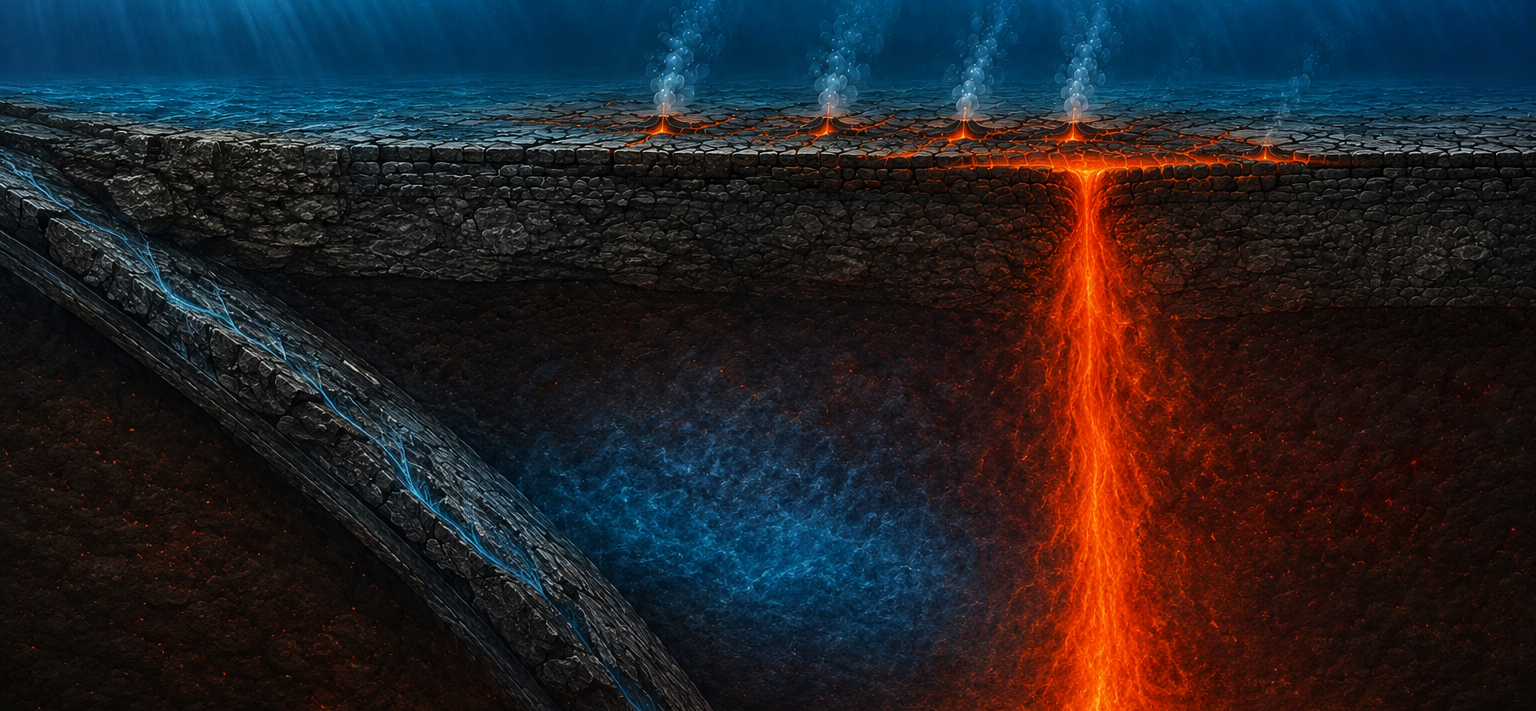
A new study led by Dr. Zheng-Yu Long and Prof. Frédéric Moynier, researchers at the Institut de Physique du Globe de Paris (IPGP/Université Paris Cité/CNRS), with international colleagues, shows that water from Earth's early surface had already been carried down into the mantle by at least 3.6 billion years ago. Published in Nature Communications, the work uses potassium isotopes in komatiites, rare and very ancient volcanic rocks, to trace a subduction-style recycling of surface volatiles operating in the Archean, linking the planet's early hydrosphere to its deep interior.
Komatiites reveal that Earth’s surface water reached the deep mantle over 3.6 billion years ago

Publication date: 03/08/2026

Research

An isotopic fingerprint carried by the oldest lavas
Komatiites are ultramafic magmas formed almost exclusively during the Archean, when the mantle was hot enough to melt deeply and extensively. Because they sample the mantle directly, they act as a sensitive archive of its early composition. The team measured high-precision potassium isotope ratios in komatiites from ten localities worldwide. Three Archean localities stood out, recording potassium isotope compositions distinctly heavier than those of the mantle and of most surface reservoirs, an anomaly that calls for a specific origin.

Surface water taken into the mantle through early subduction
The most consistent explanation is metasomatism: potassium-rich fluids, released from subducted oceanic lithosphere that had been altered by seawater, infiltrated and chemically modified domains of the mantle. These modified domains were later tapped by komatiite magmas, which preserved the heavy isotopic signal. This signature is direct evidence that surface-derived water, together with the volatiles accompanying it, had entered mantle reservoirs by at least 3.6 billion years ago.

A window into the early operation of the volatile cycle
Earth’s long-term habitability depends on volatiles, including water, being exchanged between the surface and the interior. When and how this exchange began has remained debated. By showing that komatiites carry the imprint of recycled surface water, the study places the early operation of subduction-style volatile recycling firmly within the Archean. It establishes potassium isotopes in ancient mantle-derived rocks as a tracer for reconstructing when Earth’s surface and interior first became linked.

Earth’s long-term habitability depends on volatiles, including water, being exchanged between the surface and the interior. When and how this exchange began has remained debated. By showing that komatiites carry the imprint of recycled surface water, the study places the early operation of subduction-style volatile recycling firmly within the Archean. It establishes potassium isotopes in ancient mantle-derived rocks as a tracer for reconstructing when Earth’s surface and interior first became linked.

Source 

Links between the Archean hydrosphere and Earth’s interior, Nature communications, June 26

Zheng-Yu Long, Frédéric Moynier, Igor S. Puchtel, Yiheng Li, Tu-Han Luu, Jun Deng Kun-Feng Qiu


Latest news
Satellites reveal irreversible damage in a major California aquifer
A study published in Proceedings of the National Academy of Sciences (PNAS), to which Kristel Chanard, Manon Dalaison and Jean-Philippe Avouac of the ...
Academic research: a key lever for addressing the water challenge in Africa... and elsewhere!
A new Nature Sustainability publication to which Essam Heggy (lecturer-researcher at IPGP) contributed, reveals how stronger support for African-focus...
A new isotopic clue reveals the origin of the asteroid responsible for the extinction of the dinosaurs
A study led by Georgy V. Makhatadze, a postdoctoral researcher at the Institut de physique du globe de Paris (Université Paris Cité / CNRS) under the ...
A remnant from Earth's early history identified in an active volcano near Mayotte
A study led by scientists from the Institut de physique du globe de Paris, in collaboration with the École Polytechnique Fédérale de Lausanne, reveals...