
Citizen / General public
Researcher
Student / Future student
Company
Public partner
Journalist
Teacher / Pupil

Lithium isotopes unveil the hidden chemistry of Guadeloupe’s volcanic waters

IPGP researchers present the first systematic lithium isotope survey of Guadeloupe's surface waters, revealing that a single small island can host a remarkably wide spectrum of chemical weathering processes, with direct implications for understanding how tropical volcanic terrains evolve through time and shape the chemistry of the global ocean.
Lithium isotopes unveil the hidden chemistry of Guadeloupe’s volcanic waters

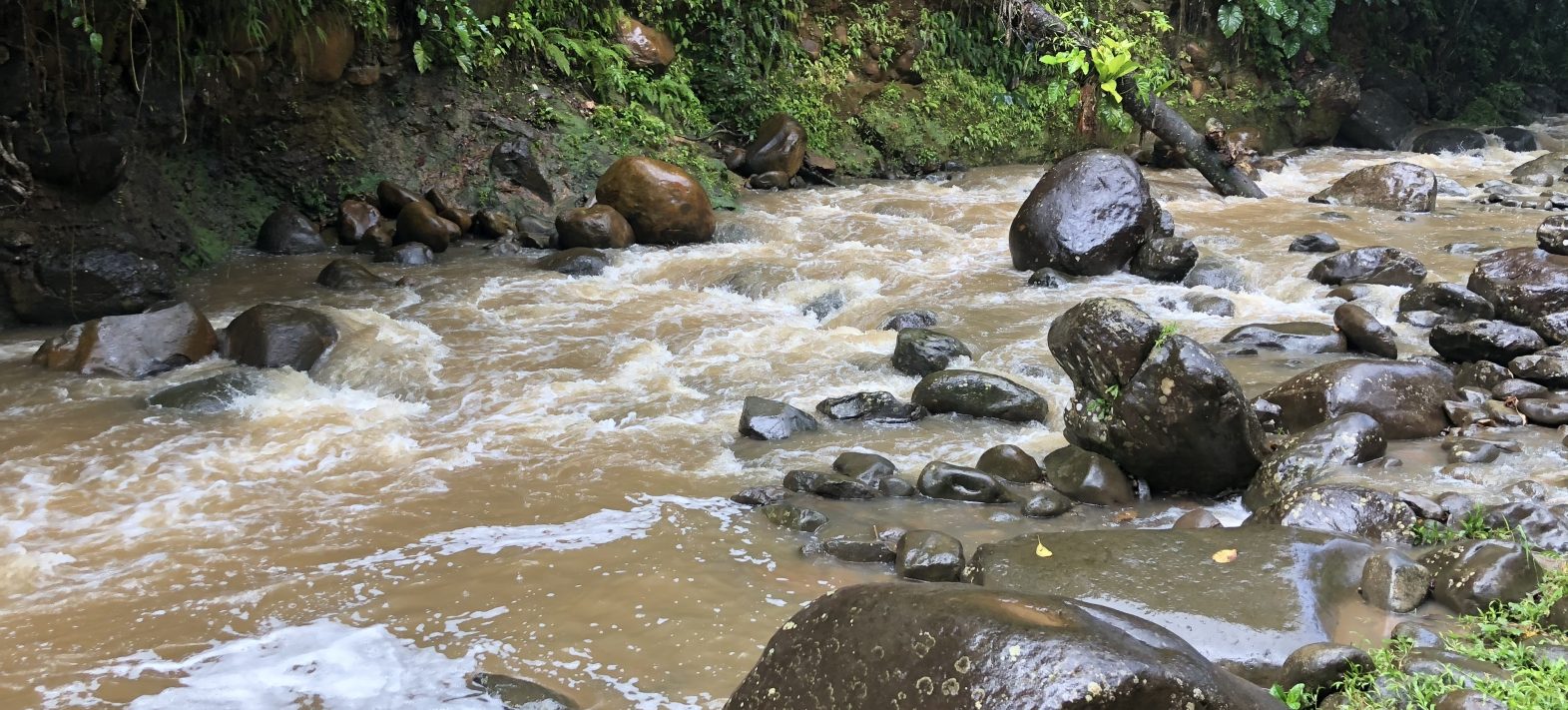
Grande Rivière de Vieux-Habitants / @IPGP - Jérôme Gaillardet

Publication date: 31/03/2026

Research
Lithium isotopes (δ⁷Li) have emerged over the past two decades as a powerful tracer of silicate weathering, that is the dissolution of rocks by rainwater that releases elements into rivers and ultimately into the ocean. Because the isotopic composition of dissolved lithium is sensitive to both the intensity and the style of weathering, it holds potential to reconstruct past climates and chemical erosion rates from ancient marine sediments.

Yet most of what we know about δ⁷Li in rivers of volcanic areas comes from temperate or cold environments such as Iceland and tropical volcanic islands, where warm, wet conditions drive intense rock breakdown, have remained largely unexplored. Guadeloupe, with its active La Soufrière volcano, its contrasting geology spanning from young lavas to ancient deeply weathered formations, and its abundant high-temperature hydrothermal activity, offers a natural laboratory of exceptional richness.

Within the framework of the ObsERA Observatory, a team of IPGP researcher collected water samples from eleven of Guadeloupe’s main rivers across Basse-Terre island and from four thermal springs on the flanks of La Soufrière. For each sample, they measured lithium concentrations and δ⁷Li values, then combined these data with existing information on chemical weathering rates, rock ages, rainfall, topography and regolith thickness. The result is the most complete lithium isotope dataset ever assembled for a tropical volcanic island, spanning a δ⁷Li range of +3.0 to +31.6‰, one of the largest ever reported for a single, geographically compact area.

Lithium isotopes in Guadeloupe's volcanic river waters

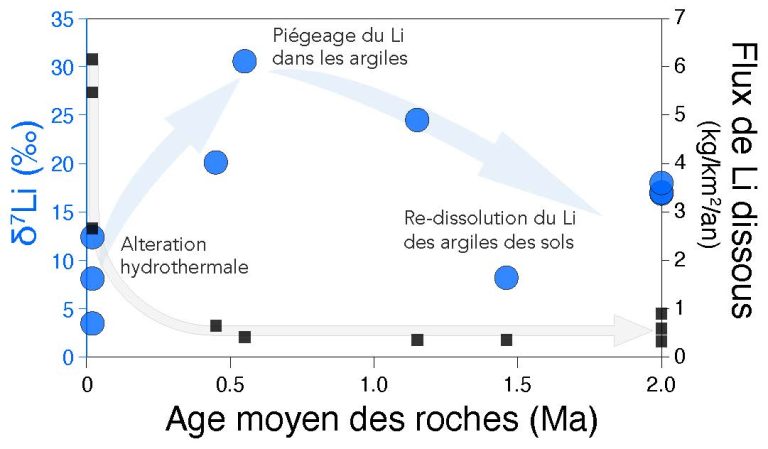
Comparing Guadeloupe with Iceland reveals a striking contrast. In Iceland, high δ⁷Li values characterize old, weathered catchments and low δ⁷Li values characterize young catchments where the highest chemical weathering values are recorded. In contrast, in Guadeloupe, the temporal evolution of dissolved river δ⁷Li with bedrock age shows a non-linear pattern, with low δ⁷Li during early (<0.45 Myr; la Soufrière volcano) and late (≥1.5 Myr) stages of weathering, and high δ⁷Li values during intermediate ages. The reason of this contrast lies in weathering intensity: Iceland’s thin soils and cold climate sustain a regime where primary minerals remain abundant and δ⁷Li reflects a balance between mineral dissolution and clay formation. In Guadeloupe’s tropical environment, the early-stage weathering is dominated by rapid (high Li-specific yield) and congruent dissolution at high-temperature with limited incorporation of Li in secondary minerals. Then, when weathering is more advanced, regoliths are thick and depleted, and an additional process – the long-term accumulation and eventual re-release of lithium from secondary soil minerals – dominates the isotopic signal in older catchments.

This means that dissolved δ⁷Li in Guadeloupe is governed primarily by the solid residence time and long-term weathering history of the regolith, rather than by modern hydrological parameters such as water transit time, a fundamental shift in perspective with broad implications for how the global lithium isotope record is interpreted.
This study shows that early-stage weathering on tropical volcanic islands produces both high lithium yields and low δ⁷Li values – a combination previously linked mainly to high-mountain rivers – and can therefore significantly influence the isotopic composition of seawater. However, this influence is confined to a geologically brief early phase: once volcanic terrains mature and their soils deepen, lithium yields drop sharply and converge towards values typical of high-intensity weathering environments worldwide.

These findings highlight the need for more studies on tropical volcanic islands to refine global riverine and oceanic lithium budgets, and to improve our ability to read the δ⁷Li record of past seawater as an archive of ancient continental weathering and climate change.

Bibliography
Dessert, C., Dellinger, M., Clergue, C., Gaillardet, J., & Benedetti, M. F. (2026). Lithium isotopes in waters of the tropical volcanic island of Guadeloupe: A proxy of high and low-temperature water-rock interactions.

Geochimica et Cosmochimica Acta. DOI:10.1016/j.gca.2026.01.047


Latest news
Guillaume Avice: CNRS bronze medal for his work on noble gases in the atmospheres of terrestrial planets
Guillaume Avice, a geochemist and cosmochemist, is a research fellow at the IPGP (CNRS/IPGP/University of Paris Cité). He uses mass spectrometry to st...
MAJIS on board JUICE: a key instrument for exploring Jupiter’s icy moons
As part of the team involved in the development and validation of the MAJIS instrument, the Paris Institute of Earth Physics is contributing to the sc...
Frédéric Moynier elected member of the Academia Europaea
Frédéric Moynier, professor at the Institut de physique du globe de Paris (IPGP) and Université Paris Cité, and Deputy Director for Research at IPGP, ...
Can we listen to Titan’s heartbeat?  Icequakes as a window into a hidden ocean.
Can we listen to Titan’s heartbeat? Icequakes as a window into a hidden ocean.
What lies beneath the surface of Titan, Saturn’s largest moon? This question is central to the upcoming Dragonfly mission, which will deploy a drone e...