Citizen / General public
Researcher
Student / Future student
Company
Public partner
Journalist
Teacher / Pupil

Magnetic Bacteria: Tracking the Earliest Signs of Life

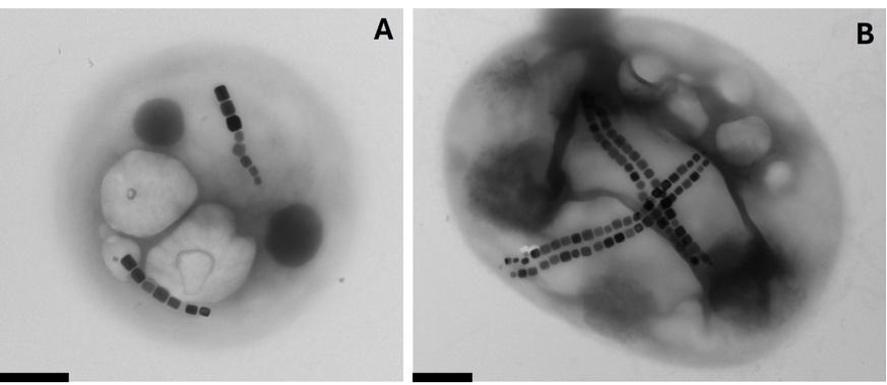
In lakes and oceans live some rather unusual bacteria. Inside their cells, they produce tiny crystals of magnetite, a magnetic iron mineral. Arranged in chains, these crystals form a kind of compass. They allow these so-called “magnetotactic” bacteria to orient themselves using the Earth's magnetic field.
Magnetic Bacteria: Tracking the Earliest Signs of Life

Publication date: 04/11/2026

Research

Fossils: A Journey Back in Time

These bacteria may be among the earliest living organisms to have produced minerals, possibly more than 2.5 billion years ago. After they die, their crystals can be preserved in sediments and eventually in rocks. These are known as “magnetofossils”. The oldest known examples date back 2.1 billion years. Some researchers have even suggested that they may have found evidence of magnetofossils in a Martian meteorite dating back more than 3.9 billion years, although this hypothesis remains controversial.

Real Fossil or False Alarm?

This is where the challenge lies: magnetite can also form without any involvement of living organisms. Over time, the clues that distinguish magnetite produced by bacteria (crystal shape, chain-like arrangement and magnetic properties) can disappear. Laboratory experiments had shown that bacterial magnetite carries a distinctive chemical signature. However, these findings were based on two bacterial strains grown under artificial conditions (see previous feature). But what happens in nature, where many different species coexist?

Heading to Lake Pavin

To find out, a research team including scientists from IPGP, BIAM and IMPMC travelled to Lake Pavin, in the Puy-de-Dôme region of France. Its deep waters, which are oxygen-free and rich in iron, resemble those of the oceans several billion years ago. Magnetotactic bacteria live there in a very thin layer, just 1.6 metres thick, within the water column at a depth of around 56 metres.

A Meticulous Undertaking

In July 2022, the researchers pumped approximately 1,800 litres of water over the course of a week. Using magnets, they concentrated the bacteria. The result: less than one milligram of cells. An extremely small amount, but enough to carry out highly detailed chemical analyses. The researchers then extracted and purified the crystals.

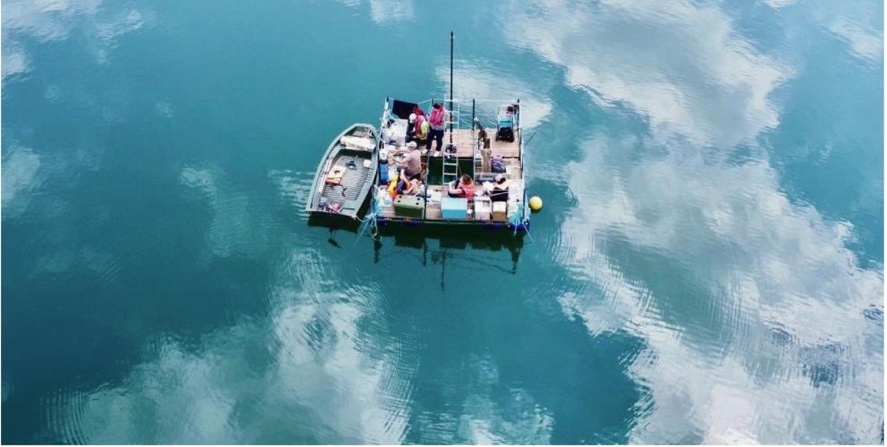
The scientific platform anchored in the middle of Lake Pavin to collect water samples. © Busigny et al.


A Distinctive Signature

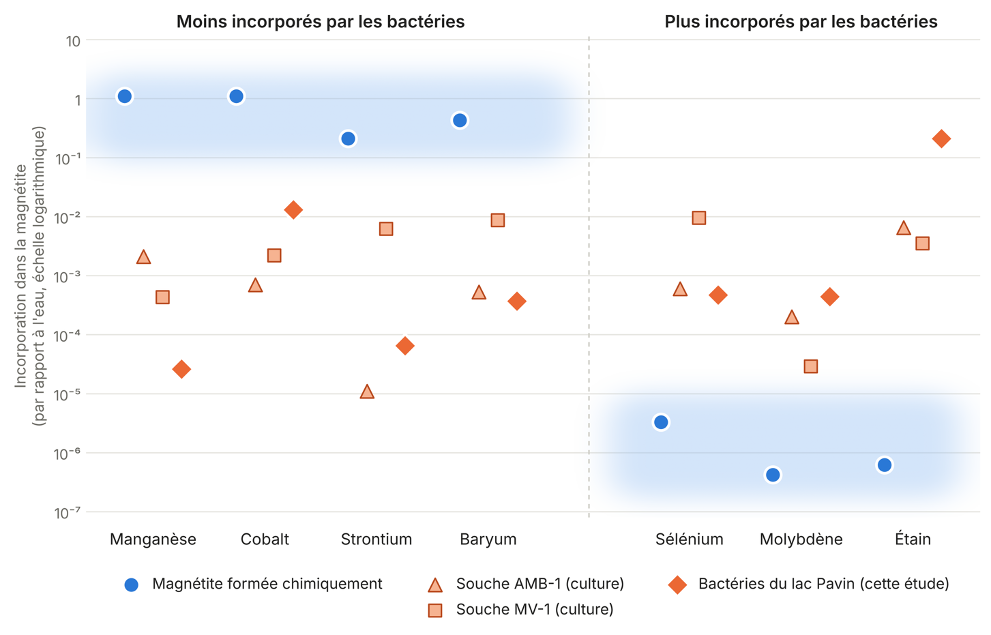
The results are clear. Magnetite produced by bacteria in natural environments shares the same key characteristics as magnetite from laboratory-grown strains. It contains at least 100 times more selenium, molybdenum and tin than magnetite formed through purely chemical processes. Conversely, it contains around 100 times less manganese, cobalt, strontium and barium.

There is another clue: its iron is isotopically “lighter”. When producing magnetite, bacteria preferentially incorporate slightly lighter iron atoms into the crystals, whereas purely chemical processes, without any involvement of living organisms, do the opposite.

Magnetite produced by bacteria from Lake Pavin behaves in the same way as that produced by two laboratory-grown strains. It differs markedly from magnetite formed in the absence of bacteria. Based on Busigny et al.

A New Tool for Fossil Hunters

This signature is therefore not a laboratory artefact. It is also found in natural communities made up of several bacterial species. Combined with traditional identification criteria, it could help scientists detect traces of ancient life in Earth’s rocks, and perhaps one day in samples from other planets.

What Comes Next?

Several questions remain unanswered. To interpret this signature, scientists need to know the composition of the water in which the crystals formed — water that has long since disappeared in the case of ancient rocks. The researchers suggest estimating it using other associated minerals, such as carbonates.

Another challenge is to determine whether these crystals and their chemical composition can survive burial over geological timescales. One possible approach would be to collect a sediment core from the bottom of Lake Pavin and study how magnetite and associated minerals have changed over time.

Reference: Busigny V., Praharaj A., Amor M., Mathon F. P., Monteil C. L., Menguy N., Benzerara K., Mehta N., Jézéquel D., Viollier E., Lefèvre C. T. “Geochemical signatures of magnetite are conserved in diverse populations of environmental magnetotactic bacteria”. PNAS, 2026

DOI : https://doi-org.insu.bib.cnrs.fr/10.1073/pnas.2621335123

Latest news
Heading for Phobos: IPGP at the heart of Japan’s MMX mission
On 19 October 2026 at 9:41 p.m. Paris time, Japan’s MMX space mission will lift off towards Mars and its two moons, Phobos and Deimos, from the Tanega...
From Tokyo to Mount Fuji: a Franco-Japanese week at the crossroads of Earth sciences and music
From 9 to 17 November 2026, several scientific events in Japan will bring together IPGP researchers and their Japanese partners. The programme include...
Using neutrinos to probe the composition of Earth’s deep interior
What if neutrinos could offer a new way of looking inside our planet? An interdisciplinary team involving researchers from the IPGP is exploring the u...
Planetary Research: a new open-access journal for planetary sciences
Led by an international community of researchers, with strong involvement from IPGP scientists, the new journal Planetary Research offers an alternati...