
Citizen / General public
Researcher
Student / Future student
Company
Public partner
Journalist
Teacher / Pupil

Melting planets reveal the internal history of rocky worlds

An international research team, led by scientists from the Institut de Physique du Globe de Paris (IPGP) in collaboration with researchers from Canada and the United Kingdom, reveals in a study published on 29 July 2025 in Nature Astronomy that so-called ‘lava planets’, exoplanets that are extremely close to their star, provide valuable clues about the internal dynamics and chemical evolution of rocky worlds.
Melting planets reveal the internal history of rocky worlds

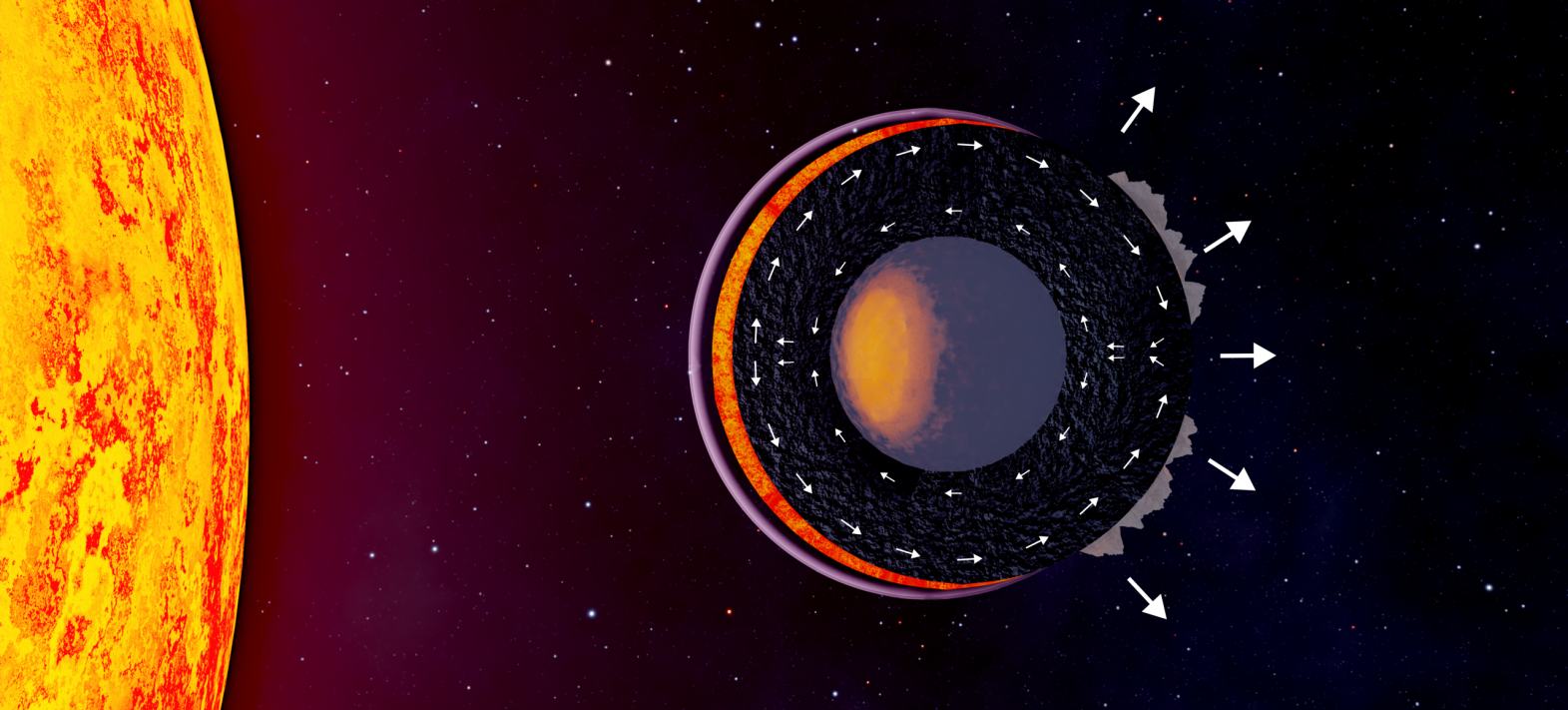
Artistic illustration of the internal structure of a lava planet in a cold state, showing a day‑side magma ocean overlain by a mineral atmosphere. © Romain Jean-Jacques

Publication date: 31/07/2025

Research

Lava planets, which have one side perpetually facing their star and heated to temperatures capable of melting rock, offer a unique natural laboratory for exploring the interactions between the atmosphere, surface and deep mantle.

An atmosphere shaped by chemical fractionation

The study highlights the importance of crystallisation and differentiation processes between solids and liquids deep in the mantle. Using unprecedented numerical simulations, the researchers show that these planets evolve according to two main thermal scenarios:

• If the planet’s interior is completely molten, the atmosphere reflects the overall composition of the planet, and the night-time surface is unstable and constantly renewed.

• If the interior is mostly solid, with only a shallow ocean of lava on the illuminated side, the atmosphere is depleted of certain volatile elements such as sodium, potassium and iron.

As the planet cools, distinct minerals precipitate from the magma and accumulate, altering the composition of the residual lava ocean and, by rebound effect, that of the silicate atmosphere. This gradual chemical transformation is a signature that can be measured from a distance.

Observations to trace back in time

Current observation instruments, notably the James Webb Space Telescope (JWST), are now capable of measuring the temperature of the night side of these planets. This key data allows us to infer their internal thermal state and, indirectly, their geological history. An international team of astronomers has just been awarded 100 hours of observation on JWST to test the hypotheses proposed in the article.

Future observations, from the ground or space, will also allow for a more detailed analysis of the composition of their atmospheres. This data will offer a unique window into the interactions between the atmosphere, magma ocean and solid mantle.

Towards a new geophysics of exoplanets

This research paves the way for an integrated geophysical approach to the study of rocky exoplanets. By combining interior modelling, atmospheric data and thermal measurements, it becomes possible to reconstruct the evolution of these worlds from their formation to their current state.

Lava planets, long perceived as exotic curiosities, now appear to be essential keys to understanding the deep history of terrestrial planets, including our own.


Documents

Latest news
Titanium and cerium nanoparticles: in the Seine river, manufactured pollution now matches natural background
A study led by researchers at the Institut de Physique du Globe de Paris (IPGP) and Université Paris Cité shows that concentrations of manufactured ti...
Razvan Caracas elected President-elect of the International Mineralogical Association
At the IMA General Meeting held last month in Nanjing, Razvan Caracas, CNRS senior researcher at the Institut de Physique du Globe de Paris, was ele...
Nepal–Tibet: reconstructing the dynamics of a high-mountain hazard cascade
On 26 August 2026, a major rock-and-ice collapse occurred near the border between Nepal and Tibet. As it travelled through a confined valley, the movi...
Sand grains realize a Brownian motor conceived forty years ago
A team led by Olivier Devauchelle, a researcher at the Institut de physique du globe de Paris (IPGP/Université Paris Cité/CNRS), working with colleagu...