
Citizen / General public
Researcher
Student / Future student
Company
Public partner
Journalist
Teacher / Pupil

Sand grains realize a Brownian motor conceived forty years ago

A team led by Olivier Devauchelle, a researcher at the Institut de physique du globe de Paris (IPGP/Université Paris Cité/CNRS), working with colleagues from the universities of Belgrade and Warsaw and the Jean Le Rond d’Alembert Institute (Sorbonne Université/CNRS), has experimentally realized a "Büttiker-Landauer motor" for the first time; the concept was originally proposed in the late 1980s. The results have been published in Physical Review Letters.

Sand grains realize a Brownian motor conceived forty years ago

First experimental realization of a “Büttiker–Landauer engine” / @ Olivier Devauchelle

Publication date: 09/09/2026

Press, Research

Related teams :
Geological Fluid Dynamics

Bouncing grains defy classical diffusion

The experimental setup consists of a few quartz grains placed on a disk that vibrates vertically. Part of the surface is made of a softer material, causing the grains to bounce more actively there; consequently, their agitation, and thus their diffusivity, is higher in this area. The researchers observed that, on average, the grains spend less time where they are more agitated. As a consequence, their density varies inversely with their diffusivity—a behavior that deviates from Fick’s law, which is traditionally used to describe particle diffusion.

This phenomenon is reminiscent of the Chladni figure, known since the 18th century: when a sand-covered plate is vibrated, grains bouncing on its surface tend to accumulate where the plate’s movement is weakest. The new experiments demonstrate that this distribution can be explained without invoking any average force pushing the grains from one region to another; it arises simply from diffusivity differences.

A steady current sustained by fluctuations

The researchers then slightly tilted the vibrating disk to introduce the effect of gravity. The gradient of grain agitation is then no longer aligned with the force acting upon them, replicating the theoretical configuration envisioned by Markus Büttiker and Rolf Landauer in 1987. A steady current emerges: the grains move up the slope in zones of high agitation before going down in regions where agitation is lower. They thus form a continuous circulation, sustained solely by the device’s vibrations.

This experiment marks the first practical demonstration of this mechanism, in which random fluctuations can generate organized motion at the macroscopic scale. This work builds on the team’s research into the statistical physics of granular transport, which play a key role in the formation of alluvial rivers.

Référence
Granular Büttiker-Landauer Motor, Physical Review Letters 137, 097101, 24 août 2026
O. Devauchelle, P. Popović, P. Szymczak, A. Abramian, A. Lazarus

Latest news
Marc Chaussidon has been awarded the 2026 Leonard Medal, the Meteoritical Society’s highest honour
On the occasion of its 88th Annual Meeting the Meteoritical Society has presented the 2026 Leonard medal to Marc Chaussidon for his transformative con...
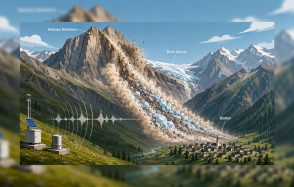
The Blatten Avalanche: Abnormal Mobility?
On 28 May 2025, approximately 9.3 million cubic metres of rock and ice collapsed above the Swiss village of Blatten, destroying part of the municipali...
Komatiites reveal that Earth's surface water reached the deep mantle over 3.6 billion years ago
A new study led by Dr. Zheng-Yu Long and Prof. Frédéric Moynier, researchers at the Institut de Physique du Globe de Paris (IPGP/Université Paris Cité...
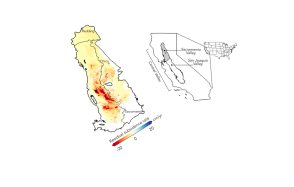
Satellites reveal irreversible damage in a major California aquifer
A study published in Proceedings of the National Academy of Sciences (PNAS), to which Kristel Chanard, Manon Dalaison and Jean-Philippe Avouac of the ...