Citizen / General public
Researcher
Student / Future student
Company
Public partner
Journalist
Teacher / Pupil

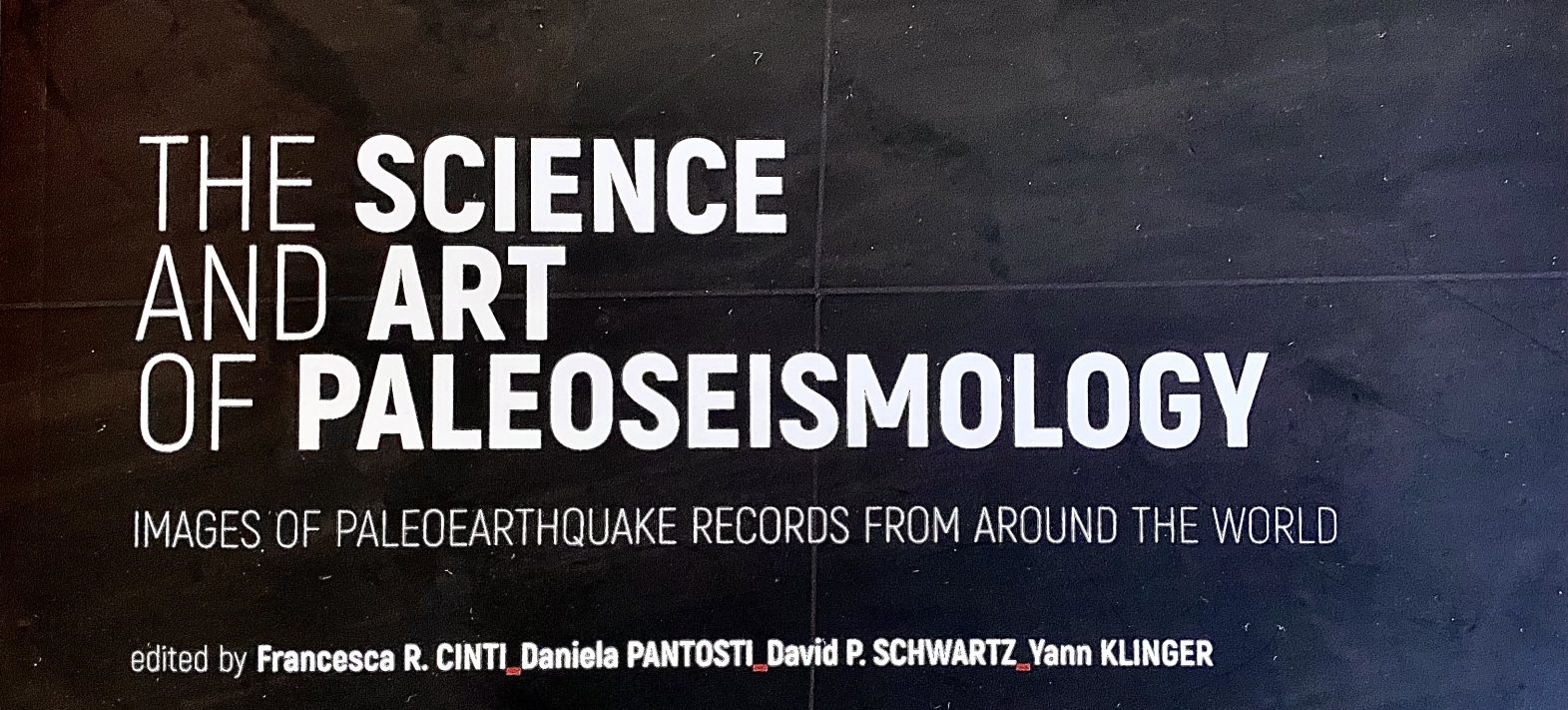
The Science and Art of Paleoseismology : a collective work to enrich research and teaching

Paleoseismology aims to understand past earthquakes in order to better predict future ones. This discipline, which is based on the study of the traces left by ancient earthquakes in geological deposits, has just been enriched by a book: The Science and Art of Paleoseismology. The result of collaboration between the Institut de Physique du Globe de Paris (IPGP) and the Istituto Nazionale di Geofisica e Vulcanologia (INGV), this book aims to centralise data that has hitherto been scattered and difficult to access.
The Science and Art of Paleoseismology : a collective work to enrich research and teaching

Publication date: 20/03/2025

Events, Press, Research

An unprecedented collaboration

This book is the result of a collective effort led by passionate researchers. They include Francesca R. Cinti and Daniela Pantosti (INGV), David P. Schwartz, one of the “father” of paleoseismology, and Yann Klinger (IPGP). Their ambition? To bring together a bank of images and field observations to form a reference resource for the scientific community and students.

‘Our idea was to ask our colleagues who have good photos or specific images of their trenching studies to share them with us. By grouping them together, we are building up a sort of collection that will enable beginner students to say to themselves: ‘Oh yes, this looks familiar’’, explains Yann Klinger.
“We wanted to use images of the trench exposures to document the variability of the stratigraphy and of the structures in different tectonic environments and provide insights to directly explore the basis for paleoearthquake recognition”, say Daniela Pantosti and Francesca R. Cinti.

With an initial print run of 2,000 copies, including 400 for the IPGP, The Science and Art of Paleoseismology is aiming for wide distribution. A digital version is also planned, to provide simplified access to this data and, in the long term, to enable it to be added to collaboratively.

A project forming part of a strengthened scientific partnership

This initiative reflects the relevance of the memorandum of understanding signed between the IPGP and the INGV in September 2024. This strategic partnership aims to strengthen scientific and technical exchanges between the two institutions, particularly in the fields of volcanology, seismology and natural risk assessment.

With The Science and Art of Paleoseismology, paleoseismology has taken a major step forward in the dissemination and sharing of knowledge, highlighting the wealth of field observations and their usefulness in understanding past and future earthquakes.

Latest news
Radio ‘whistlers’ originating from lightning strikes reveal unprecedented behaviour above the magnetic equator
A team from the Institut de Physique du Globe de Paris (IPGP – Université Paris Cité / CNRS) has, for the first time, documented and explained the unu...
What can the light from Vesta’s avalanches tell us?
A study conducted at the Institut de Physique du Globe de Paris uses images from NASA’s Dawn mission and a Bayesian inversion of the Hapke photometric...
Cosmochemistry in the service of Alzheimer's disease diagnosis: copper reveals its isotopic secrets
A multidisciplinary study led by researchers at the Institut de Physique du Globe de Paris (IPGP), in collaboration with teams from the Faculty of Hea...
Are the hidden currents of Ganymede’s ocean finally detectable?
A study conducted by researchers from the Institut de physique du globe de Paris (IPGP) and CNRS shows that the convection motions driving the hidden ...