Citizen / General public
Researcher
Student / Future student
Company
Public partner
Journalist
Teacher / Pupil

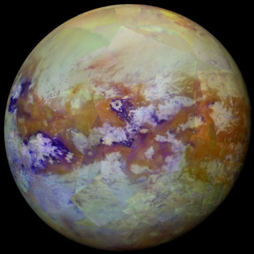
Titan’s surface seen in infrared by the Cassini probe

Titan, Saturn's largest satellite, was flown over 127 times by the Cassini probe between 2004 and 2017. An international team comprising researchers from the Laboratoire de Planétologie et Géodynamique (LPG, CNRS/Univ. Angers/Univ. Nantes), the Institut de Physique du Globe de Paris (IPGP, Université Paris Diderot/CNRS) and IRAP (CNRS/Université Paul Sabatier-Toulouse III), has compiled all the data from the VIMS imaging spectrometer to create a global map of the surface in infrared, showing the geological diversity of the terrain. A synthetic video illustrates the main features, from equatorial dune fields to impact craters, right up to the landing site of the Huygens module.
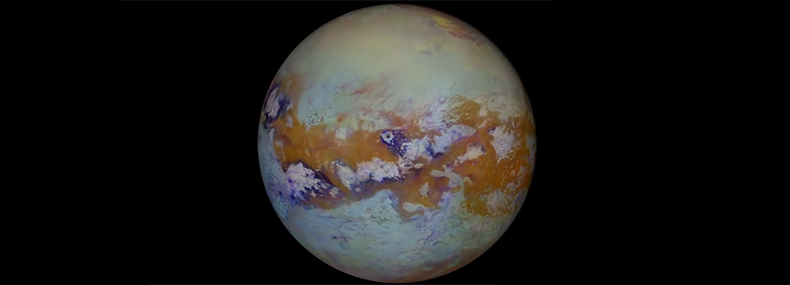
Titan’s surface seen in infrared by the Cassini probe

Publication date: 10/12/2018

General public, Press, Research

Related themes : Origins

13 years of observations by the Cassini probe’s VIMS imaging spectrometer have been combined to produce a false-colour global map of Titan’s surface. The advantage of the VIMS instrument, which records 64×64 pixel images in 352 wavelengths, is that it can observe through the atmospheric haze in several infrared ‘windows’ where the methane is partly transparent, giving access to the surface. Generating homogeneous maps proved to be a particularly arduous task, not least because of the effects of the atmosphere, which scatters and absorbs light strongly, coupled with the ever-changing observation geometry from one overflight to the next, as well as temporal variations over the 13 years of observation.

First we had to sort and calibrate all the raw images precisely, then try to reduce the influence of the atmosphere, before obtaining these global maps of the surface at different wavelengths. By combining the observations, we can then highlight the geological diversity and reveal the main units in terms of composition, on a global scale. The band ratio technique, in which an image taken at one wavelength is divided by an image taken at another wavelength, has proved particularly effective in highlighting variations in composition.

In the synthetic video below, showing Titan’s surface in false colour, a large area appears in brown at the equator around the satellite. This zone corresponds to immense dune fields when compared locally with Cassini’s radar images (which only cover two-thirds of the surface). Other bluish regions appear on this new map, reflecting the presence of terrains of different composition, which can be explained by a local enrichment in water ice or organic compounds. The Sinlap and Menrva craters, shown in the video, are good examples. The integration of the entire VIMS dataset into a synthetic map enables a more detailed comparison with other observations, such as those from the Cassini probe’s radar, or with the images taken by the Huygens module during its landing, as can also be seen at the end of the video.

During the data analysis process, tools have been put in place to preview each individual spectral observation. Anyone can now easily access the beauty of Titan’s infrared images (and those of the other ice satellites) in just a few clicks using the https://vims.univ-nantes.fr website.

Cassini has revealed all the geological richness of Titan, the only body outside the Earth to have rain, rivers and seas, formed by hydrocarbons at 180°C, not water. Everything we have learned makes us want to go back with new means of investigation.


Ref : S. Le Mouélic, T. Cornet, S. Rodriguez , C. Sotin, B. Seignovert, J.W. Barnes, R. H. Brown, K. H. Baines, B. J. Buratti, R. N. Clark, P. D. Nicholson, J. Lasue, V. Pasek, J. M. Soderblom (2019) The Cassini VIMS archive of Titan: From browse products to global infrared color maps, Icarus, 319, doi:10.1016/j.icarus.2018.09.017 (arxiv.org/abs/1809.06545)

Latest news
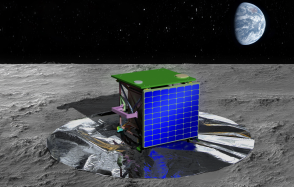
CNES and IPGP to supply SPSS instrument as France’s contribution
 to U.S. Artemis IV mission
CNES and IPGP to supply SPSS instrument as France’s contribution
 to U.S. Artemis IV mission
The French space agency CNES (Centre National d’Études Spatiales) and the Institut de physique du globe de Paris – Université Paris Cité are proud to ...
Kristel Chanard receives the 2025 Irène Joliot-Curie Prize in the “Young Female Scientist” category.
Awarded by the Ministry of Higher Education, Research, and Space, the Academy of Sciences, and the Academy of Technologies, this prize has been recogn...
International honours for Daniel Neuville in the field of glass science
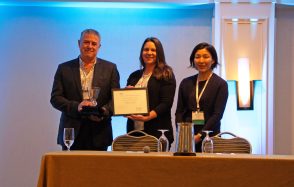
Daniel Neuville, CNRS research director at IPGP, was awarded the Morey Prize in 2025 and was elected chair of the technical committees of the Internat...
Medieval tsunami revealed by giant coral blocks in the Caribbean
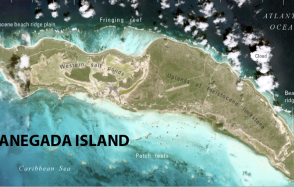
New scientific research has just shed light on a geological event that is as spectacular as it is forgotten: a tsunami of exceptional magnitude that i...