
Citizen / General public
Researcher
Student / Future student
Company
Public partner
Journalist
Teacher / Pupil

Piton de la Fournaise’s ten-year eruptive cycles linked to the fertility of its mantle source

Piton de la Fournaise (Réunion Island) is one of the most active volcanoes on the planet. However, it has alternating periods of intense activity (12 to 24 years) and periods of rest (3 to 6 years). This study, involving researchers from the Laboratoire magmas et volcans in Clermont-Ferrand and the Institut de physique du globe in Paris, shows that this cyclical activity is closely linked to the fertility of its mantle source, which modulates the flow of magma towards the surface.
Piton de la Fournaise’s ten-year eruptive cycles linked to the fertility of its mantle source

Publication date: 29/10/2018

General public, Observatories, Press, Research

Related themes : Natural Hazards

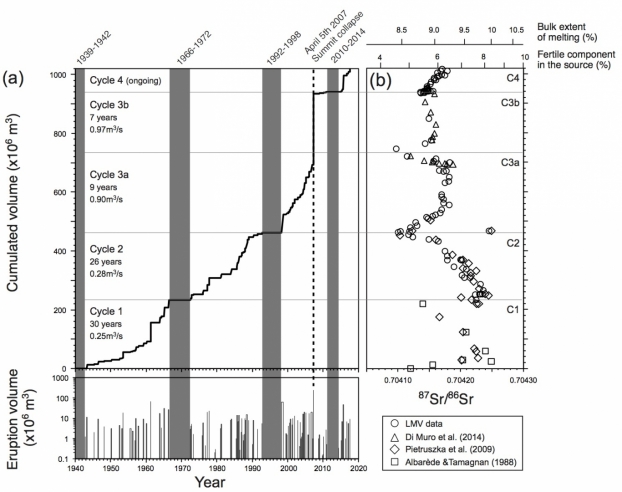
Changes in lava production (a) versus changes in the 87Sr/86Sr ratio of lava (b) at Piton de la Fournaise between 1940 and 2017. The shaded areas (a) indicate periods of inactivity > 3 years, which delimit decadal eruptive cycles. These cycles are correlated with the isotopic evolution (b), indicating that the magma source controls eruptive activity.

Hot spot volcanoes such as Kilauea on the island of Hawaii or Piton de la Fournaise on the island of Réunion are very regularly active. However, their eruptive activity is not continuous, but shows major fluctuations on a decadal scale. It is generally accepted that these major changes in regime reflect a variable supply of magma from partially molten regions of the mantle. However, little is known about the deep processes that modulate the flow of magma towards the surface and determine eruptive activity in the first instance.

This is a particular issue at Piton de la Fournaise, where over the past 80 years the volcano has shown periods of intense activity lasting 12 to 24 years, framed by rest periods of 3 to 6 years. This study reports a high temporal resolution record of the composition of the lavas emitted between 1942 and 2017.

This record reveals a close link between the cyclic activity of the volcano and the 87Sr/86Sr isotopic composition of the lavas emitted. This link indicates that the eruptive cycles are initiated by the melting of fertile regions (i.e. more fusible due to their enrichment in incompatible elements) and are progressively fed by liquids from refractory regions. The fertile property is attributed to the presence of a few per cent pyroxenites, whose solidus is lower than that of peridotites up to 180°C. The increase in lava production from 0.25 m3/s during cycle 1 (1942-1966) to more than 0.9 m3/s during cycle 3 (1998-2010), correlated with a general decrease in the 87Sr/86Sr ratio, suggests that the melting of fertile domains during cycles 1 and 2 subsequently (cycle 3) favoured the extraction of liquids from the refractory matrix. More generally, this result suggests that the distribution of fertile and refractory lithologies in the source mantle of volcanoes determines their eruptive activity on a decadal scale.

This research is based on regular lava sampling carried out by several generations of volcanologists, particularly since 1980 by members of the Piton de la Fournaise Volcanological Observatory (OVPF). They involve regular analysis of the samples and constant efforts to obtain reproducible data and build up a quality database.


Ref: I. Vlastélic, A. Di Muro, P. Bachèlery, L. Gurioli, D. Auclair & A. Gannoun (2018). Control of source fertility on the eruptive activity of Piton de la Fournaise volcano, La Réunion, Scientific Reports, volume 8, Article number: 14478

Latest news
Heading for Phobos: IPGP at the heart of Japan’s MMX mission
On 19 October 2026 at 9:41 p.m. Paris time, Japan’s MMX space mission will lift off towards Mars and its two moons, Phobos and Deimos, from the Tanega...
From Tokyo to Mount Fuji: a Franco-Japanese week at the crossroads of Earth sciences and music
From 9 to 17 November 2026, several scientific events in Japan will bring together IPGP researchers and their Japanese partners. The programme include...
Using neutrinos to probe the composition of Earth’s deep interior
What if neutrinos could offer a new way of looking inside our planet? An interdisciplinary team involving researchers from the IPGP is exploring the u...
Planetary Research: a new open-access journal for planetary sciences
Led by an international community of researchers, with strong involvement from IPGP scientists, the new journal Planetary Research offers an alternati...